Fine motor skills (drawing lines) Math Worksheets for Ages 4-5
7 filtered results
-
From - To
Enhance your child's fine motor skills with our engaging "Drawing Lines" math worksheets, specially designed for ages 4-5. These printable activities focus on improving hand-eye coordination, grip strength, and precision through fun and interactive exercises. Kids will enjoy tracing various types of lines, from straight to zigzag, while developing essential early math skills. These worksheets make learning enjoyable and effective, helping prepare your little ones for future academic success. Perfect for at-home practice or classroom activities, our resources encourage creativity and confidence in young learners, laying a strong foundation for both math and motor skill proficiency. Download now and watch them thrive!

Count and Match Vegetables 1 – 7 Math Worksheet
 Assign to My Students

Counting Eggs Worksheet

Count and Match Vegetables 2 – 8 Math Worksheet
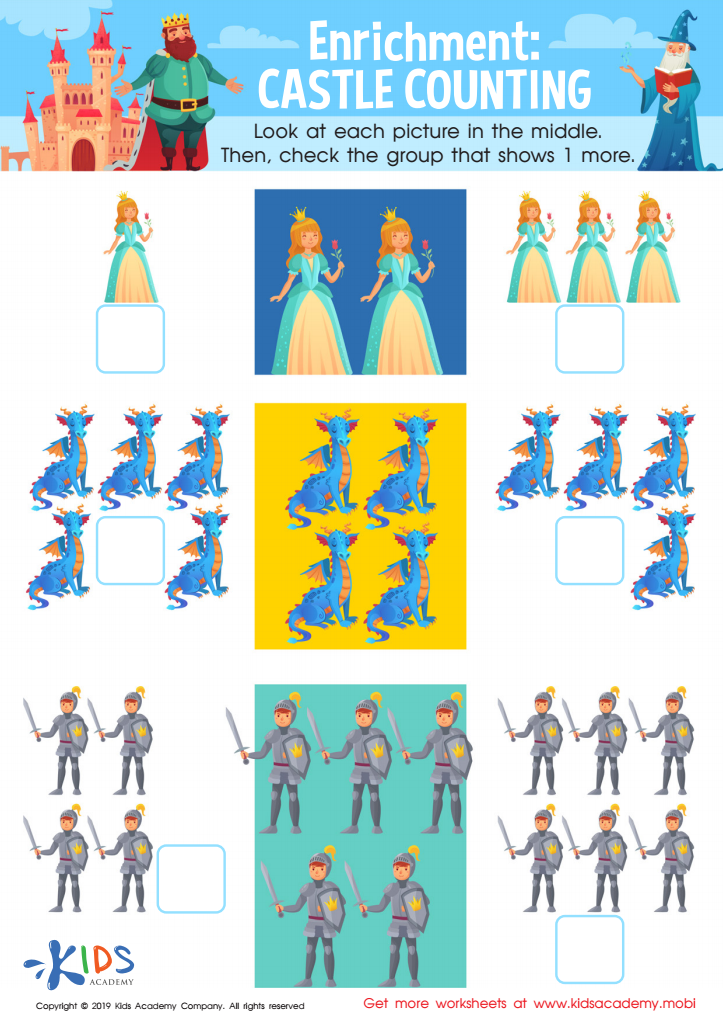
Enrichment: Castle Counting Worksheet


.jpg)





Fine motor skills, including drawing lines, play a vital role in the educational development of children aged 4-5, particularly in the context of math. Developing these skills enhances a child's hand-eye coordination and dexterity, which are essential for tasks such as writing, using scissors, and manipulating small objects. Proficiency in drawing lines forms the foundation for understanding geometric shapes, sequencing, and patterns—key mathematical concepts.
As children learn to draw straight and curved lines, they engage in activities that require focus, control, and patience, qualities that contribute to their overall cognitive development. Drawing lines also invites opportunities for creativity, allowing children to express themselves visually while reinforcing their understanding of mathematical concepts, such as symmetry and measurement.
For parents and teachers, fostering fine motor skills benefits children not only academically but also emotionally. It instills a sense of achievement as they complete tasks and overcome challenges. Encouraging these skills through fun activities, such as coloring, tracing, and crafting, can profoundly impact children's readiness for future learning, ensuring they possess the foundational skills necessary for more complex mathematical tasks as they progress in their education. Prioritizing fine motor development is therefore essential in nurturing well-rounded learners.








