
Number counting Math Worksheets for Ages 4-5
3 filtered results
Difficulty Level
Grade
Age
-
From - To
Subject
Activity
Standards
Our "Number Counting Math Worksheets for Ages 4-5" make learning foundational math skills fun and engaging for preschoolers and kindergarteners. Designed to enhance number recognition and counting skills, these worksheets feature colorful illustrations and exciting activities. Your child will confidently learn to count from 1 to 20 while improving their fine motor skills with activities such as tracing, matching, and number puzzles. Perfect for parents and teachers, our worksheets provide a strong number sense foundation, preparing young learners for math success in school. Download now and turn math practice into an enjoyable learning adventure for your child!
Favorites
With answer key
Interactive
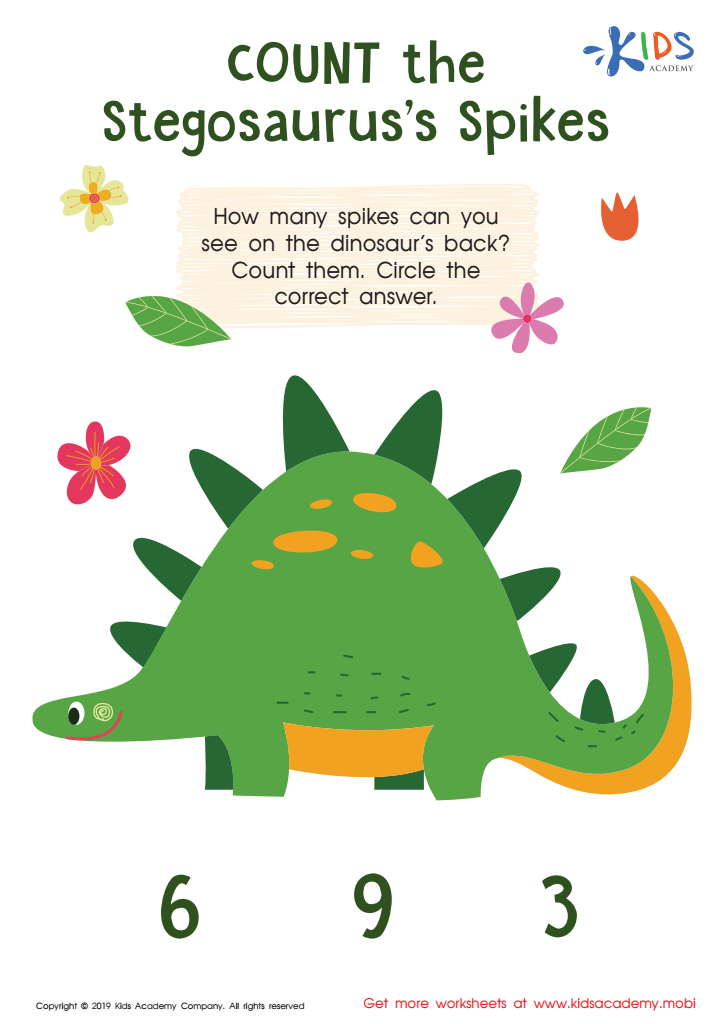
Count the Stegosaurus's Spikes Worksheet
Dinosaurs walked the earth long before humans, meaning no contact was made before they became extinct. Scientists have used research and diggings to find out about these animals, even giving them names. In this worksheet, help your students count the spikes on the stegosaurus and circle the correct answer.
 Assign to My Students
Count the Stegosaurus's Spikes Worksheet
Worksheet
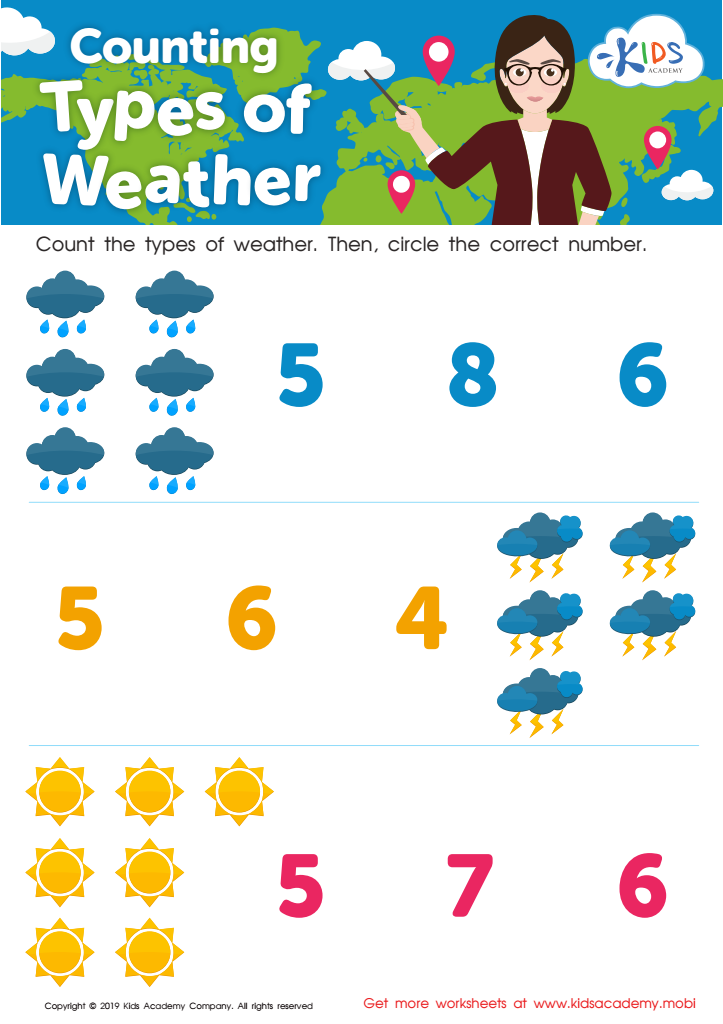
Counting Types of Weather Worksheet
Have your students look outside and tell you the weather today. Get kindergartners thinking by asking them to name different types of weather. Point to each one in the picture and get them to tell you what it is. Then, have them count the types and circle the number.
Counting Types of Weather Worksheet
Worksheet
Join Kids Academy for Free
Who is primarily going to use this learning content?







Number counting is foundational for early childhood development, specifically for children aged 4-5. At this stage, children's brains are rapidly developing and their capacity for learning new concepts is high. Number counting is not just about reciting numerals; it helps establish critical thinking and problem-solving skills.
Parents and teachers should understand that counting serves as a gateway to more complex mathematical concepts. When children count objects, they begin to understand quantity, which leads to grasping addition and subtraction later on. This early comprehension of numbers enhances cognitive development and spatial reasoning, crucial for disciplines beyond math, such as science and engineering.
Furthermore, engaging in counting activities fosters language skills and improves attention spans. It encourages children to focus, follow sequences, and recognize patterns. Basic counting also aids in the development of fine motor skills when children count using their fingers or manipulatives like blocks.
Creating a solid foundation in number counting ensures children are more prepared for formal schooling, reducing anxiety and increasing confidence in their abilities to meet academic challenges. Therefore, investing time in teaching number counting equips children with essential skills that impact their long-term educational development, making it a critical focus for both parents and teachers.








