
Understanding measurements Math Worksheets for Ages 4-5
5 filtered results
Difficulty Level
Grade
Age
-
From - To
Subject
Activity
Standards
Explore our engaging "Understanding Measurements Math Worksheets for Ages 4-5" designed to introduce young learners to essential measurement concepts. Our colorful and interactive worksheets help preschoolers and kindergarteners grasp basics like length, height, and weight through fun activities involving familiar objects. By comparing and contrasting, children develop critical thinking and observational skills. Perfect for at-home practice or classroom use, our resources make learning enjoyable while laying a strong foundation for future math success. Jumpstart your child's understanding of measurements and boost their confidence in math today with these delightful worksheets!
Favorites
With answer key
Interactive
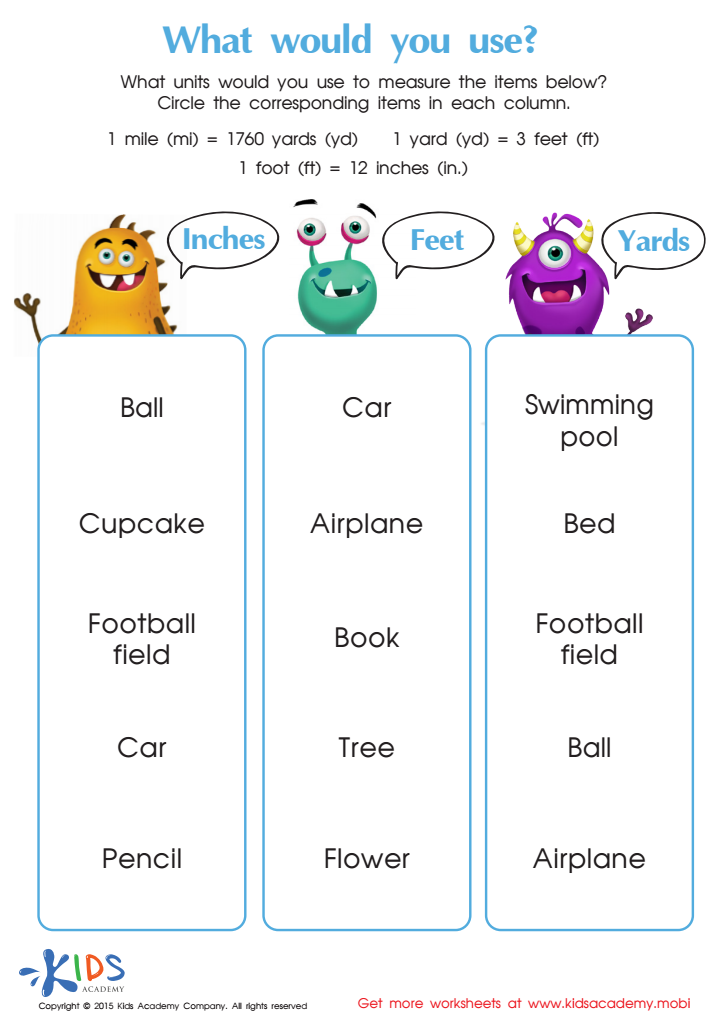
Learning about measuring objects in inches, feet and yards Worksheet
Download, cut and let your preschoolers learn and have fun estimating objects like pencils, airplanes and swimming pools in inches, feet and yards!
 Assign to My Students
Learning about measuring objects in inches, feet and yards Worksheet
Worksheet
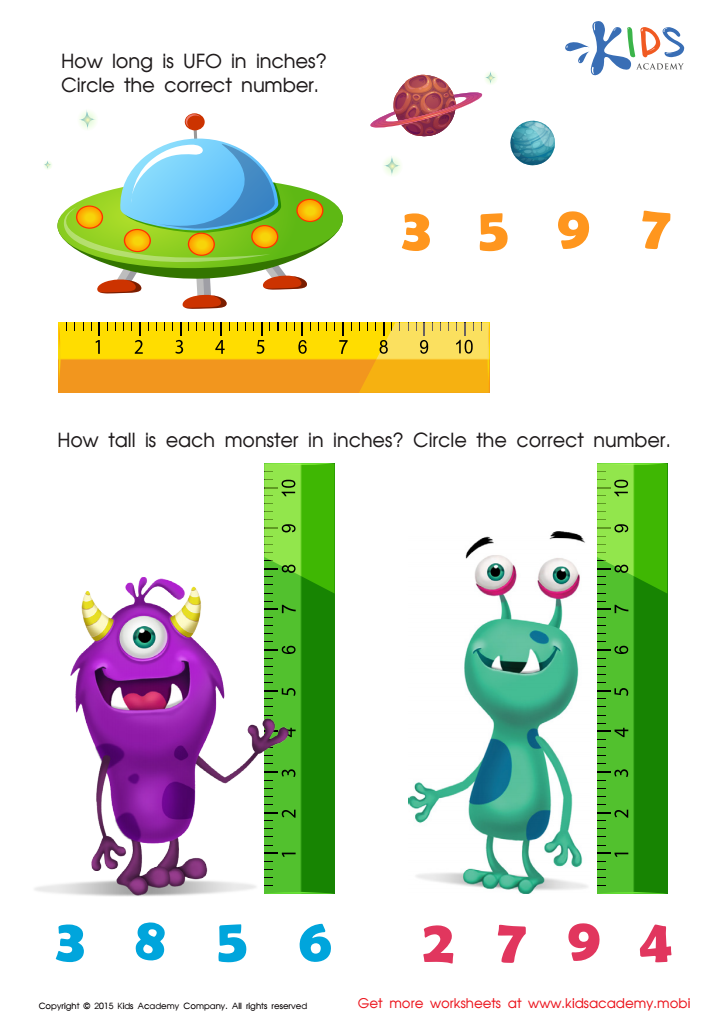
Measuring in Inches Worksheet
Look at the picture, can you measure the UFO & monsters? Write down how long each is. Which is tallest? Circle it. Get more free printable math worksheets for kindergarten at our website.
Measuring in Inches Worksheet
Worksheet
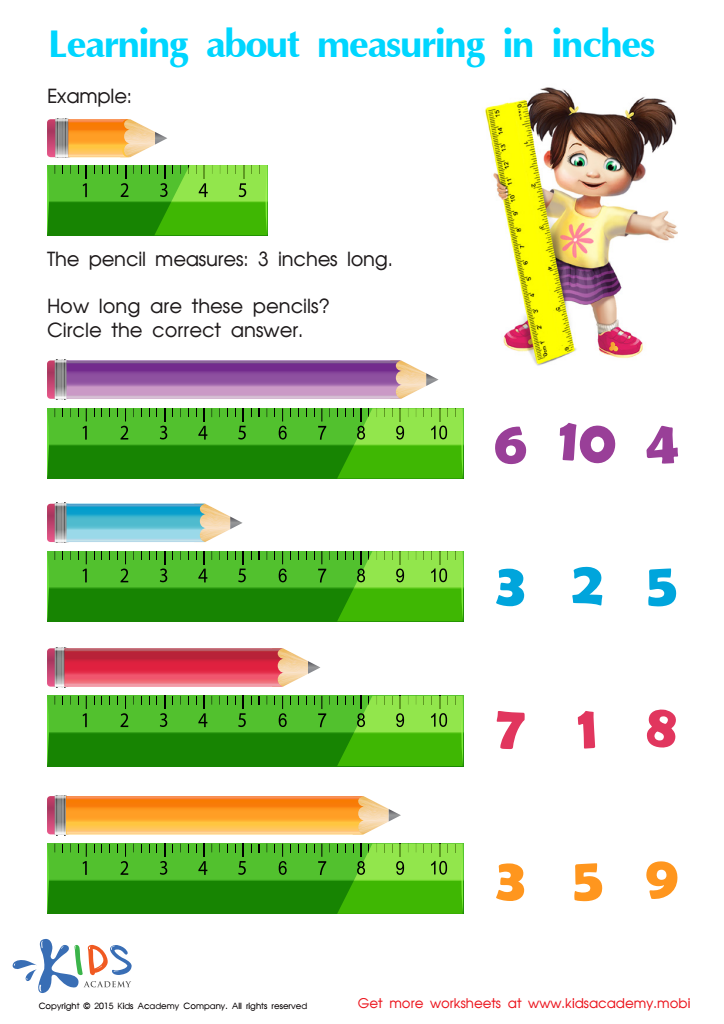
Learning About Measuring In Inches Printable
Print this free worksheet and measure pencils together with kids. See who finds the longest and the shortest! Enjoy learning math with your kids.
Learning About Measuring In Inches Printable
Worksheet
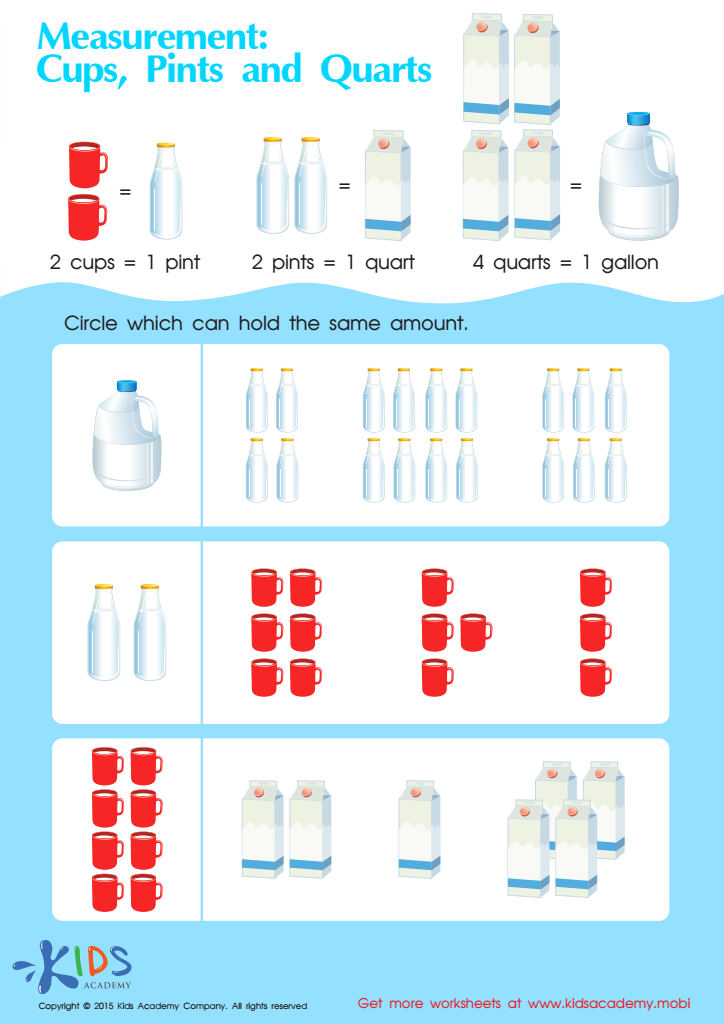
Cups, Pints and Quarts 2 Worksheet
Practice measuring liquids with our free math worksheets. Learn how many cups are in a quart and how many quarts are in a gallon. Accurately calculate the answers and write them in the provided spaces. Visit Kids Academy for a collection of free worksheets and make math fun!
Cups, Pints and Quarts 2 Worksheet
Worksheet
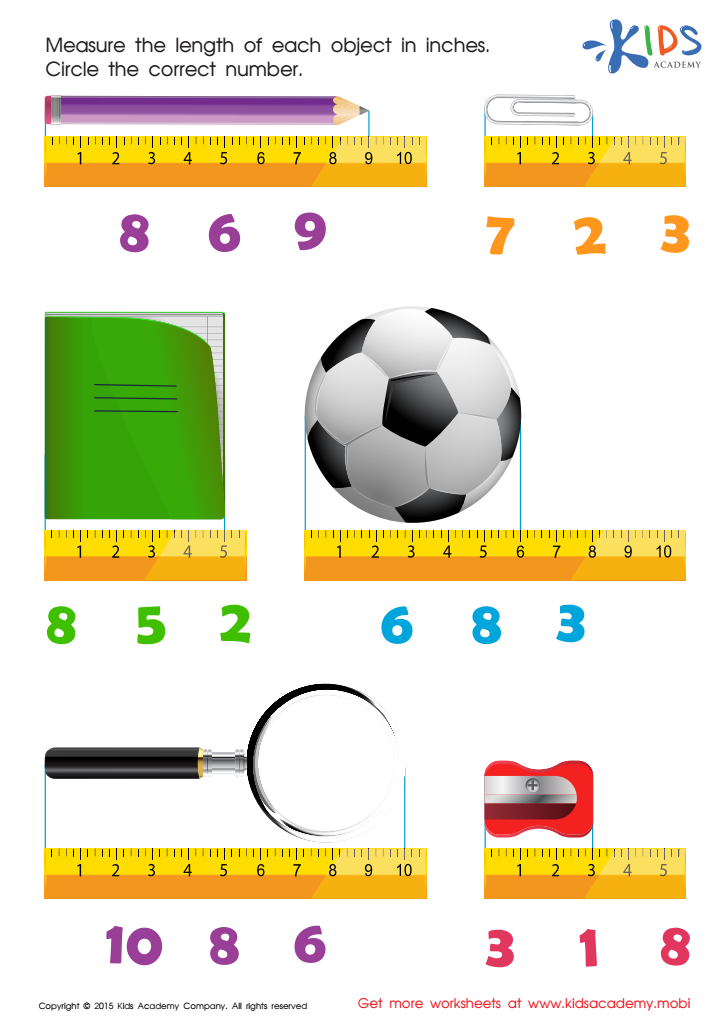
Learning measuring objects in inches Worksheet
Help your little learners gain confidence in using a ruler! Print out our free worksheet, cut out the inch ruler, and let them measure and record objects' width and length. Kids Academy has a variety of math worksheets to make learning math fun! Check out our website for more free printables!
Learning measuring objects in inches Worksheet
Worksheet
Join Kids Academy for Free
Who is primarily going to use this learning content?







Understanding measurements in early childhood, specifically for ages 4-5, is crucial for several reasons, and both parents and teachers should invest in fostering this foundational skill. Firstly, early exposure to measurement concepts like length, weight, volume, and time builds a child's numeracy and improves their ability to compare and describe the world around them. These concepts form the foundation for more advanced themes in mathematics and science taught later in life.
Moreover, learning measurements helps develop problem-solving and critical thinking skills. When children measure objects, they make decisions about which tools to use and how to use them, promoting cognitive development. For instance, deciding whether to measure the length of a toy with a ruler or a piece of string.
Additionally, measurements are part of everyday activities that stretch beyond the classroom. They become meaningful when children see their relevance in baking, drawing, setting the table, or building blocks. This real-world application enhances learning engagement and retention.
Finally, fostering an early understanding of measurements encourages a growth mindset. It shows children that they can acquire new skills and master concepts through practice which boosts confidence and prepares them for future challenges in other subjects. Such an approach sets the stage for lifelong learning and curiosity in STEM fields.








