Comparing shapes Geometry Worksheets for Ages 4-6
3 filtered results
-
From - To
Introduce young learners to the world of geometry with our "Comparing Shapes: Geometry Worksheets for Ages 4-6." Designed to make learning fun and engaging, these worksheets help children identify and compare different shapes, enhancing their spatial awareness and problem-solving skills. Perfect for early grade students, each activity is crafted to align with educational standards, focusing on circles, squares, triangles, and more. Through colorful illustrations and hands-on tasks, kids will not only recognize shapes but also understand their similarities and differences. Ideal for preschool and kindergarten, these worksheets lay the foundation for a lifetime of math success.
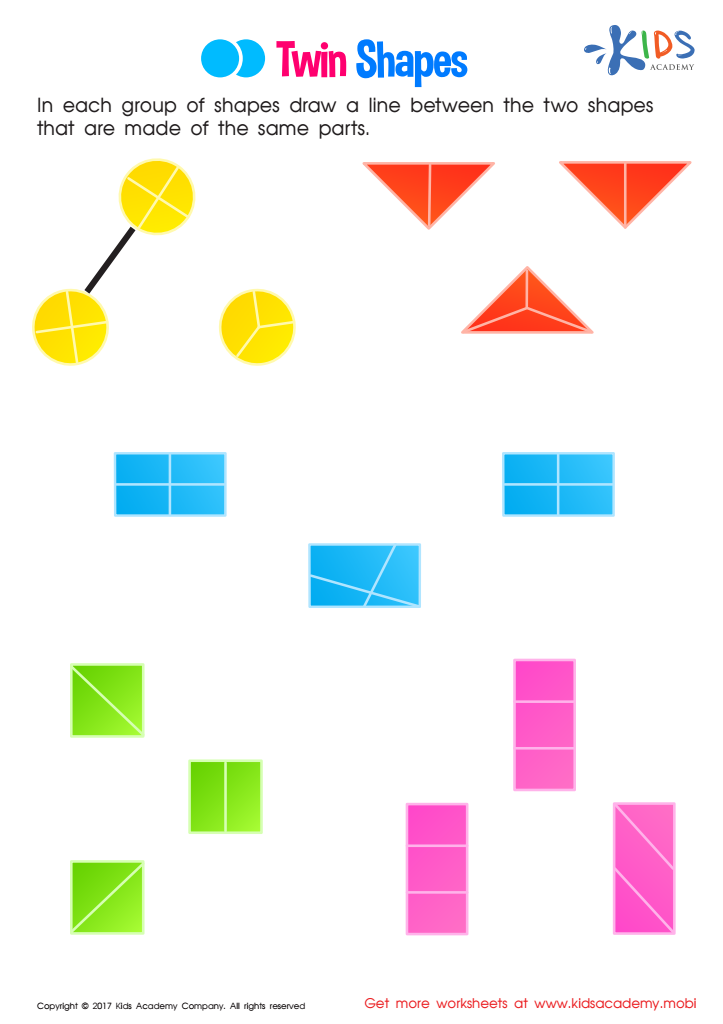
Twin Shapes Worksheet
 Assign to My Students











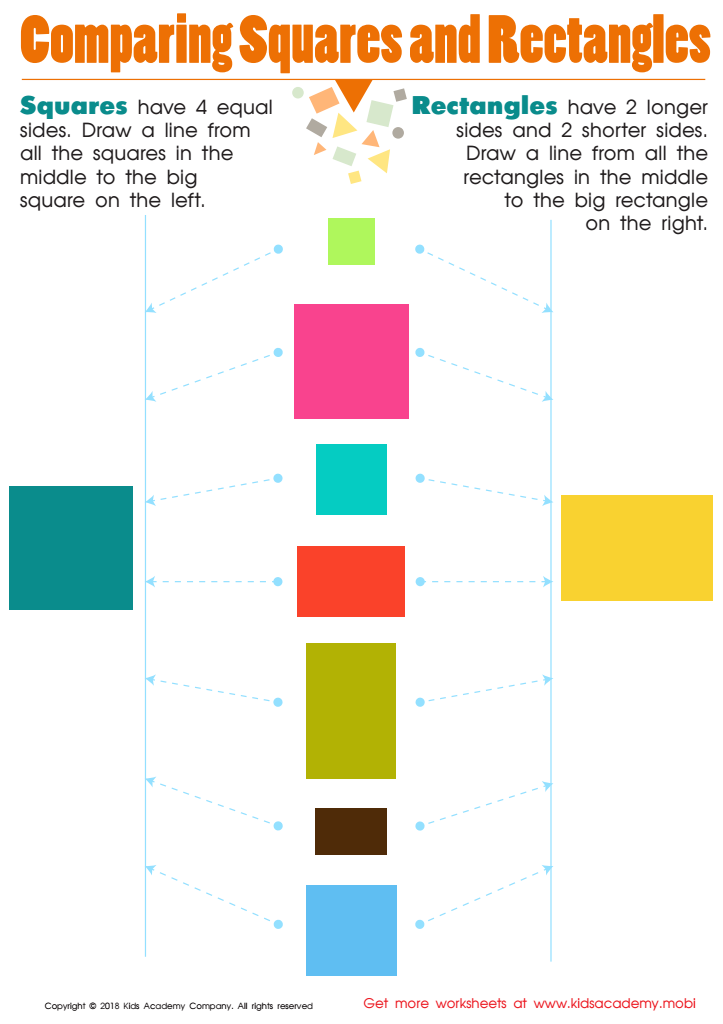
Comparing Squares Rectangles Worksheet
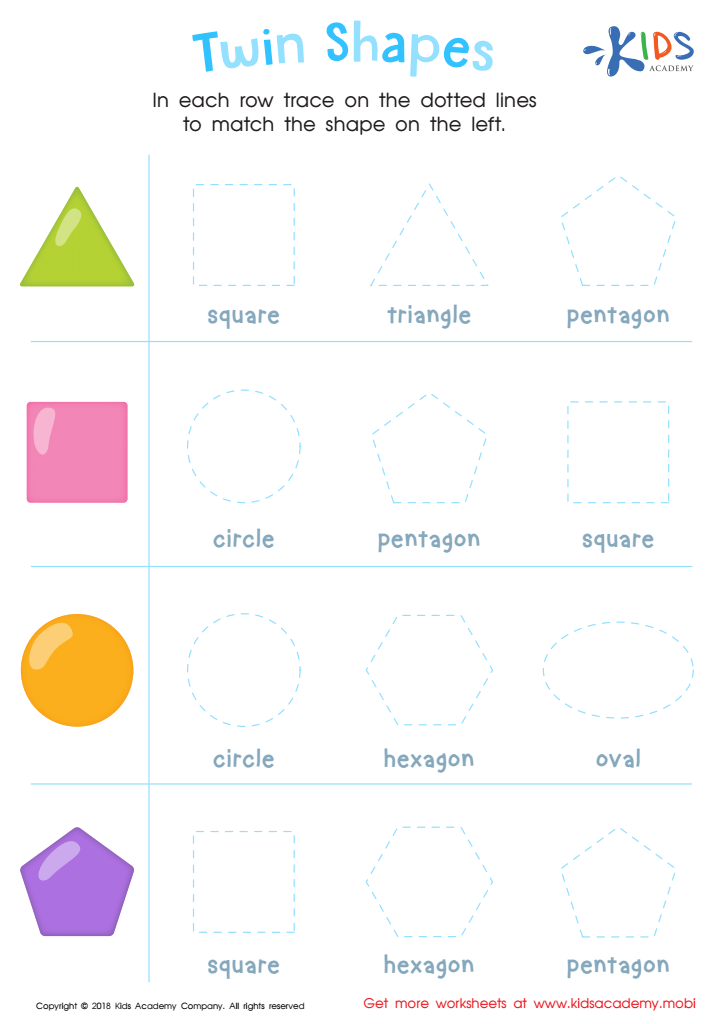
Twin Shapes Dot-to-Dot Worksheet








Introducing young children to comparing shapes provides foundational skills essential for their cognitive and mathematical development. For children aged 4-6, understanding basic geometry initiates a vital learning process that enhances their spatial reasoning, a critical skill for problem-solving and navigating their environment.
When children compare shapes, they recognize attributes such as size, color, number of sides, and corners, promoting observational and analytical skills. This process encourages them to discern patterns and differences, cultivating early classification skills crucial for more complex mathematical concepts later. Through engaging activities like sorting, matching, and drawing, young learners develop fine motor skills and hand-eye coordination, enhancing their physical and intellectual abilities.
Additionally, comparing shapes introduces children to descriptive language, boosting their vocabulary. Teachers and parents can facilitate conversations where children use terms like ‘larger,’ ‘smaller,’ ‘circle,’ and ‘triangle,’ integrating language skills with mathematical context. Fostering these dialogues supports linguistic and social development, as children learn to articulate their observations and reasoning.
Investing time in these early geometry experiences builds a positive attitude towards mathematics. Engaging, hands-on activities make learning enjoyable, laying a strong academic foundation. By emphasizing comparing shapes, parents and teachers ensure children are equipped with fundamental skills that will support their ongoing educational journey and everyday life challenges.








