
Encourage attention to detail Worksheets for Ages 4-7
3 filtered results
Difficulty Level
Grade
Age
-
From - To
Subject
Activity
Standards
Discover our engaging "Encourage Attention to Detail Worksheets" designed for children aged 4-7! These worksheets promote essential skills through fun and interactive activities that encourage young learners to focus on details. Your child will enjoy exercises like finding differences in images, completing patterns, and solving puzzles—each crafted to enhance observation skills and cognitive development. Our thoughtfully designed materials not only make learning enjoyable but also foster critical thinking and concentration. Perfect for both classroom and at-home learning, these worksheets will help your child build a strong foundation in attention to detail, setting the stage for future academic success. Get started today!
Favorites
With answer key
Interactive
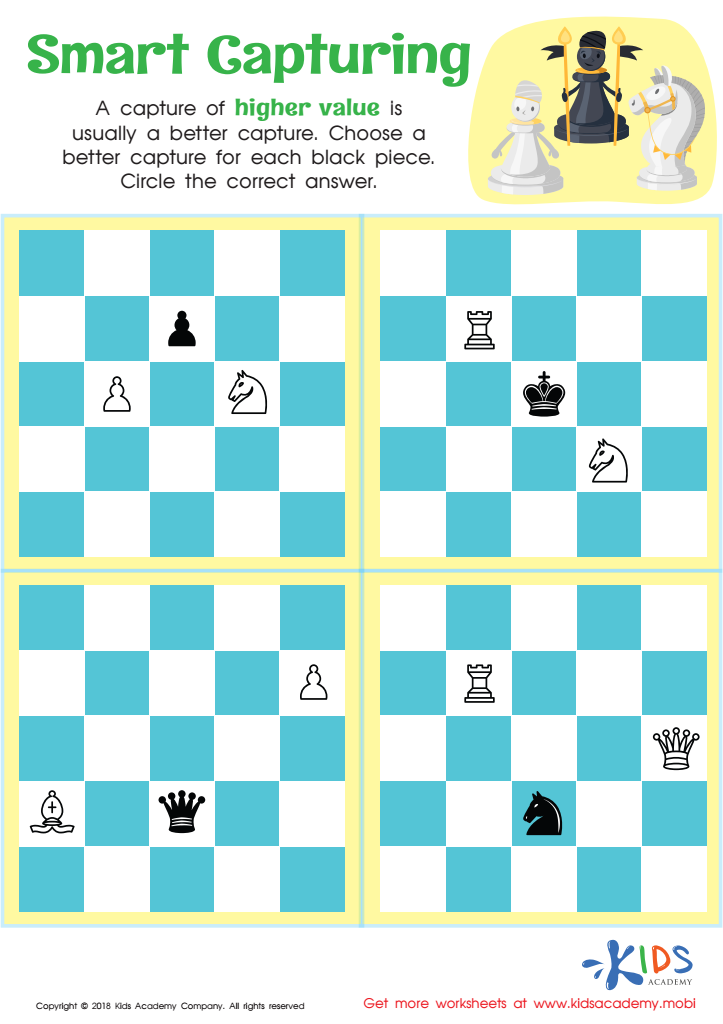
Smart Capturing Worksheet
Chess is a game of strategy and calculation. When presented with two captures, a player should always go for the one that yields the highest value. For example, taking a knight over a pawn. In this worksheet, your children will choose the best capture for each black piece. Ask them to circle the correct answers. (80 words)
 Assign to My Students
Smart Capturing Worksheet
Worksheet
Join Kids Academy for Free
Who is primarily going to use this learning content?








Encouraging attention to detail in children aged 4-7 is essential for their cognitive development and overall learning experiences. At this stage, young minds are exceptionally curious and absorb information rapidly. By fostering attention to detail, parents and teachers help children enhance their observation skills, critical thinking, and creativity. Activities that promote this focus, such as puzzles, sorting games, and art projects, encourage children to notice subtle differences and explore their environment closely.
Attention to detail also supports literacy and numeracy skills. When children pay attention to detail in reading, they learn to recognize symbols, sounds, and patterns, aiding in their understanding of language. Similarly, in math, noticing differences in numbers or shapes lays the foundation for problem-solving abilities. Furthermore, cultivating this skill equips children with patience and perseverance—traits necessary for completing tasks and managing challenges.
In a broader social context, being detail-oriented nurtures self-discipline and responsibility. As children learn to organize their thoughts and actions, they gain confidence in their abilities. Thus, encouraging attention to detail during these formative years not only promotes academic success but also fosters lifelong skills and habits that positively influence personal and social development.








