Counting skills enhancement Math Worksheets for Ages 4-7
3 filtered results
-
From - To
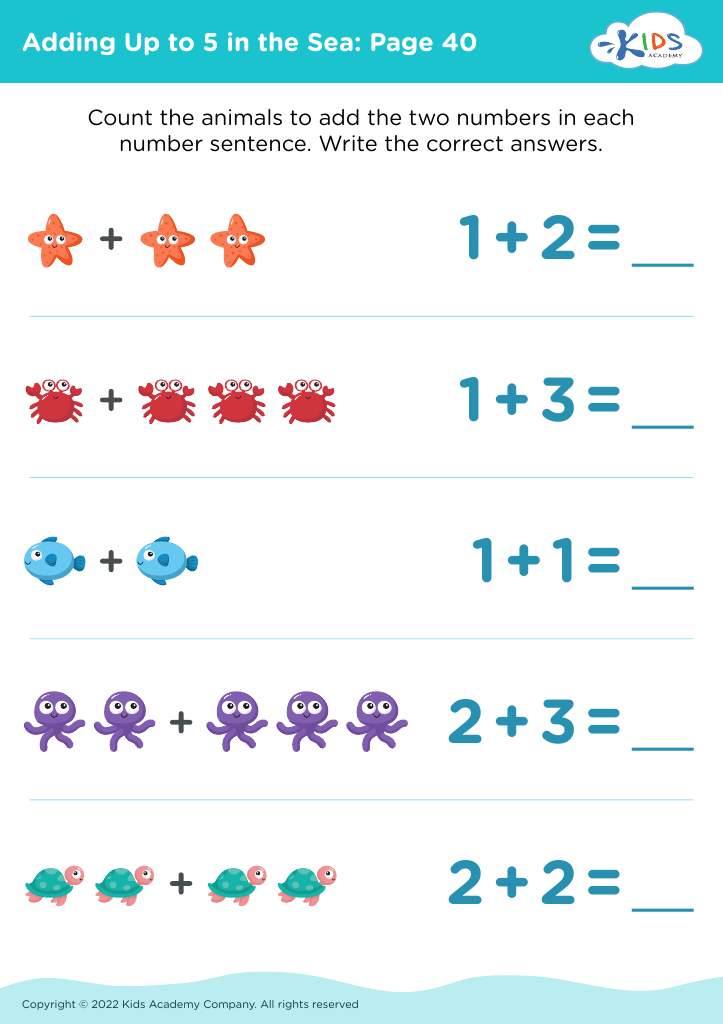
Enhance your child's counting skills with our expertly designed Math Worksheets for Ages 4-7. These fun and engaging activities help young learners build a strong foundation in counting, sequencing, and number recognition. Ideal for preschoolers and early elementary students, our worksheets incorporate colorful visuals and interactive exercises to make learning enjoyable. With a focus on progressive skill development, children can confidently master numbers and counting at their own pace. Perfect for both classroom and home use, our Counting Skills Enhancement Math Worksheets are a valuable resource for parents and teachers dedicated to fostering early math success.
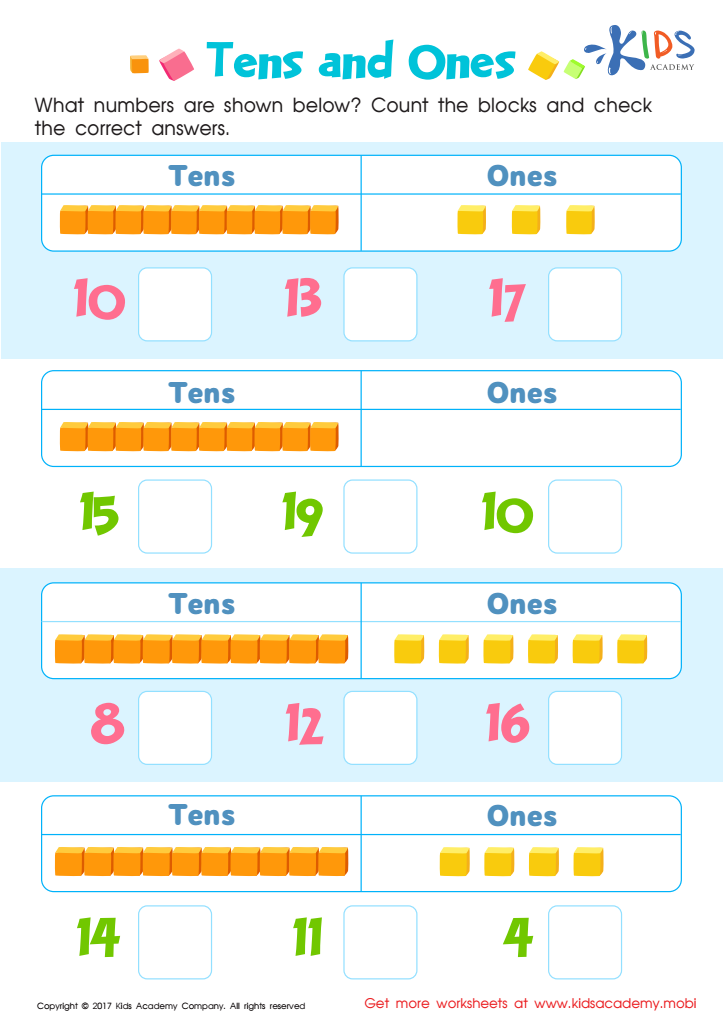
Tens and Ones Worksheet
 Assign to My Students
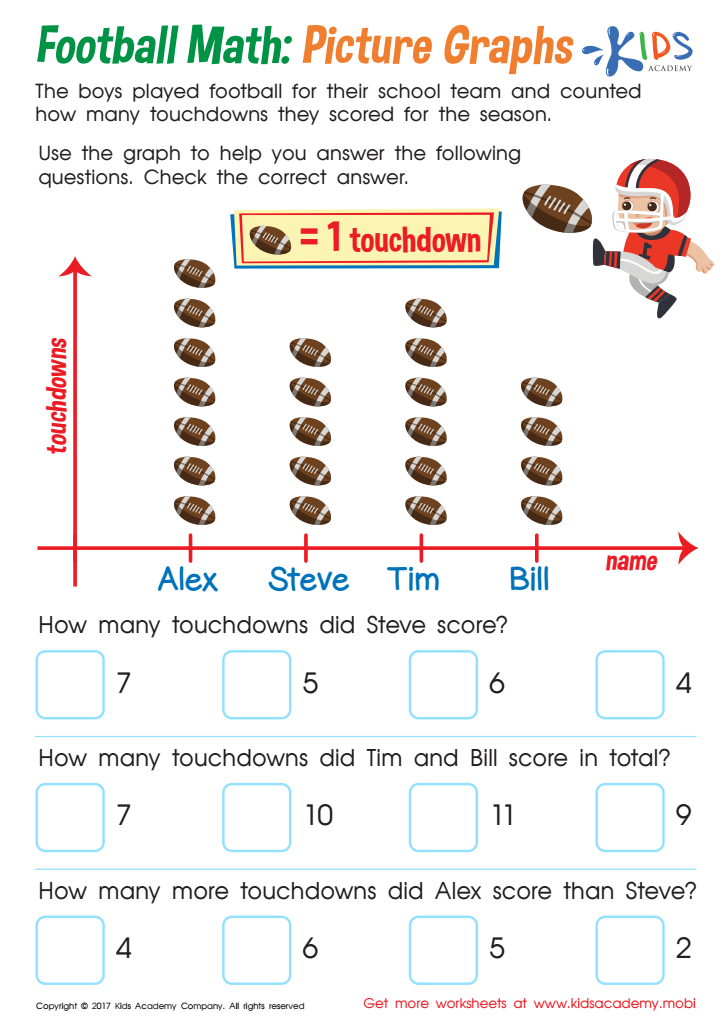
Football Math Worksheet






.jpg)

Counting skills serve as the foundation for almost all future mathematical understanding, making their enhancement critical for children aged 4-7. At this developmental stage, math isn't just about numbers; it inherently involves understanding patterns, sequencing, and spatial awareness. By nurturing these skills early on, parents and teachers pave the way for a smoother transition into more complex areas of mathematics.
For children in this age group, strong counting skills translate directly into enhanced problem-solving capabilities. This happens because counting teaches children how to organize and process information logically and efficiently. Once a child masters the basic principles of counting, they are then prepared to tackle arithmetic, which forms the bedrock of virtually all higher-level math topics.
Furthermore, early proficiency in counting and basic math fosters a love for learning, encouraging children to explore more advanced subjects with increased confidence. Developing counting skills also complements language skills; math often has its unique vocabulary, which further improves children's overall communication abilities.
Parents and teachers who focus on enhancing early math skills give children a significant advantage. These foundational skills do not only apply academically but also to everyday tasks, fostering self-esteem and independence as children learn to navigate the world around them mathematically. Thus, investing time in math from a young age sets the stage for successful lifelong learning.








