Recognizing shapes Math Worksheets for Ages 4-7 - Page 2
33 filtered results
-
From - To
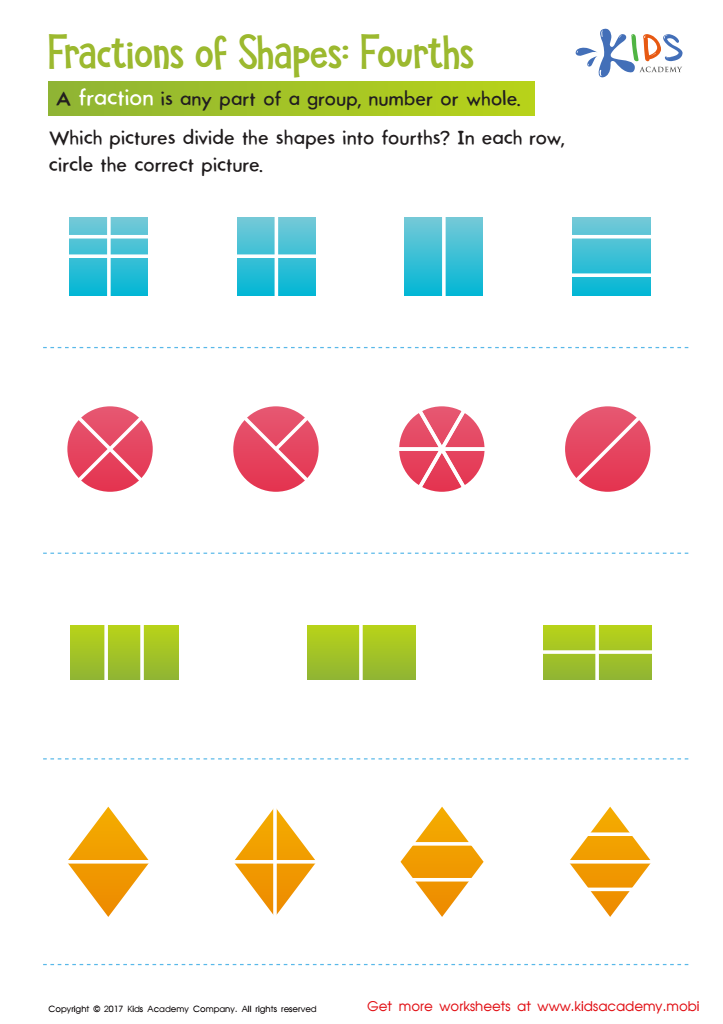
Fractions of Shapes Worksheet
 Assign to My Students








Recognizing shapes in early childhood is foundational for cognitive and academic development. For children ages 4-7, understanding basic geometric shapes fosters both their mathematical abilities and their problem-solving skills. When parents and teachers focus on teaching shapes like circles, squares, triangles, and rectangles, they contribute to children's spatial awareness, which is crucial for more advanced math concepts such as geometry, patterns, and symmetry.
Learning shapes also significantly boosts children's language development. As children identify, describe, and compare shapes, they acquire important vocabulary that enhances their ability to communicate effectively. Moreover, recognizing and categorizing shapes helps in developing sorting and classification skills, which are vital for critical thinking.
Shapes also appear ubiquitously in the environment, from traffic signs to toys, thus this knowledge helps children better understand and engage with the world around them. For example, a child's ability to recognize the ‘STOP’ sign is linked to identifying its octagonal shape.
Furthermore, integrating shape recognition in playful activities encourages fine motor skills and hand-eye coordination, reinforcing early writing skills. Consequently, parents and teachers who emphasize recognizing shapes in early education provide children with a well-rounded foundation that supports their overall academic and developmental growth.








