Visual-motor skills Math Worksheets for Ages 4-7
5 filtered results
-
From - To
Enhance your child's math abilities with our Visual-Motor Skills Math Worksheets specially designed for ages 4-7. These engaging activities combine visual perception and fine motor skills to improve hand-eye coordination, critical thinking, and problem-solving. Perfect for preschool and early elementary students, our worksheets feature fun and educational exercises like tracing shapes, matching numbers, and completing patterns. By integrating essential visual-motor development with foundational math concepts, each activity provides an exciting and effective learning experience. Boost your child's confidence and academic progress with our expertly crafted, easy-to-use math worksheets today!
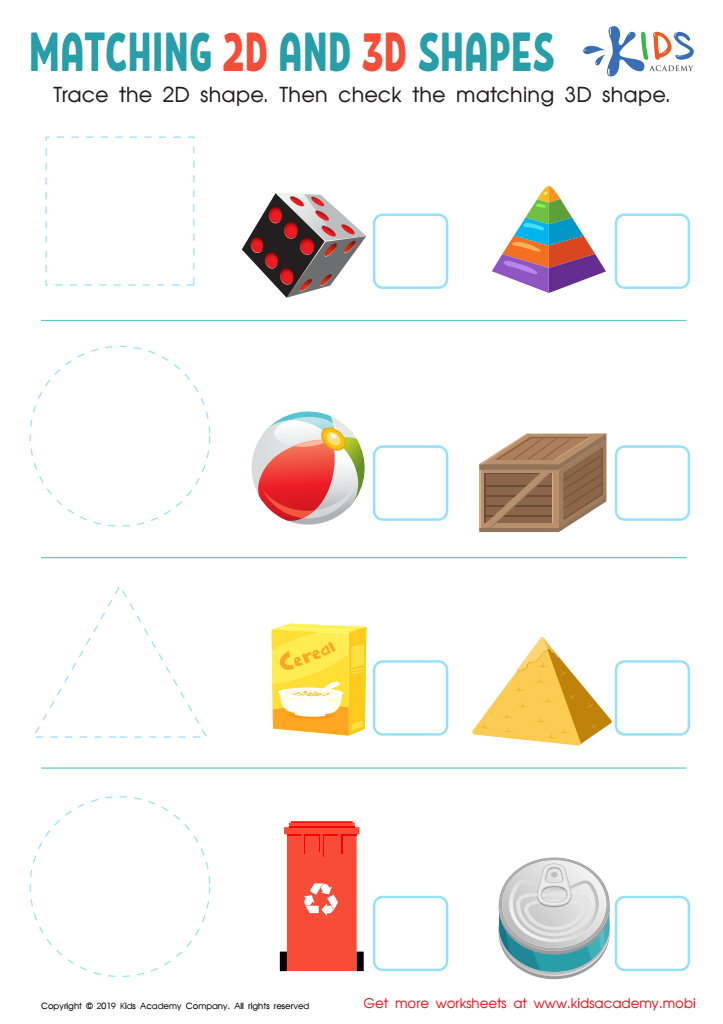
Matching 2D and 3D Shapes Worksheet
 Assign to My Students







Visual-motor skills are essential for young children's early mathematical development, especially between the ages of 4 to 7. These skills coordinate visual perception (the ability to see and interpret visual information) with motor function (the physical manipulation or movement responses), creating a foundation for success in math and other academic areas.
For starters, visual-motor integration helps children grasp basic mathematical concepts, such as recognizing numbers and shapes, which are critical in this age group. These skills enable kids to track numbers on a page, align them correctly, and form them properly, laying the groundwork for writing numbers and solving math problems. In particular, they are crucial for tasks like copying patterns, sequencing, and aligning items – all key components of early math skills.
Additionally, well-developed visual-motor skills are linked with improved hand-eye coordination, essential for activities like cutting, coloring, and block-building, which inherently involve counting and measuring. Furthermore, activities that enhance visual-motor integration, such as puzzles and drawing shapes, also boost cognitive capabilities like spatial awareness and problem-solving, contributing to a more well-rounded academic foundation.
Parents and teachers who invest in developing these skills can therefore help children enhance their overall educational achievement and confidence. By ensuring that enjoyable, skill-appropriate activities are part of their daily learning, we set the stage for lifelong competencies in math and other disciplines.








