Comparing object weights Measurement Worksheets for Ages 4-7
3 filtered results
-
From - To
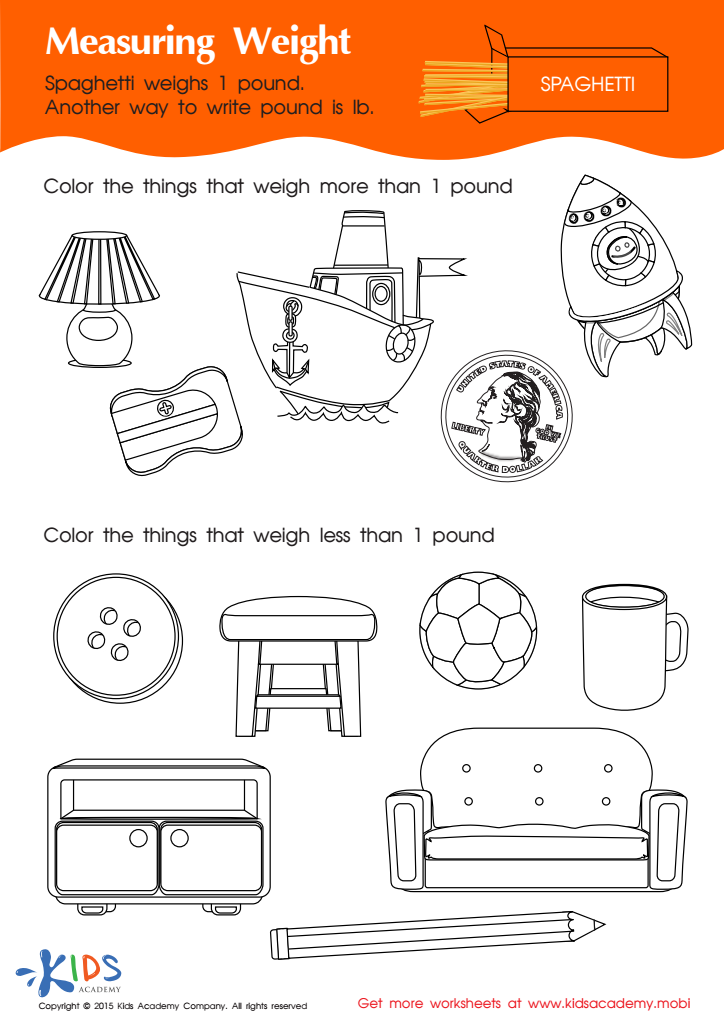
Explore our engaging "Comparing Object Weights Measurement Worksheets" designed for children aged 4-7! These worksheets provide fun and interactive activities that help young learners understand the concept of weight measurement. Children will compare different objects, developing important skills in estimation, critical thinking, and understanding balance. Each worksheet is colorfully designed to capture children’s attention while making learning enjoyable. Ideal for homeschooling, classroom settings, or extra practice at home, our resources support foundational math skills in a way that encourages curiosity and exploration. Start building your child's measurement skills today with our user-friendly and visually appealing worksheets!
 Assign to My Students
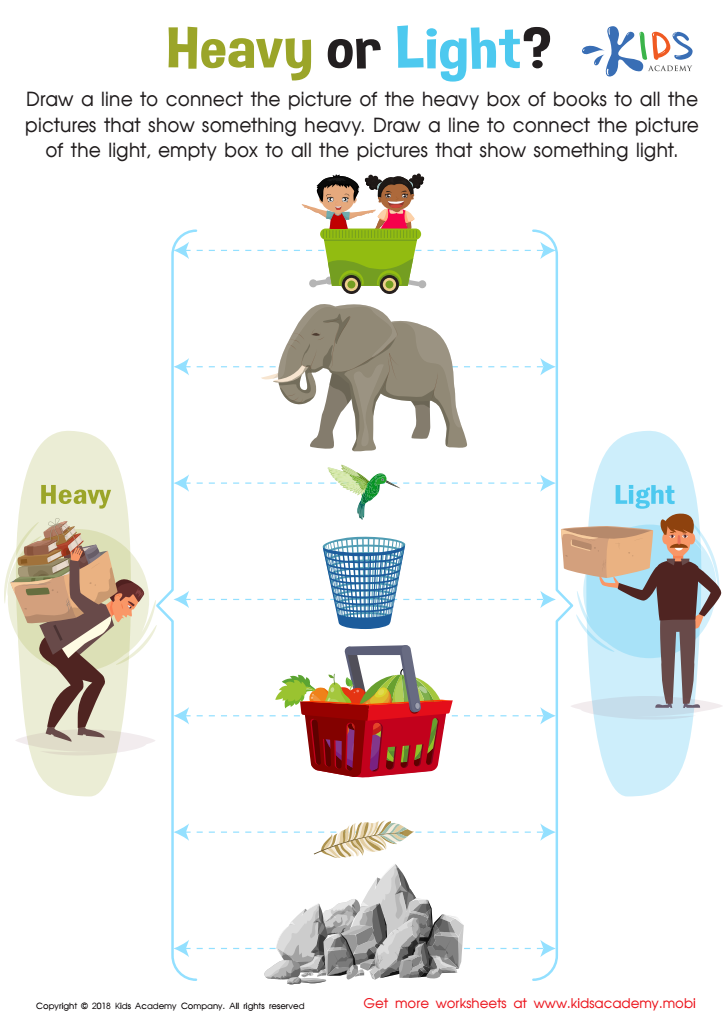
Heavy or Light? Worksheet
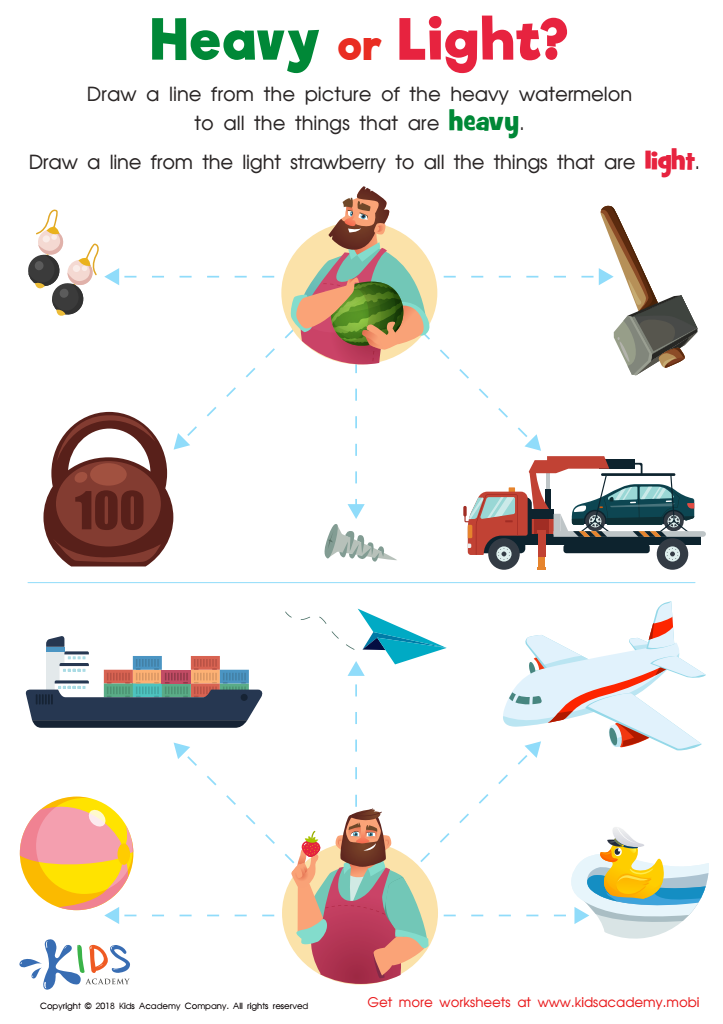
Heavy or Light? Worksheet








Comparing object weights is a fundamental concept in early education for children ages 4-7. Engaging in weight comparison activities helps to lay a strong foundation for mathematical understanding and critical thinking skills. At this age, children are naturally curious about the world around them, and exploring weight comparison provides an exciting opportunity for hands-on learning.
Parents and teachers should care about this skill because it fosters experiential learning. Through activities like weighing household items or using balance scales, children develop a practical grasp of heavier and lighter. This not only enhances their understanding of measurement concepts but also boosts vocabulary, as they learn terms such as “more,” “less,” “heavier,” and “lighter.”
In addition, weight comparison encourages observation, experimentation, and problem-solving. Children learn to ask questions and draw conclusions based on their experiences, which nurtures their investigative skills. Moreover, these activities foster social skills when conducted in groups, enabling collaboration and communication.
Finally, incorporating weight comparison in early education sets the stage for more advanced mathematical concepts later on. By showing children that math is both fun and relevant to everyday life, parents and teachers instill a lifelong love of learning and reinforce the importance of developing strong cognitive skills in young learners.








