
Drawing skills Reading Worksheets for Ages 4-7
3 filtered results
Difficulty Level
Grade
Age
-
From - To
Subject
Activity
Standards
Introduce children to the joy of learning with our "Drawing Skills Reading Worksheets" for ages 4-7. These engaging worksheets blend creativity and literacy, helping young learners develop essential reading skills while having fun. Designed by education experts, each worksheet promotes comprehension, vocabulary, and fine motor skills through drawing activities and reading exercises. Perfect for both classroom and home use, our worksheets encourage imagination and enhance cognitive development. Give your kids a head start with activities that excite and educate, fostering a love for reading and the arts from an early age. Dive into the world of creative education today!
Favorites
With answer key
Interactive
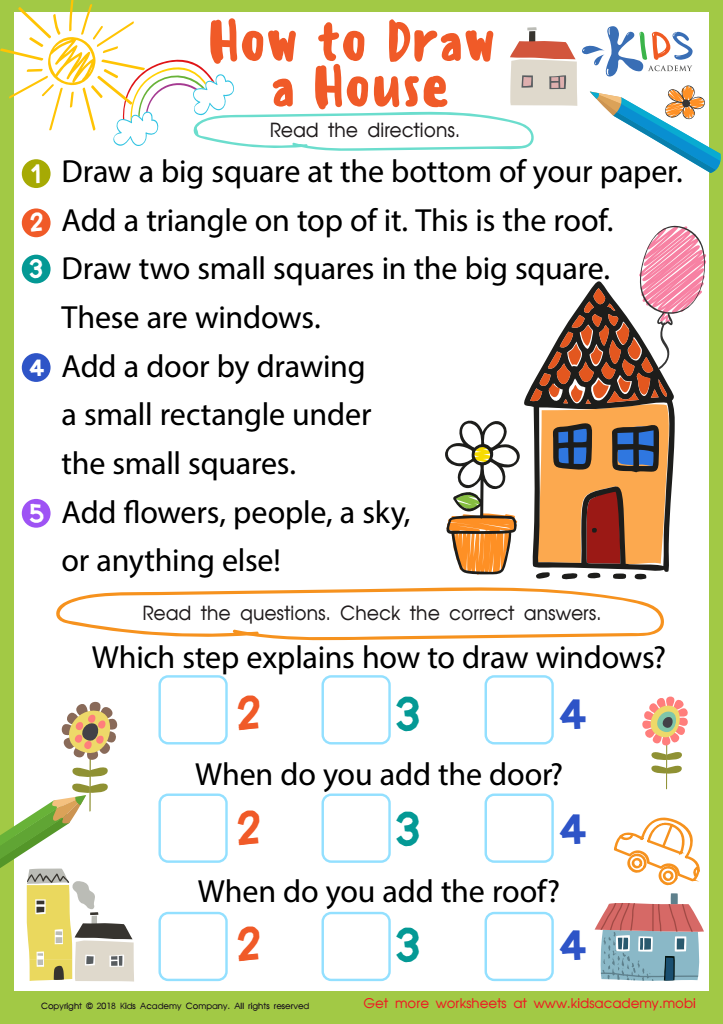
How to Draw House Worksheet
Does your child love to draw? Why not try teaching them some easy tricks? Get them to follow directions on this worksheet and learn how to draw a house. Read the questions at the end and ensure they get the answers right. Your kids will surely love it!
 Assign to My Students
How to Draw House Worksheet
Worksheet
Join Kids Academy for Free
Who is primarily going to use this learning content?







Parents and teachers should prioritize drawing and reading skills for children aged 4-7 because these activities fundamentally support cognitive development and literacy. At this crucial stage, drawing enhances fine motor skills, hand-eye coordination, and spatial awareness, which are foundational for later writing abilities. Engaging in drawing allows children to express creativity and emotions, fostering self-expression and emotional well-being. It also encourages problem-solving and critical thinking as they determine how to represent their ideas visually.
Reading skills, on the other hand, are essential for developing language and comprehension abilities. Early exposure to reading enriches children’s vocabulary, sharpens their listening skills, and helps them understand the structure of language. Reading aloud to children also improves concentration and memory, provides a calming routine, and builds a strong parent-child bond through shared activities.
Moreover, both drawing and reading contribute to socio-emotional development. Drawing can be a collaborative activity, promoting social skills and cooperative play. Reading often introduces moral lessons and diverse perspectives, fostering empathy and cultural awareness. In summary, nurturing drawing and reading skills in early childhood lays a robust foundation for academic success, emotional resilience, and lifelong learning.








