
Comparing heights Worksheets for Ages 4-8
3 filtered results
Difficulty Level
Grade
Age
-
From - To
Subject
Activity
Standards
Introduce your child to the exciting world of measurement with our Comparing Heights Worksheets for ages 4-8. These engaging worksheets help young learners develop essential skills in comparing and contrasting different heights. Perfect for both classroom and home use, each activity is designed to captivate curious minds while promoting critical thinking and observational abilities. Featuring colorful illustrations and interactive exercises, our worksheets make learning fun and accessible. Encourage budding mathematicians to explore and understand concepts of tall, short, and every height in between. Start your child's educational journey with our expertly crafted activities that inspire growth and understanding.
Favorites
With answer key
Interactive
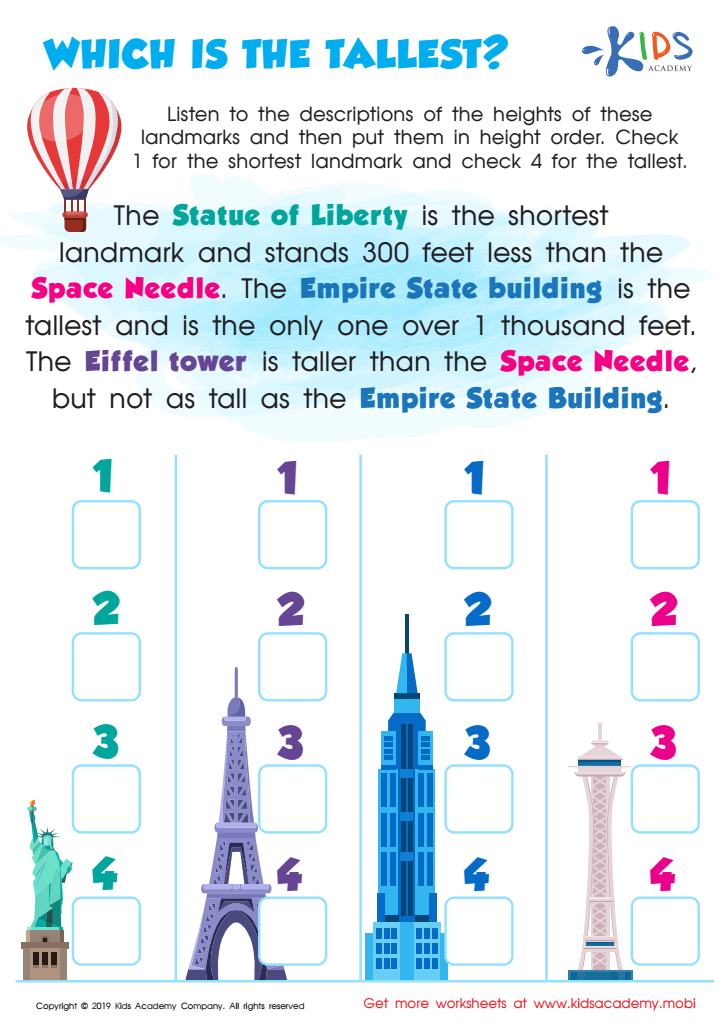
Which is the Tallest? Worksheet
Help your kids arrange the buildings in order of height: highest (4) to lowest (1). Ask them if they can think of other ways things can be measured. Read the texts describing the buildings and check 4 for the tallest and 1 for the shortest.
 Assign to My Students
Which is the Tallest? Worksheet
Worksheet
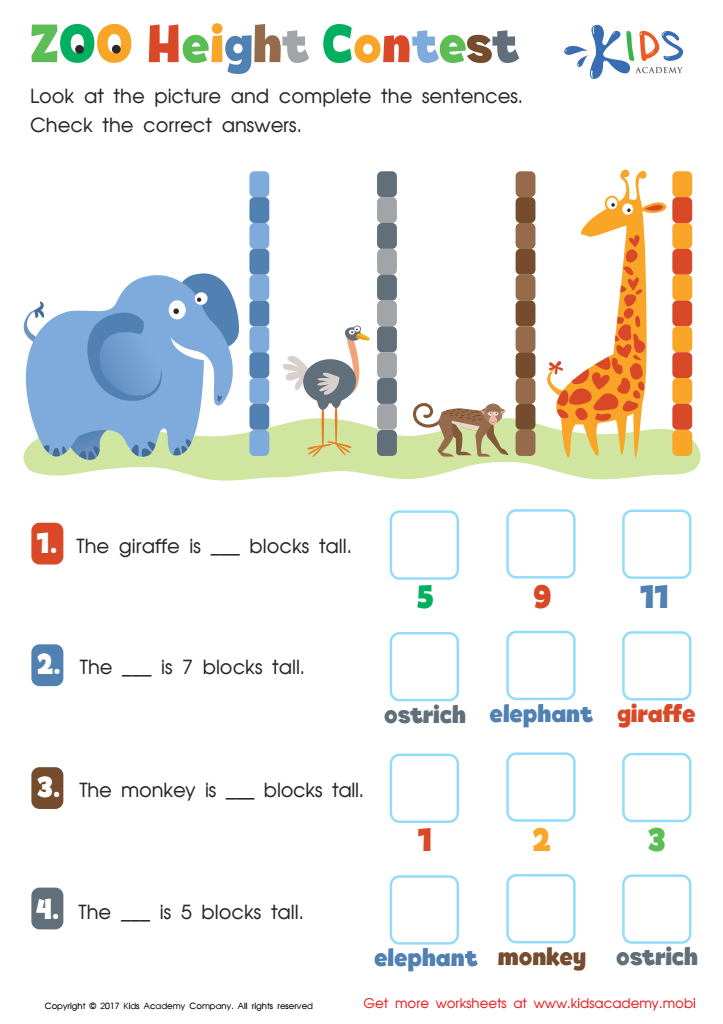
Zoo Height Contest Worksheet
Let's head to the zoo and use colorful blocks to measure your child's favorite animals! With this Kids Academy worksheet, help them practice and prepare for learning measurement. Guide them in looking at the zoo animals and counting blocks to find the height. Then, read the questions and check the box next to the correct answer.
Zoo Height Contest Worksheet
Worksheet
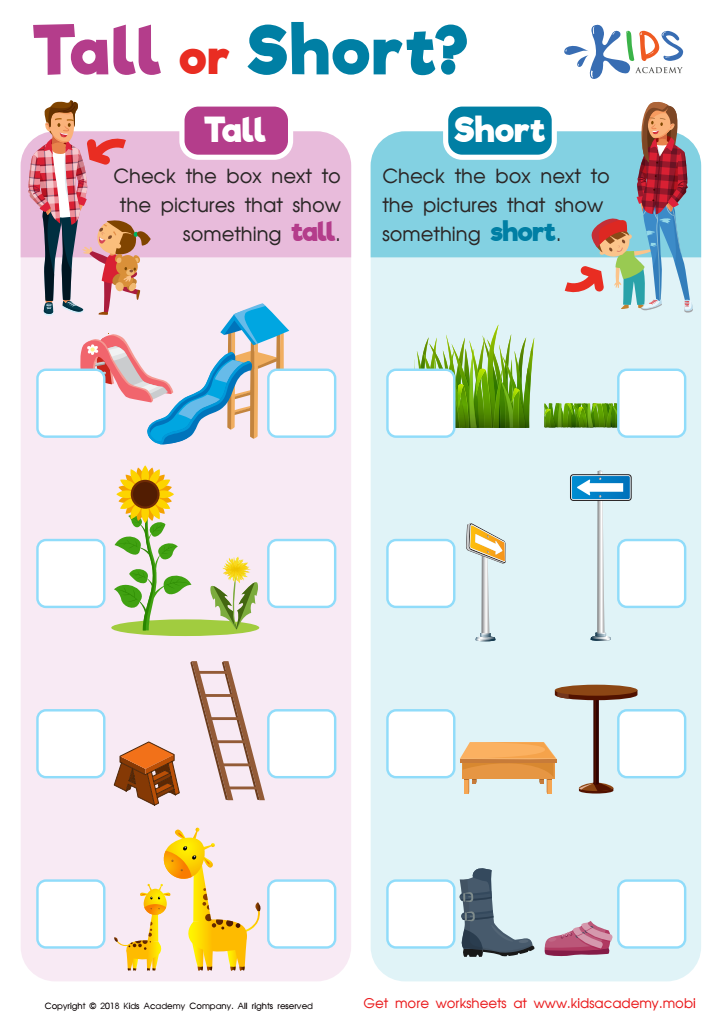
Tall or Short? Worksheet
Comparing tall and short objects is an early math skill. Our free worksheet uses fun colors and pictures to help kids practice. This will give them a head start for higher-level measurement skills, and they'll remember tangible objects for comparison.
Tall or Short? Worksheet
Worksheet
Join Kids Academy for Free
Who is primarily going to use this learning content?








Parents and teachers should care about comparing heights for ages 4-8 because it plays a crucial role in early childhood development. At this age, children are naturally observant and curious, and comparing heights can serve as a practical introduction to mathematical and scientific concepts. When they compare their own height with their peers, they begin to understand measures and differences, which helps build the foundation for more complex math skills later in life.
Moreover, comparing heights helps promote social and emotional development. It provides opportunities for children to engage in discussions, enhancing their communication skills. Celebrating diversity in height can also teach children to appreciate individual differences, fostering a sense of empathy and inclusion.
In a classroom context, teachers can turn measuring activities into fun, interactive lessons that captivate young minds. For instance, creating a height chart can be a collective project that not only teaches math but also inspires teamwork.
Lastly, tracking height is an essential aspect of monitoring healthy growth. Teachers can identify students who may need further evaluation for growth-related health concerns, ensuring early intervention if necessary. Thus, comparing heights is not just about numbers, but a rich, multi-faceted tool that nurtures various dimensions of a child's early development.








