
Comparing object weights Worksheets for Ages 4-8
3 filtered results
Difficulty Level
Grade
Age
-
From - To
Subject
Activity
Standards
Unlock your child's potential with engaging "Comparing Object Weights" worksheets, tailored for ages 4-8! These hands-on activities help young learners grasp the concept of weight by comparing various objects. Perfect for enhancing critical thinking and observation skills, our worksheets make learning fun with colorful illustrations and simple exercises. Kids will learn to discern differences in object weights, enriching their understanding of mass and improving problem-solving capabilities. Ideal for both classroom and at-home learning, these printable resources are designed to correlate with early education standards. Boost your child's confidence and knowledge today with our interactive worksheets!
Favorites
With answer key
Interactive
 Assign to My Students
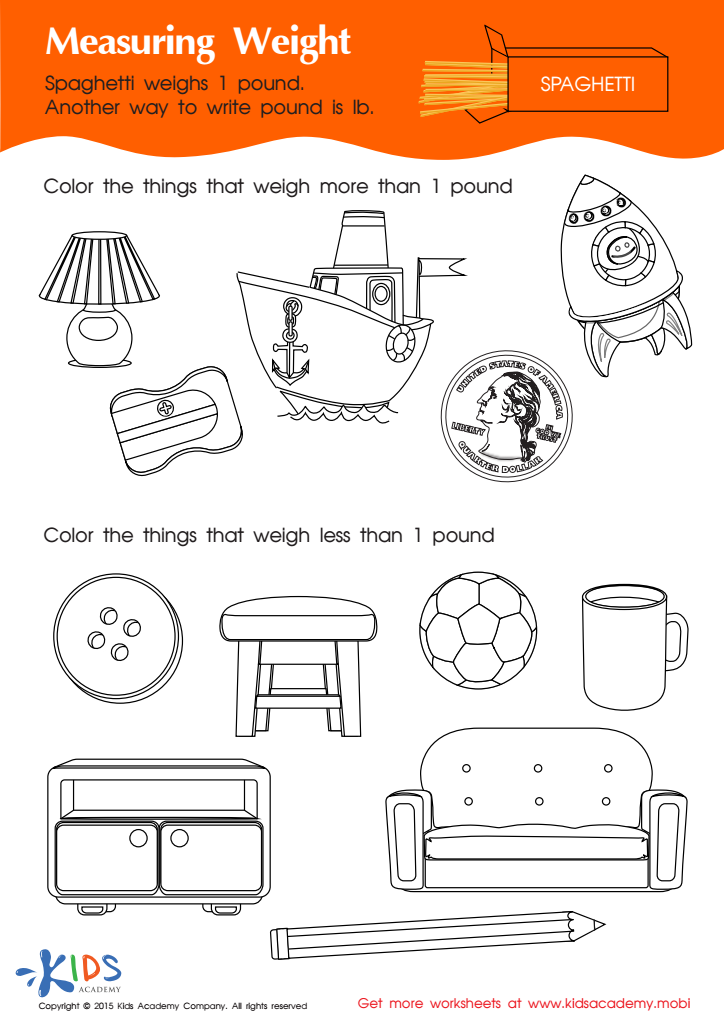
Measurement: Measuring Weight in Pounds 1 Worksheet
Worksheet
Heavy or Light? Worksheet
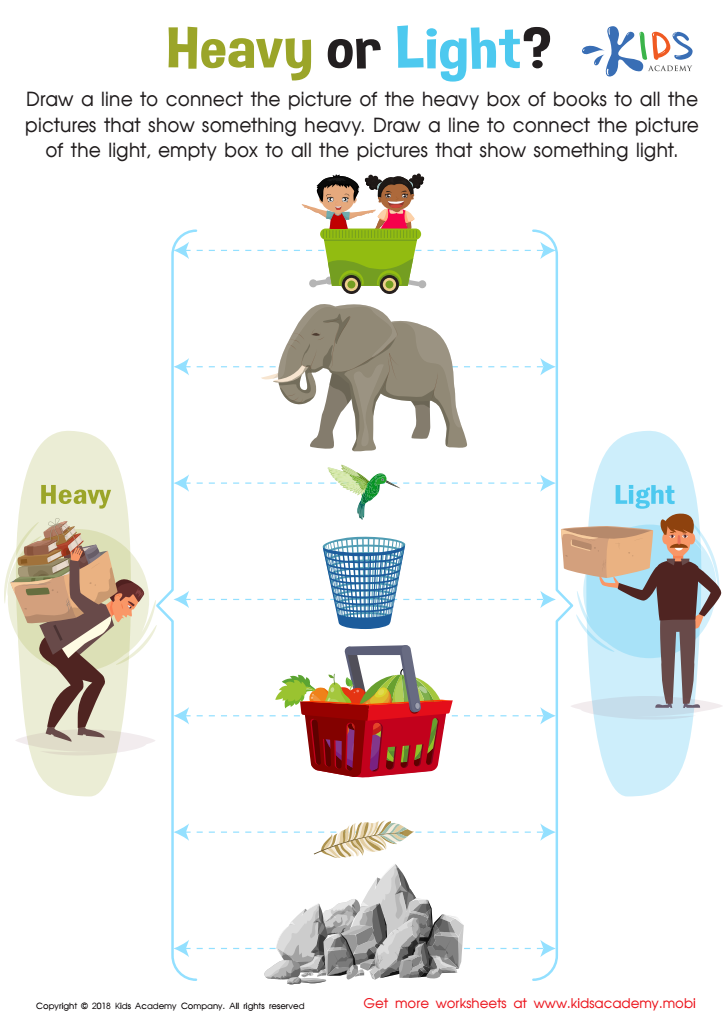
Kids can struggle to understand weight comparison, as size and mass matter. This free PDF helps develop fine-motor and hand-eye skills as kids trace lines to match pictures. The familiar pictures create concrete representations, ideal for learning more complex concepts.
Heavy or Light? Worksheet
Worksheet
Heavy or Light? Worksheet
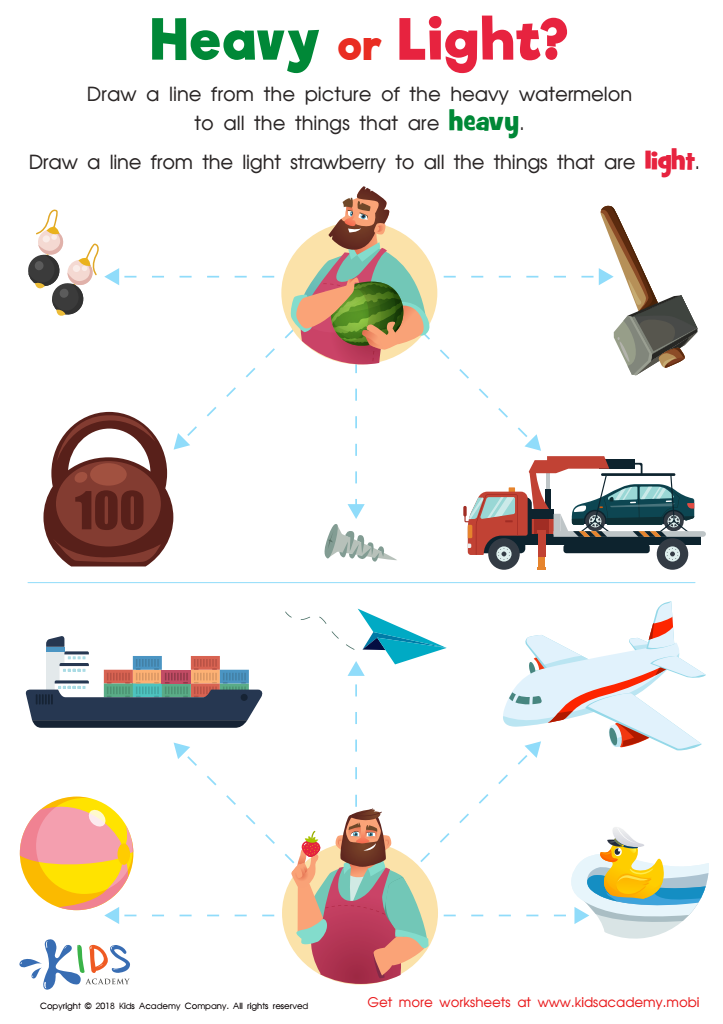
This fun, free worksheet helps kids build measurement skills and reinforce concepts of 'heavy' and 'light', while also improving their fine motor skills. Kids use traceable lines to connect the gentleman to objects they know, giving them a strong foundation for understanding weight.
Heavy or Light? Worksheet
Worksheet
Join Kids Academy for Free
Who is primarily going to use this learning content?




.jpg)
Understanding and comparing object weights is a fundamental concept that sets the stage for a child's mathematical and scientific development. For ages 4-8, this hands-on activity bridges cognitive skills and everyday learning experiences. As children engage in weight comparison, they develop critical thinking abilities, enhance observational skills, and improve their capacity to differentiate between attributes of various objects.
This activity also supports vocabulary building. Introducing terms like "heavier," "lighter," "equal," fosters language development and helps children articulate their thoughts more clearly. From a numerical perspective, comparing weights can lead to early comprehension of measurement and basic math concepts such as addition, subtraction, and the idea of estimation.
Moreover, these exercises encourage children to explore and observe the physical world around them, promoting curiosity and inquiry-based learning. Schools and parents can use simple tools like scales and balanced objects as practical, low-cost educational resources.
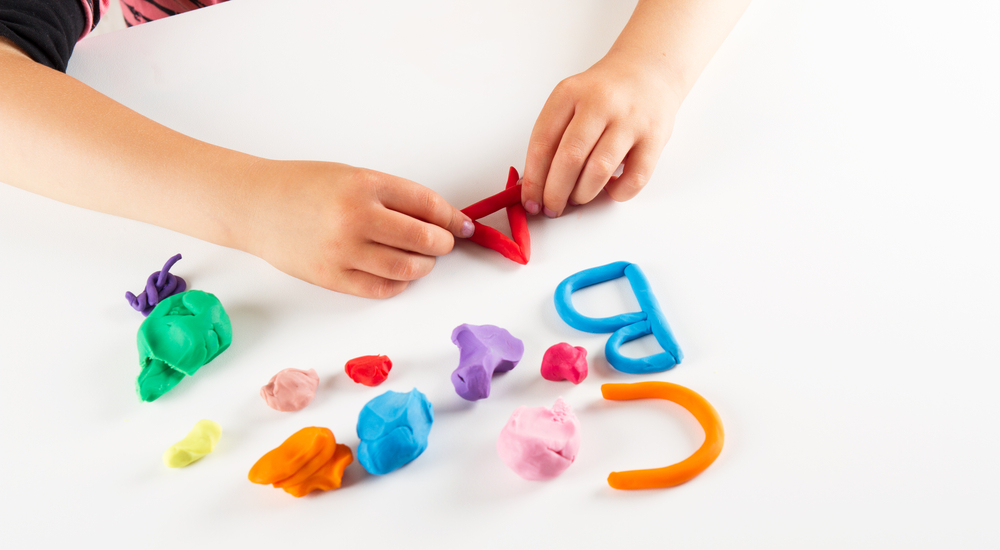
Incorporating comparative weight activities into playtime supports fine motor skills and hand-eye coordination while making learning interactive and fun. It’s a pivotal step towards cultivating a foundation of lifelong learning and an appreciation for STEM (Science, Technology, Engineering, and Mathematics) fields. Therefore, engaging kids in comparing object weights is crucial for their well-rounded cognitive and academic growth.








