Numerical comparisons Worksheets for Ages 4-8
3 filtered results
-
From - To
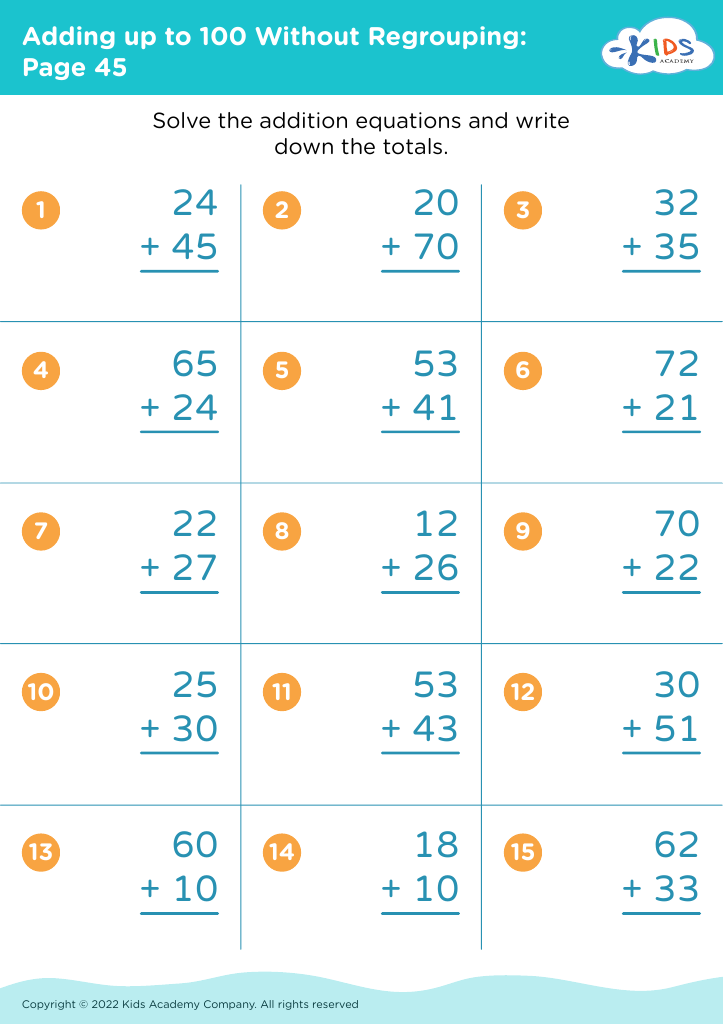
Unlock your child's potential with our Numerical Comparisons Worksheets for Ages 4-8 designed by Kids Academy. These engaging, printable exercises help young learners grasp the fundamentals of comparing numbers through fun and interactive activities. Our age-appropriate resources nurture critical thinking and problem-solving skills, enabling kids to confidently identify greater and lesser values. Perfect for both classroom and homeschooling environments, these worksheets come in a variety of themes and levels to cater to your child's unique learning pace. Download today and watch your child achieve math success while having fun!







Numerical comparisons are essential for children ages 4-8 because they lay the groundwork for quantitative thinking and mathematical concepts later in life. During these formative years, kids are naturally curious and are developing their cognitive abilities rapidly. Engaging with numerical comparisons helps them understand the basic idea of more or less, bigger or smaller, and equal or unequal. These are not just mathematical ideas; they are life skills that foster critical thinking and decision-making.
For parents and teachers, nurturing this understanding can make abstract mathematical concepts more accessible and less intimidating as children grow. It fosters an environment where math is seen as a part of daily life, encouraging curiosity and a positive attitude towards learning. Activities like comparing the number of apples versus oranges, or understanding that three is more than two, form the building blocks for more complex concepts such as addition, subtraction, and even problem-solving.
Moreover, these skills are fundamentally linked to literacy and language development. Through discussions where children explain their reasoning in numerical comparisons, they enhance their verbal skills and logical thinking simultaneously. In essence, focusing on numerical comparisons in early education helps build a strong, multi-disciplinary educational foundation for the child.








