
Understand number sequencing Worksheets for Ages 4-8
3 filtered results
Difficulty Level
Grade
Age
-
From - To
Subject
Activity
Standards
Our "Understand Number Sequencing" worksheets for ages 4-8 are expertly designed to help young learners grasp the concepts of number order and patterns in a fun and engaging way. These printable worksheets are filled with colorful visuals, interactive tasks, and age-appropriate challenges that promote critical thinking and strengthen foundational math skills. Ideal for preschool to early elementary students, these activities support the development of logical reasoning while enhancing number recognition and sequencing abilities. Support your child's educational journey with our vibrant and stimulating number sequencing worksheets!
Favorites
With answer key
Interactive
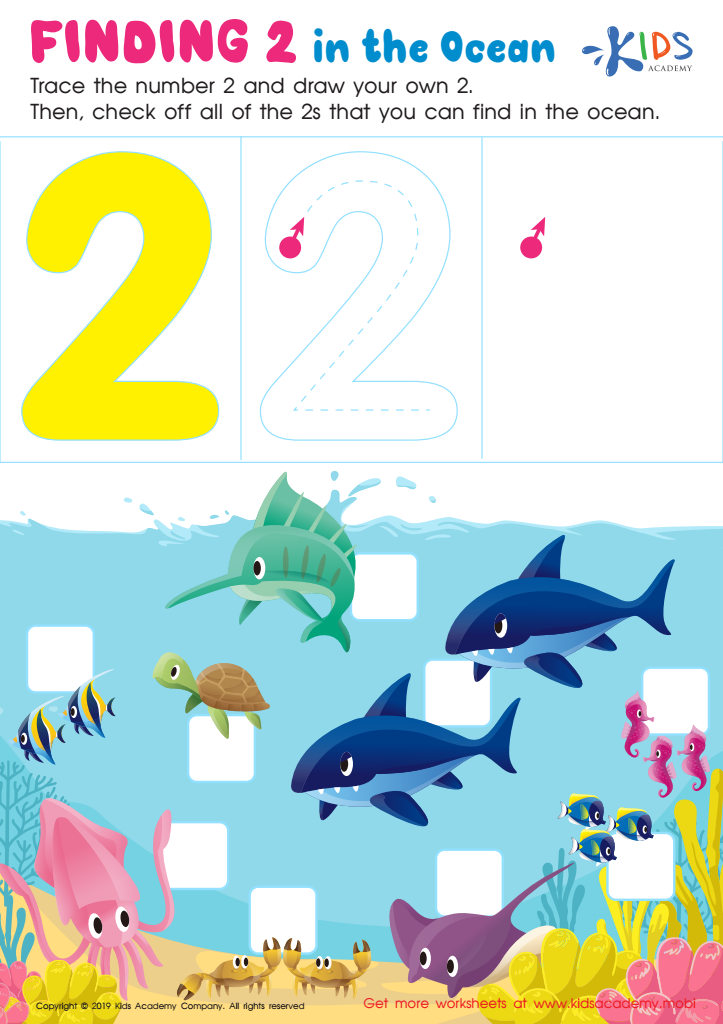
Finding 2: In the Ocean Worksheet
Kids start their math journey with basic numbers. Finger counting, number representation with pictures and this worksheet help build number sense. Kids trace lines and dots to write the number two and identify groups of two sea creatures for easy success and to feel proud of their math skills.
 Assign to My Students
Finding 2: In the Ocean Worksheet
Worksheet
Join Kids Academy for Free
Who is primarily going to use this learning content?





.jpg)


Understanding number sequencing is a foundational skill that plays a crucial role in a child's early mathematical development. For children ages 4-8, grasping number sequencing helps in building a solid foundation for more complex mathematical concepts that they will encounter later on. When children learn to count in sequence, they enhance their ability to recognize patterns, which is a critical aspect of problem-solving and logical thinking.
For parents and teachers, fostering number sequencing skills is essential because it also helps children develop a sense of order and organization. These young learners often encounter real-world situations where knowing the proper sequence is necessary, such as understanding the order of daily routines, steps in a process, or following a story’s sequence of events.
Moreover, number sequencing encourages cognitive development by requiring children to remember and recount strings of numbers accurately. This practice significantly benefits their working memory and attention to detail. It also lays the groundwork for other mathematical operations like addition, subtraction, and even basic multiplication or division later on.
In a nutshell, by paying attention to number sequencing in the early years, parents and teachers can provide a strong mathematical foundation, ensuring that their children are well-prepared for future academic success and everyday tasks that require logical thinking and procedure.








