Enhancing problem-solving abilities Adding up to 100 Worksheets for Ages 4-8
3 filtered results
-
From - To
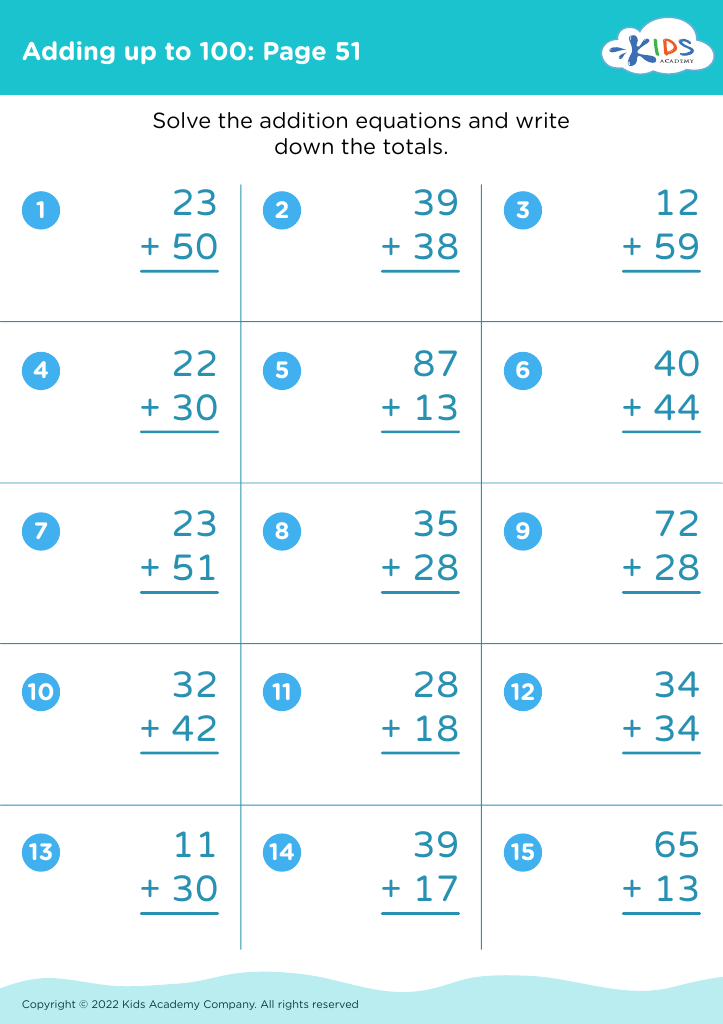
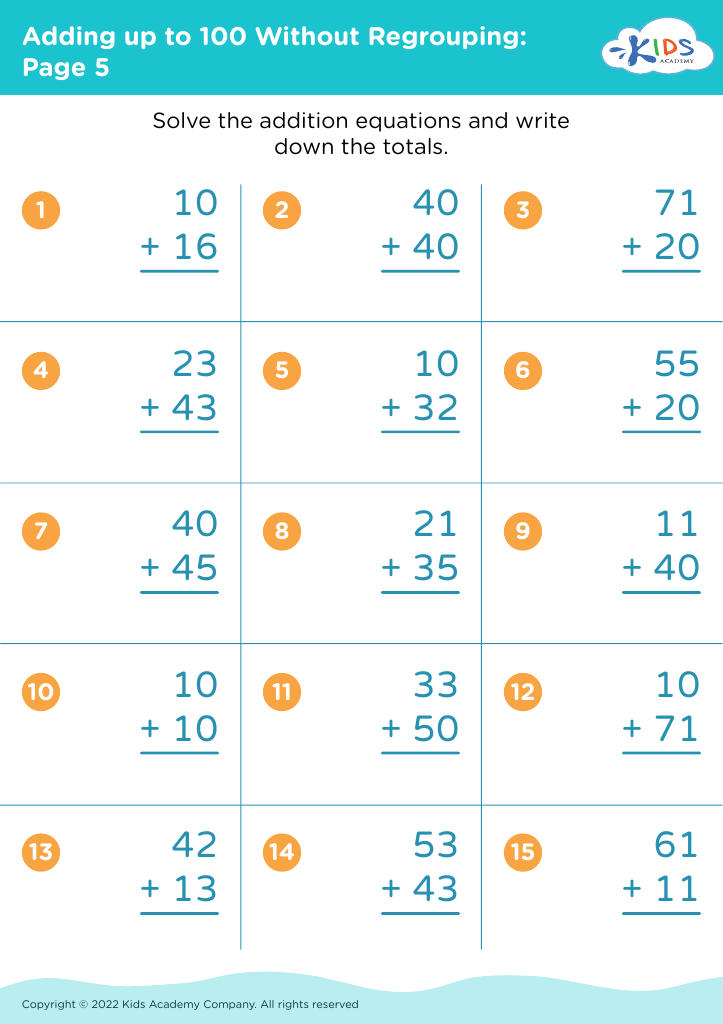
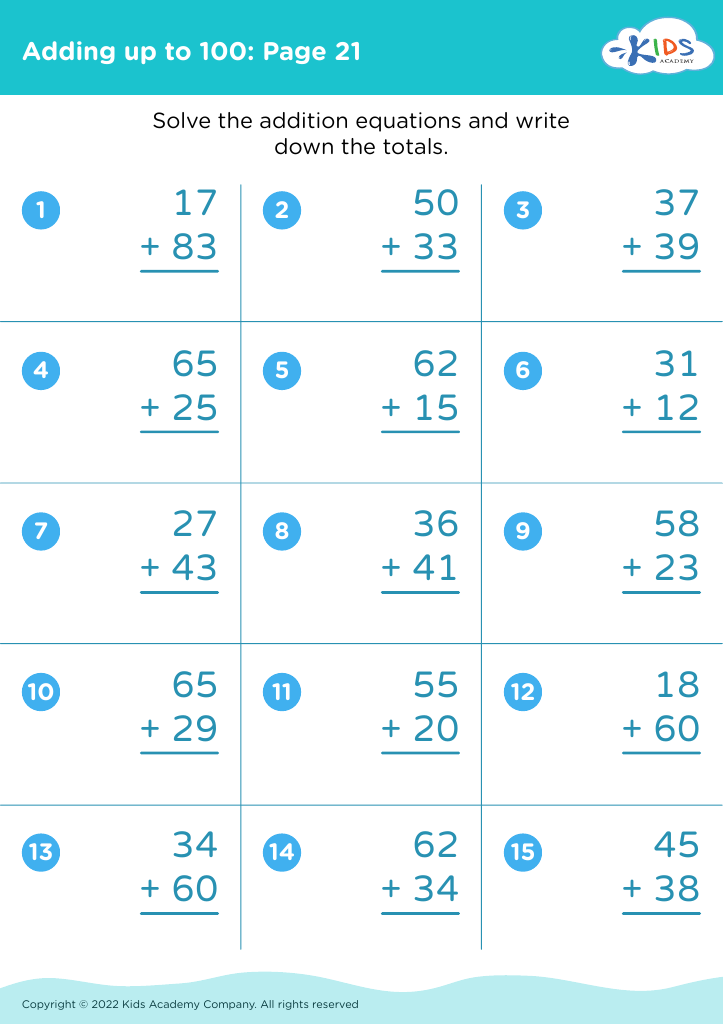
Unlock your child's mathematical potential with our "Enhancing Problem-Solving Abilities: Adding up to 100 Worksheets" designed for young learners aged 4-8. These engaging worksheets focus on developing crucial problem-solving skills and sharpening addition skills up to 100. Perfect for early grade students, the activities combine fun and learning, ensuring your child builds a strong foundation in math. Simplified instructions and colorful graphics make the exercises enjoyable and easy to follow. Help boost your child's confidence and foster a love for learning with our expertly crafted worksheets. Start your child's journey to mathematical mastery today!


%20(1).jpg)




Enhancing problem-solving abilities and teaching addition up to 100 for children ages 4-8 are fundamental to their developmental and academic success. At this age, young learners are in a critical period for cognitive development. Problem-solving skills encourage children to think creatively, make decisions, and develop resilience to challenges. These abilities not only foster academic success but also build confidence and independence, forming a strong foundation for lifelong learning.
Adding up to 100 teaches essential mathematical concepts such as number recognition, sequencing, and understanding value, which are crucial for future math proficiency. Mastering basic addition at an early age simplifies the transition to more complex arithmetic and problem-solving tasks, reducing anxiety and building positive attitudes towards math.
Moreover, teaching these skills in early childhood promotes critical thinking, attention to detail, and logical reasoning. Engaging in problem-solving and math exercises enhances brain development, encouraging neural connections that support overall educational growth. For parents and teachers, investing in children's problem-solving and math skills prepares them for academic achievements and cultivates practical life skills such as budgeting, time management, and strategic planning.
In summary, developing problem-solving abilities and proficiency in basic addition at a young age provides a vital academic advantage, establishes critical cognitive skills, and fosters a lifelong appreciation for learning and problem-solving.








