Understanding number patterns Addition & Subtraction Worksheets for Ages 4-8
3 filtered results
-
From - To
Explore our "Understanding Number Patterns: Addition & Subtraction Worksheets for Ages 4-8" and help your child build essential math skills! These engaging printable worksheets are designed to introduce young learners to the concepts of addition and subtraction through fun and interactive number patterns. Each activity is crafted to enhance critical thinking and problem-solving abilities, while making learning enjoyable. Perfect for parents and teachers alike, these worksheets offer a solid foundation in early math education, fostering confidence and a love for numbers in young students. Give your child the tools to succeed with our expertly designed resources!
 Assign to My Students
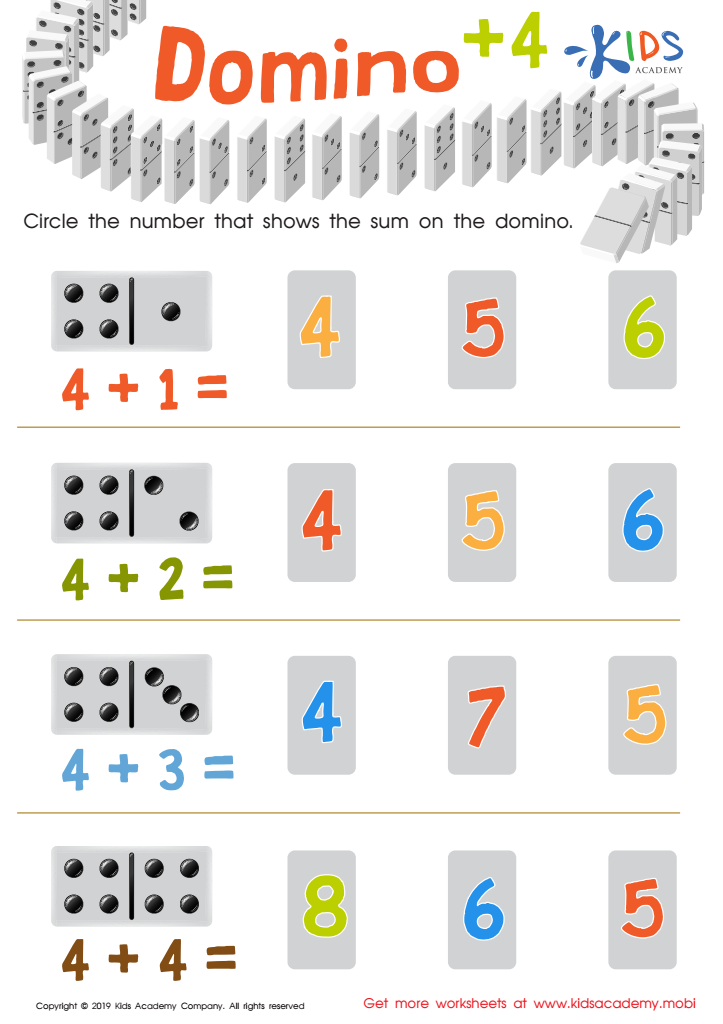
Domino +4 Worksheet








Understanding number patterns in addition and subtraction is crucial for young learners aged 4-8 because it lays the foundation for their future mathematical skills. Recognizing patterns helps children make sense of numbers and how they relate to one another, promoting logical thinking and problem-solving abilities. When parents and teachers focus on teaching these patterns, they enable children to understand concepts like odd and even numbers, counting by intervals, and the basics of arithmetic operations in an intuitive way.
For instance, comprehending that adding one more to a number consistently results in the next number in sequence (5 + 1 = 6, 6 + 1 = 7, and so on) aids children in grasping the idea of consecutive increment. Similarly, learning that subtracting one consistently moves them to the previous number helps strengthen their understanding of sequential decrement.
Moreover, early exposure to these patterns enhances number sense, a fundamental aspect of mathematical literacy. Children start to see mathematics as a set of predictable and understandable rules rather than random and confusing processes. This can increase their confidence and reduce math anxiety as they progress to more complex concepts, such as multiplication and division.
Interactive activities like playing with number grids, using manipulatives (like counters or blocks), and engaging in number-based games can make learning these patterns a fun and engaging experience, fostering a positive attitude toward math that can last a lifetime.








