
Understanding seasons Addition & Subtraction Worksheets for Ages 4-8
4 filtered results
Difficulty Level
Grade
Age
-
From - To
Subject
Activity
Standards
Enhance your child's math skills with our "Understanding Seasons Addition & Subtraction Worksheets" designed for ages 4-8. These engaging worksheets combine seasonal themes with foundational math concepts, making learning fun and relatable. Through colorful illustrations and age-appropriate exercises, children will explore addition and subtraction in context, improving their numerical understanding while connecting with nature's cycles. Perfect for parents and educators alike, these resources encourage hands-on learning and foster a love for mathematics. Help your children grasp essential math skills while enjoying the beauty of each season with our carefully crafted worksheets! Download and watch your little ones excel in math today!
Favorites
With answer key
Interactive
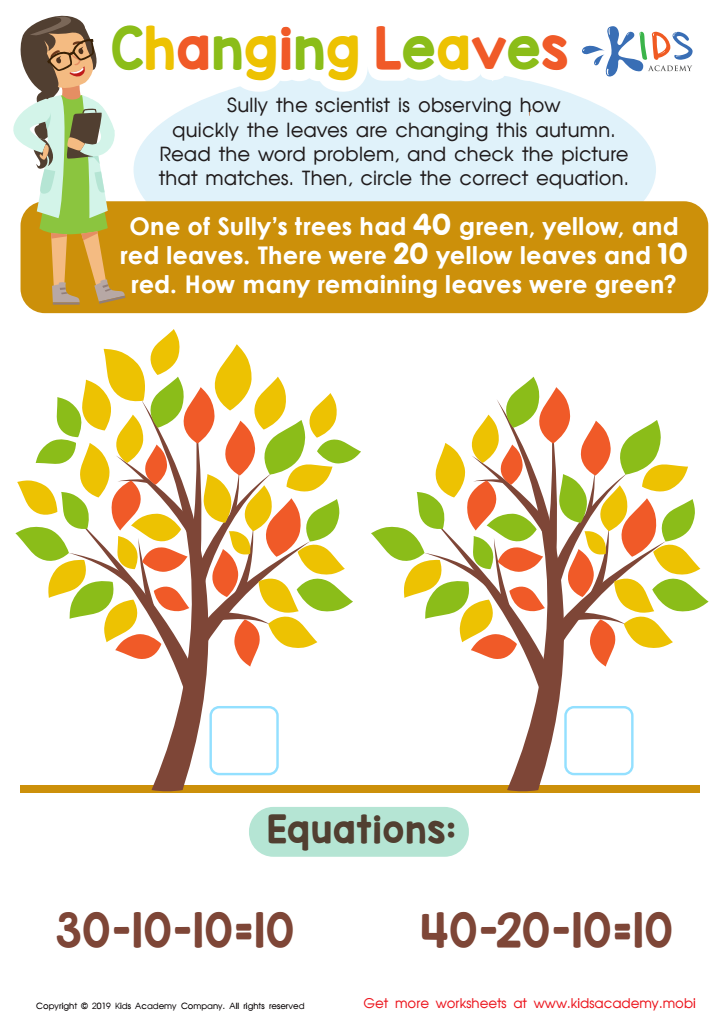
Changing Leaves Worksheet
Fall is the perfect time for kids to help Sully the scientist observe the changing leaves! Download the free worksheet with a subtraction word problem and bolded info to find the matching equation and picture. It's a fun way for your tots to learn while they admire the reddening, yellowing, and orange leaves.
 Assign to My Students
Changing Leaves Worksheet
Worksheet
Join Kids Academy for Free
Who is primarily going to use this learning content?








Understanding the concepts of seasons and addition and subtraction is crucial for children ages 4-8 as it lays the groundwork for both academic skills and real-world applications. During this developmental stage, children's cognitive abilities are rapidly evolving, and incorporating seasonal themes makes learning more engaging and relatable.
Teaching about seasons helps children enhance their observational skills and recognize patterns in nature, fostering curiosity about the world around them. It also serves as a backdrop for integrating mathematical concepts, where children can learn to count seasonal objects like leaves, snowflakes, flowers, or fruits.
Addition and subtraction are foundational math skills that promote critical thinking, problem-solving, and logical reasoning. By exploring these concepts through seasonal activities—like adding together apples in the fall or subtracting snowflakes in winter—children can develop a deeper understanding of mathematics within a meaningful context.
Moreover, involving parents and teachers in seasonal learning creates a collaborative environment, encouraging children to share their insights and discoveries. This multidimensional approach not only makes learning more enjoyable but also reinforces connections between mathematics and everyday life, inspiring a love for learning that can last a lifetime.








