Spatial reasoning Numbers Worksheets for Ages 4-8
3 filtered results
-
From - To
Boost your child's mathematical foundation with our Spatial Reasoning Numbers Worksheets designed for ages 4-8. These engaging, age-appropriate activities, offered by Kids Academy, enhance spatial awareness and numerical understanding. Our worksheets combine fun challenges with educational rigor to develop critical thinking skills. Children explore patterns, shapes, and numbers, mastering spatial concepts through interactive, hands-on learning. Each worksheet is crafted to make learning enjoyable, progressively building confidence in young learners. Support your child's early mathematical journey with our expertly designed resources, ensuring they develop essential skills for future academic success. Empower your child to excel with Kids Academy!
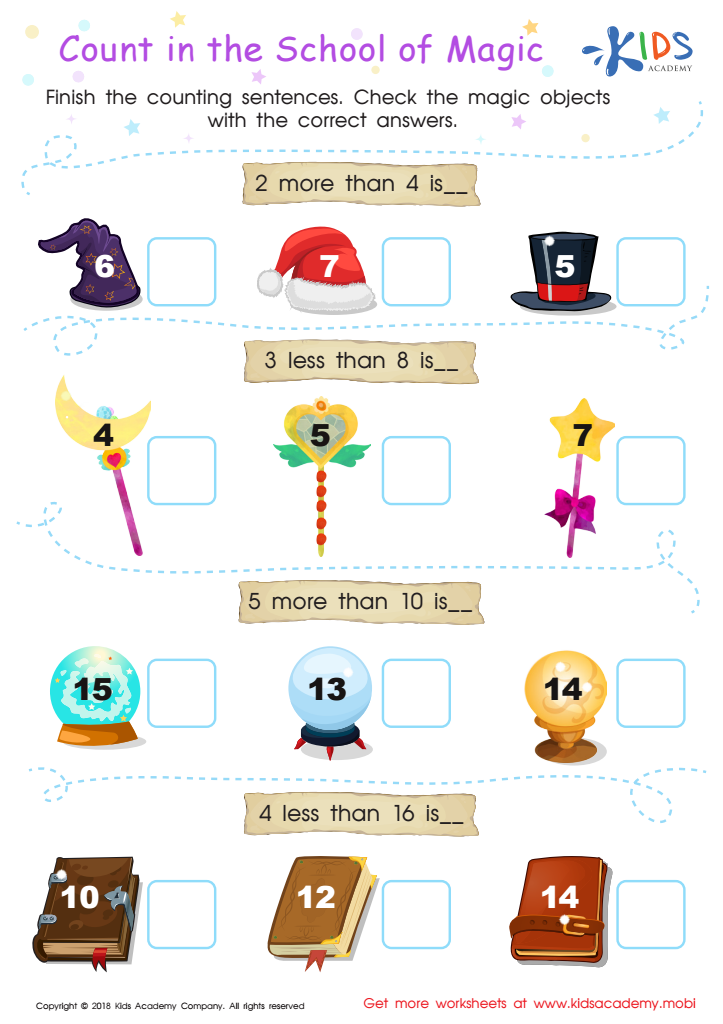
Count in the School of Magic Worksheet
 Assign to My Students
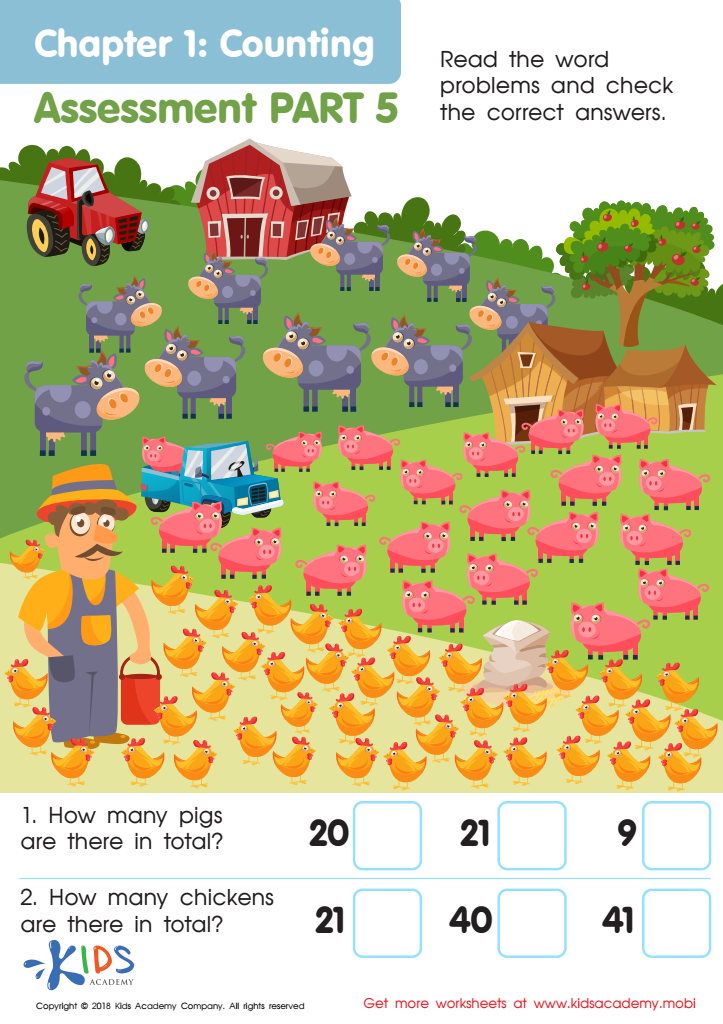
Counting: Assessment 5 Worksheet
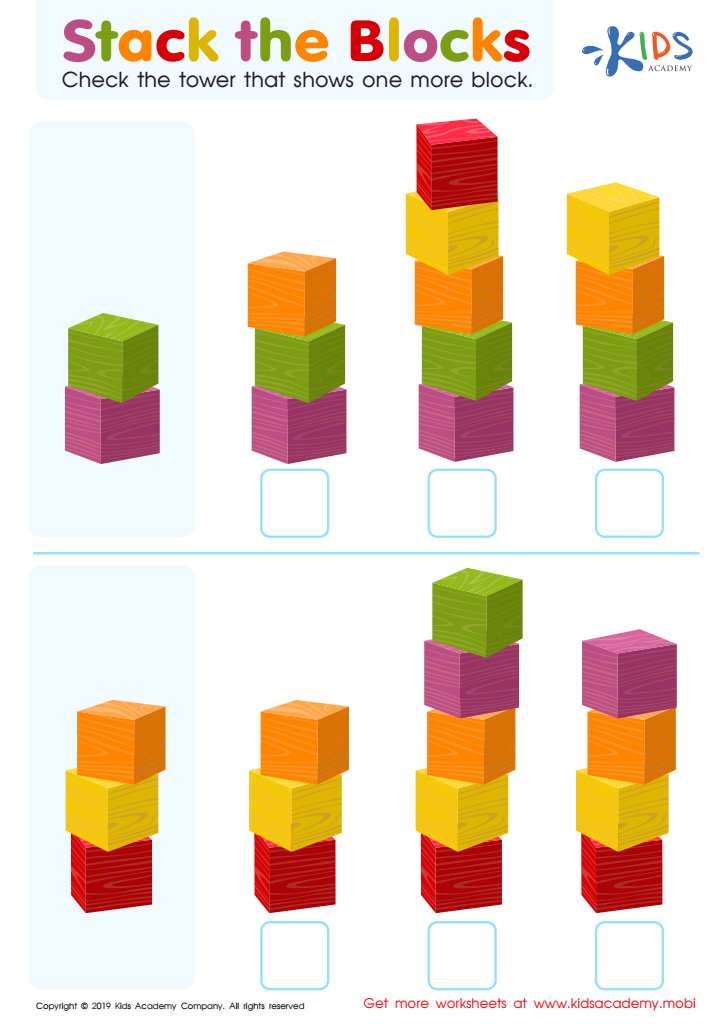
Stack the Blocks Worksheet








Spatial reasoning and understanding numbers are foundational skills that play a crucial role in a child's development, particularly between the ages of 4 and 8. Spatial reasoning involves the ability to visualize and manipulate objects in space, which is essential for problem-solving, understanding geometric concepts, and performing everyday tasks. This cognitive skill underpins abilities in science, technology, engineering, and mathematics (STEM) fields, making it critical for future academic and career success.
Introducing children to spatial reasoning at an early age enhances their ability to grasp mathematical concepts such as shapes, sizes, patterns, and the relationships between objects. Furthermore, it aids in spatial-temporal reasoning, which involves understanding sequences and transformations over time and space, a key aspect of mathematical thought and logical problem-solving.
Numbers and basic numeracy skills are equally significant, as they form the basis for all future mathematical learning. Early exposure helps children comprehend counting, addition, subtraction, and other basic arithmetic operations. Encouraging children to play with blocks, puzzles, and number games fosters these skills in a fun and engaging way, promoting a positive attitude towards learning mathematics.
Parents and teachers who focus on developing spatial reasoning and numerical skills in early childhood lay a foundation for lifelong learning and success. This balanced approach ensures children are well-equipped for complex mathematical concepts and real-world problem-solving as they grow.








