Counting skills improvement Math Worksheets for Ages 4-8
3 filtered results
-
From - To
Enhance your child’s counting skills with our engaging Math Worksheets designed specifically for ages 4-8! Our worksheets offer a fun, interactive way to improve number recognition, sequencing, and basic arithmetic. Each activity is crafted to promote critical thinking and boost confidence in young learners while adhering to educational standards. With colorful illustrations and age-appropriate challenges, children will enjoy learning through games and exercises that make counting exciting. These resources are perfect for teachers, parents, and caregivers aiming to foster a love for math. Explore our collection and support your child's journey to counting mastery today!
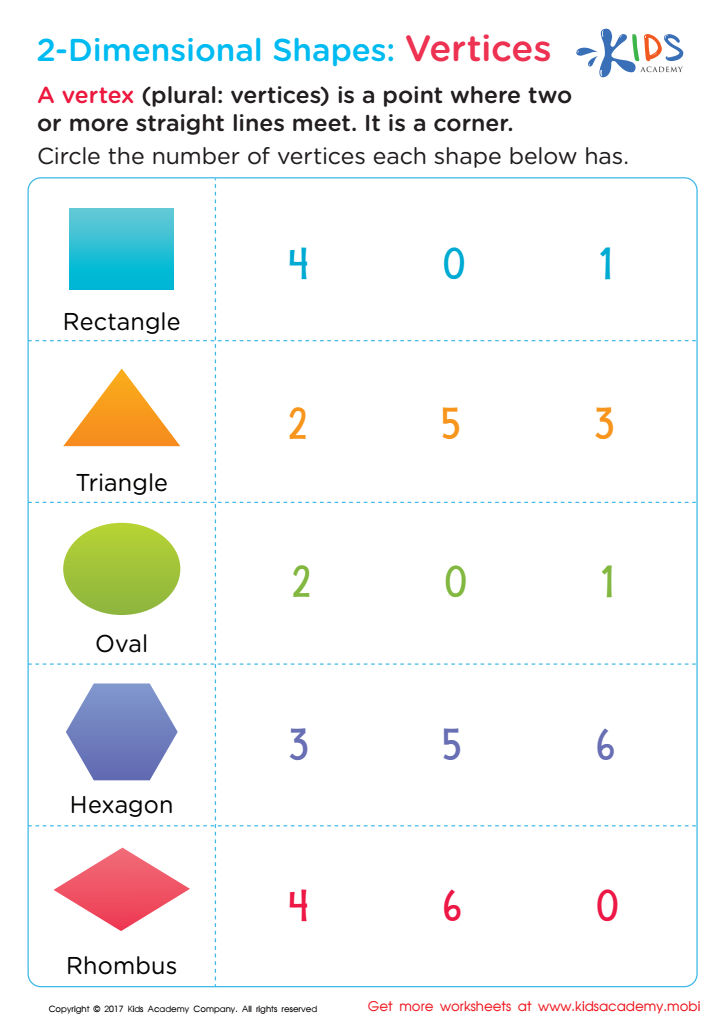
Two–Dimensional Shapes: Vertices Printable
 Assign to My Students
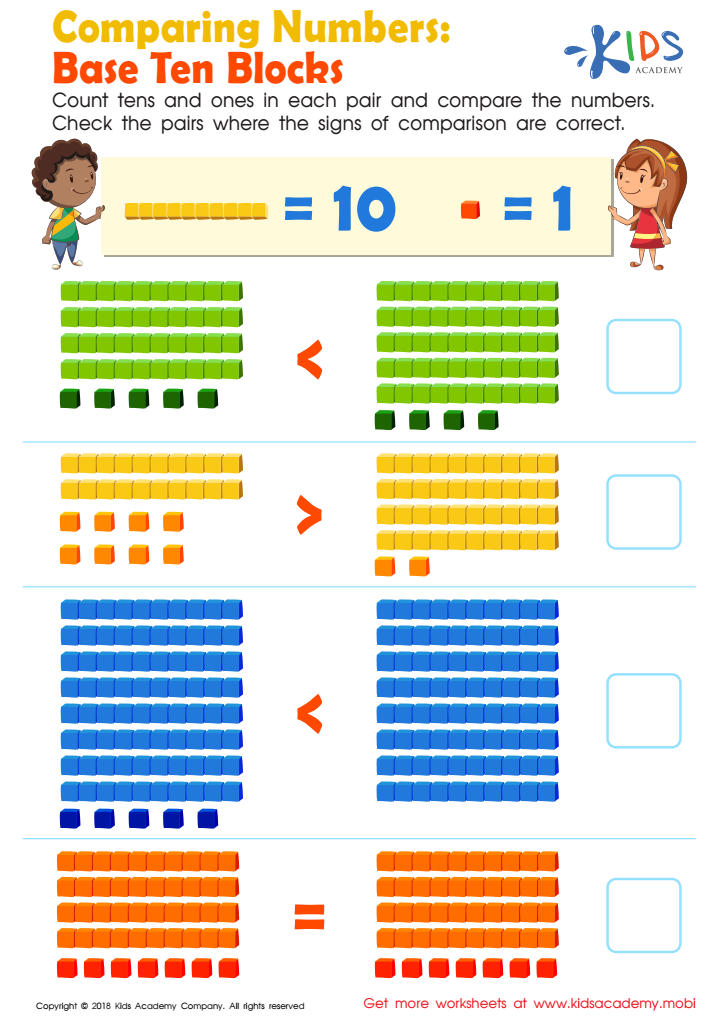
Comparing Numbers: Base Ten Blocks Worksheet
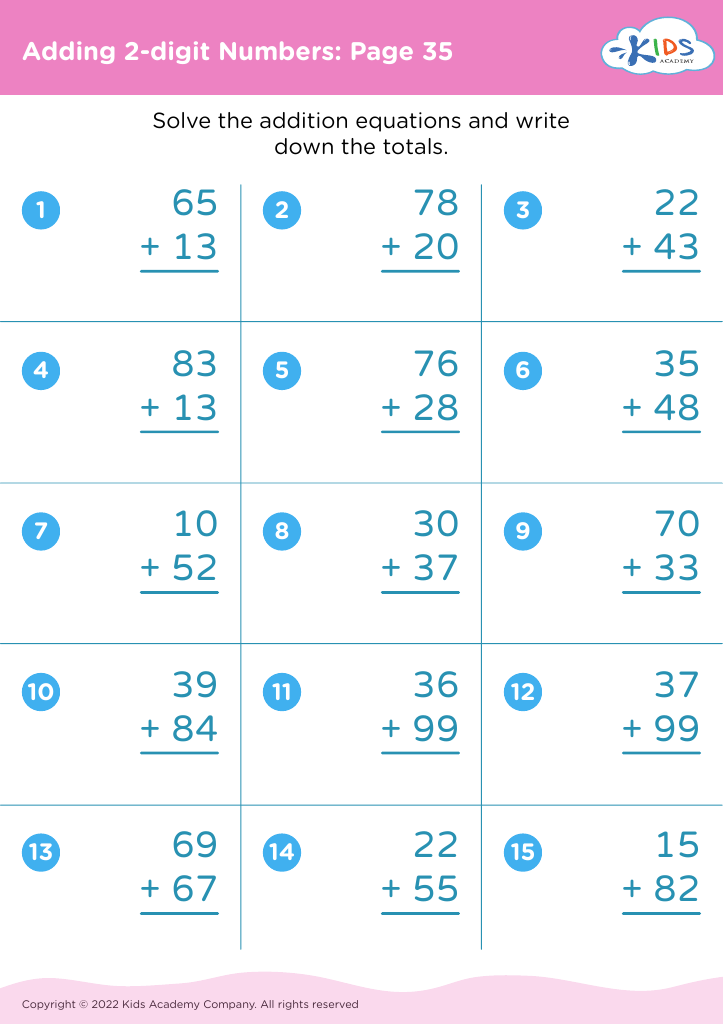







Counting skills are foundational for young learners, playing a crucial role in their overall mathematical understanding. For children aged 4-8, developing counting skills lays the groundwork for future mathematical concepts, such as addition, subtraction, and more complex problem solving. Parents and teachers should care deeply about enhancing these skills, as they are directly linked to a child's cognitive development and success in academic settings.
Mastering counting helps children recognize patterns and relationships, fostering critical thinking and reasoning abilities. Early counting experiences, such as incorporating numbers into daily routines, can build a solid numerical vocabulary that aids in comprehension. Furthermore, when children gain confidence in their counting abilities, they are more likely to engage enthusiastically in learning activities, setting a positive tone for future educational endeavors.
Additionally, counting is not isolated; it intersects with various subjects. As children count objects, they enhance language skills, spatial awareness, and even fine motor skills through hands-on play, making it an interdisciplinary approach to learning. Emphasizing counting skills encourages a love for learning and mathematics, ensuring we equip young learners with essential tools for their educational journeys ahead. Engaging parents and teachers in nurturing these skills creates a holistic support system for a child's lifelong learning.








