Telling time Math Worksheets for Ages 4-8
4 filtered results
-
From - To
Introducing our "Telling Time Math Worksheets for Ages 4-8," designed to make learning to tell time fun and engaging for young minds. These printable worksheets help children practice reading both analog and digital clocks, reinforcing skills essential for daily life. Colorful, age-appropriate activities target kids ages 4-8, progressively developing their ability to identify hours and minutes. Our worksheets incorporate familiar, everyday scenarios to make learning relevant and enjoyable. Tailored for early graders, they offer a structured path to mastering time-telling basics. Strengthen your child's math and time management skills with our expertly-crafted printables. Perfect for home or classroom use!
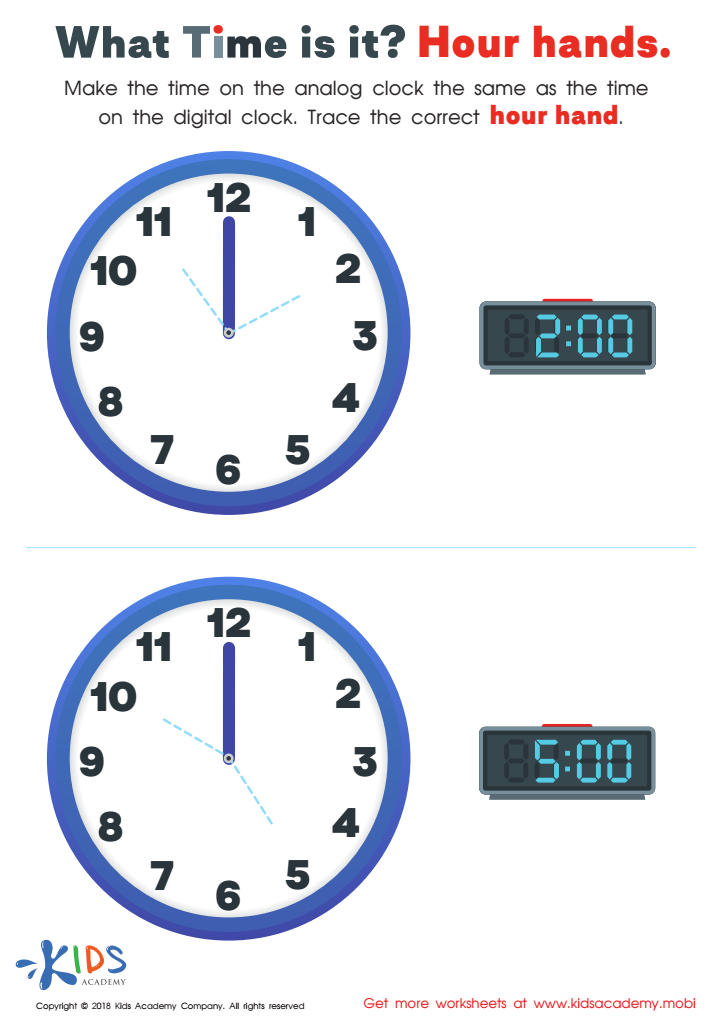
What Time Is it? Hour Hands Worksheet
 Assign to My Students






.jpg)
Teaching young children to tell time is crucial for their overall development and daily life skills. First, understanding time enhances a child's math skills. This age range is fundamental for grasping various mathematical concepts such as counting, addition, subtraction, and recognizing patterns, which are all integral to telling time. Encouraging familiarity with time nurtures a child’s ability to transition smoothly between different math areas.
Second, knowing how to tell time fosters time management skills. Comprehending concepts such as the duration of activities, schedules, and deadlines helps children become more organized and responsible. It aids in establishing routines, which are important for stability and reduces anxiety.
Moreover, learning to tell time can improve a child’s cognitive abilities. It reinforces critical thinking, and the ability to read both analog and digital clocks encourages different channels of thought processing.
Finally, being able to read the clock can promote a child's sense of independence and confidence. Simple tasks like knowing when it’s time for lunch, play, or bedtime reinforce a sense of control over their environment.
Therefore, parents and teachers should prioritize teaching time to instill foundational math competencies, time management skills, cognitive development, and a boost in confidence and independence at this essential stage.








