
Understanding number lines Math Worksheets for Ages 4-8
3 filtered results
Difficulty Level
Grade
Age
-
From - To
Subject
Activity
Standards
Unlock foundational math skills with our "Understanding Number Lines" worksheets, designed for ages 4-8. Engaging activities help young learners grasp vital concepts, from counting to basic arithmetic. Kids develop numerical fluency by pinpointing numbers, understanding sequences, and performing simple operations on number lines. Our colorful, kid-friendly worksheets make learning fun and interactive. Whether at home or in the classroom, support your child's math journey and boost their confidence with these essential tools. Download now and watch them thrive in their early math milestones!
Favorites
With answer key
Interactive
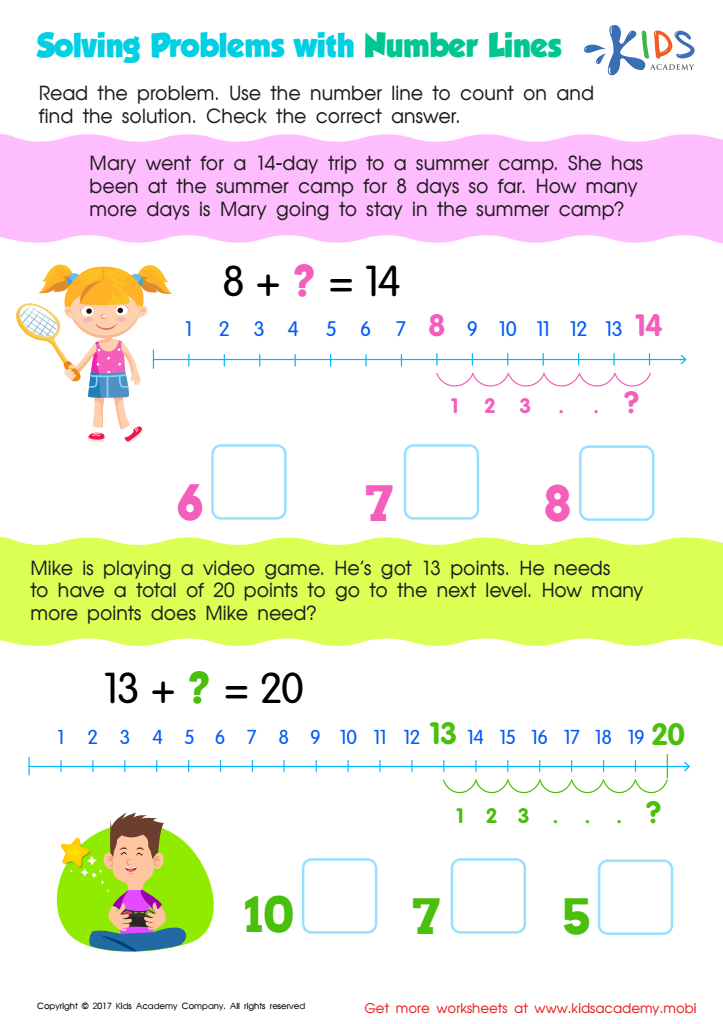
Solving Problems: Number Lines Worksheet
Number lines are fun and help build number sense and reasoning. This worksheet uses them to help students count on to find a solution to an equation. They'll have fun counting with familiar numbers and 10-bases, while also working on algebraic reasoning.
 Assign to My Students
Solving Problems: Number Lines Worksheet
Worksheet
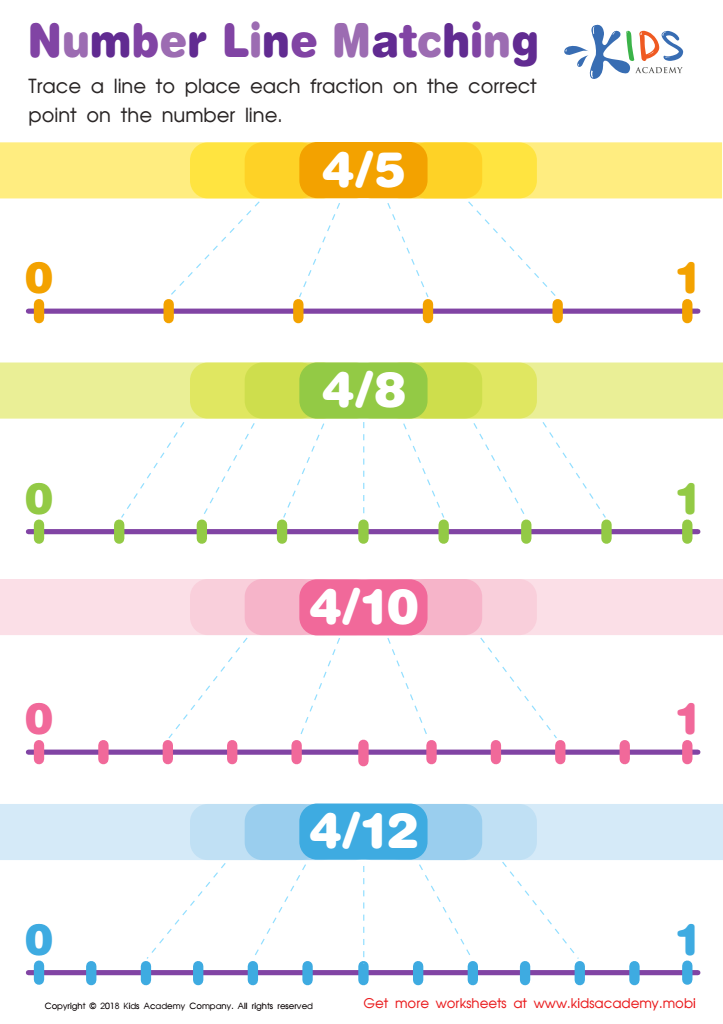
Number Line Matching Worksheet
Math can be fun! Have your child count points on the number line, then identify and trace fractions above it. It's a great way for them to learn and have some fun!
Number Line Matching Worksheet
Worksheet
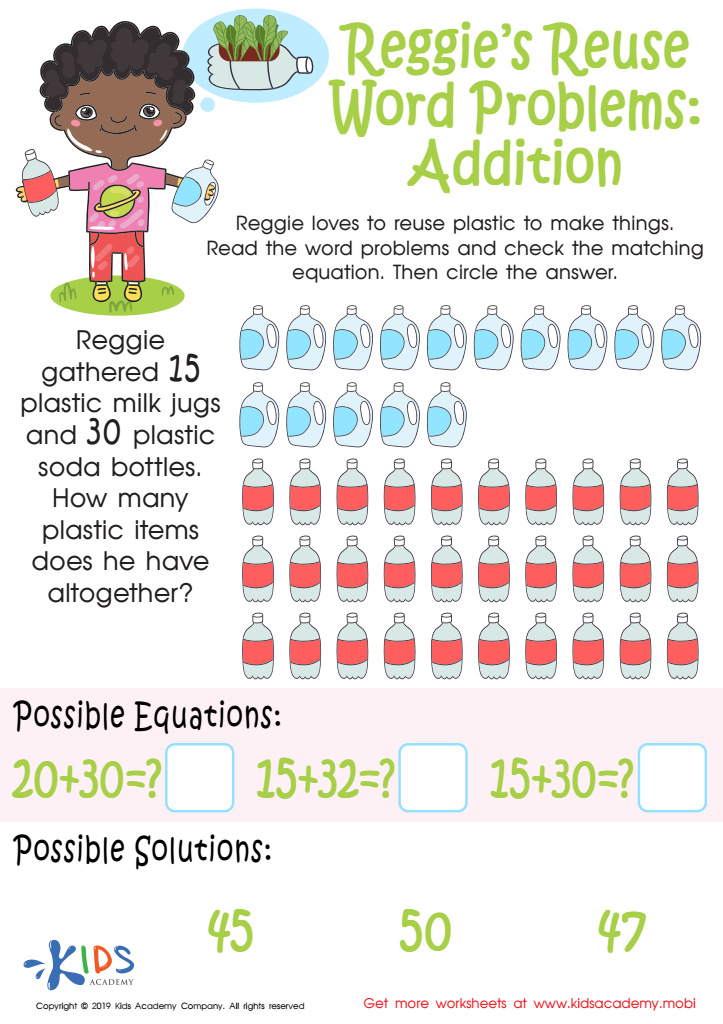
Reggie's Reuse Word Problems: Addition Worksheet
Help Reggie and your child save the planet by using this free worksheet! It reinforces addition word problems using one-to-one picture representation, and helps them pick out the correct number sentence and possible solutions. It's an easy way to help the planet and practice math!
Reggie's Reuse Word Problems: Addition Worksheet
Worksheet
Join Kids Academy for Free
Who is primarily going to use this learning content?








Understanding number lines is foundational for young children (ages 4-8) because it sets the groundwork for essential math skills and broader cognitive development. Number lines visually represent numbers and their relationships, making abstract concepts more concrete for young learners. This visual tool aids in their comprehension of counting, sequencing, addition, and subtraction, which are crucial early math skills.
Moreover, number lines help children grasp the idea of numerical order and spatial awareness. By seeing numbers in a linear progression, kids start to understand concepts of greater than, less than, or equals. This is fundamental not just in math but in everyday decision-making and problem-solving.
Engaging with number lines also encourages critical thinking and mental math. When children practice hopping or moving along the number line, they develop a sense of distance and relative quantity, which is important for more advanced math topics they will encounter later.
For parents and teachers, fostering an understanding of number lines is an investment in a child's future academic achievement. Early competency in these skills can boost their confidence and willingness to tackle math problems, set the stage for their future success, and develop a positive attitude toward learning. Therefore, integrating number lines into early childhood education can bring long-term benefits and foster a nurturing educational environment.








