Understanding symmetry Math Worksheets for Ages 4-8 - Page 2
30 filtered results
-
From - To
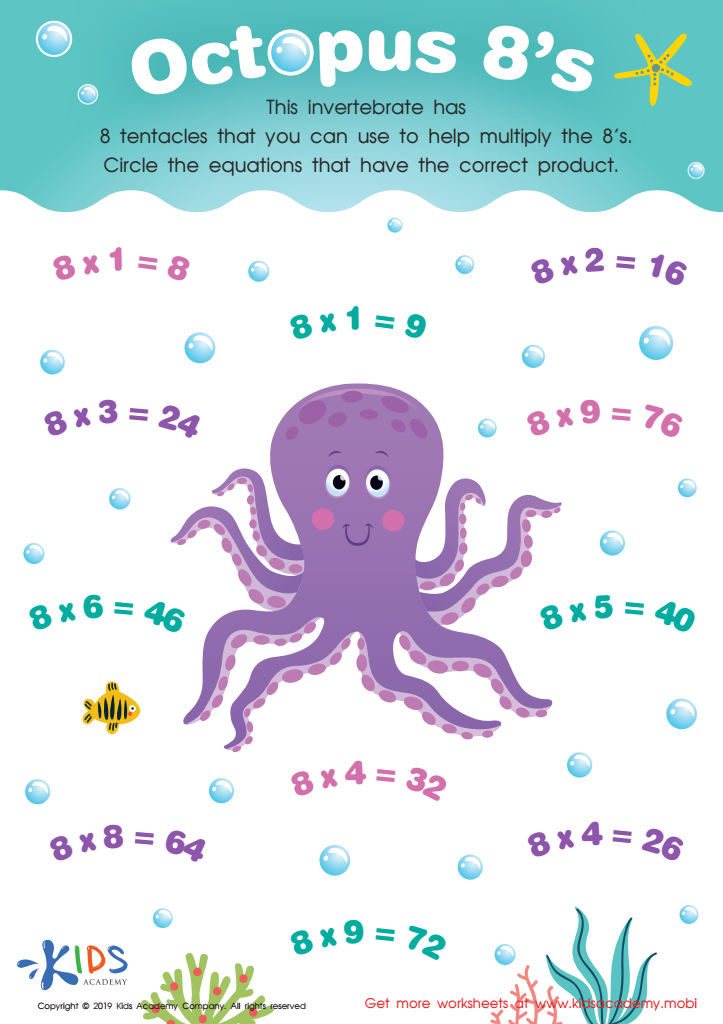
Octopus 8’s Worksheet
 Assign to My Students







Understanding symmetry in mathematics is crucial for young children, ages 4-8, as it forms a cornerstone for developing their spatial reasoning and foundational geometry skills. Symmetry appears everywhere in the natural world and early recognition helps children appreciate patterns and structures around them.
Firstly, symmetry awareness enhances visual and cognitive development. When children identify symmetrical objects, they engage in organizing visual information, which sharpens their observation and analytical skills. This fundamental concept also lays the groundwork for tackling more complex geometric ideas later in education, such as transformations, algebra, and calculus.
Secondly, symmetry nurtures creativity. As children explore symmetrical patterns in art or nature, they stimulate their creativity and imagination. This has significant benefits for their overall academic performance and problem-solving abilities.
Furthermore, understanding symmetry is linked to other key math concepts. Recognizing symmetrical shapes improves a child’s ability to classify, compare, and sort objects by attributes, fostering their early skills in logical thinking and categorization.
Lastly, grasping the idea of symmetry provides a sense of balance and aesthetics. This inbuilt tendency encourages children to seek harmony and proportion, values that are essential both in mathematics and everyday life. Thus, focusing on symmetry from an early age not only builds mathematical competence but also enriches overall cognitive and creative development.








