
Time recognition Measurement Worksheets for Ages 4-8
3 filtered results
Difficulty Level
Grade
Age
-
From - To
Subject
Activity
Standards
Discover a fun and educational way for kids ages 4-8 to master time-telling with our Time Recognition Measurement Worksheets! These engaging worksheets are designed to help young learners understand and practice reading both analog and digital clocks. Through colorful activities and step-by-step lessons, children develop critical time-telling skills that align with their cognitive development. Perfect for classroom use or home practice, these worksheets make learning to tell time enjoyable and accessible. Boost your child's confidence and math skills with our expertly crafted educational materials! Download your free printable worksheets today and watch them thrive!
Favorites
With answer key
Interactive
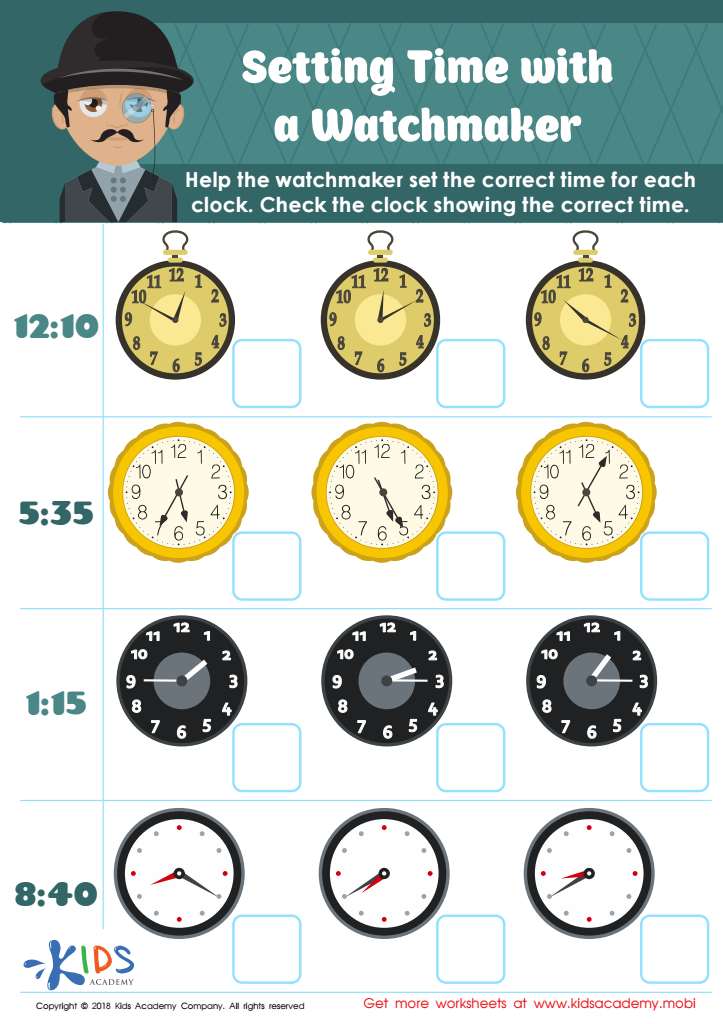
Setting Time with Watchmaker Worksheet
Can your kids tell the time? If so, this worksheet should be easy. Help them set the time for each clock: look at the time written on the left side and find the clock on the right side that matches.
 Assign to My Students
Setting Time with Watchmaker Worksheet
Worksheet
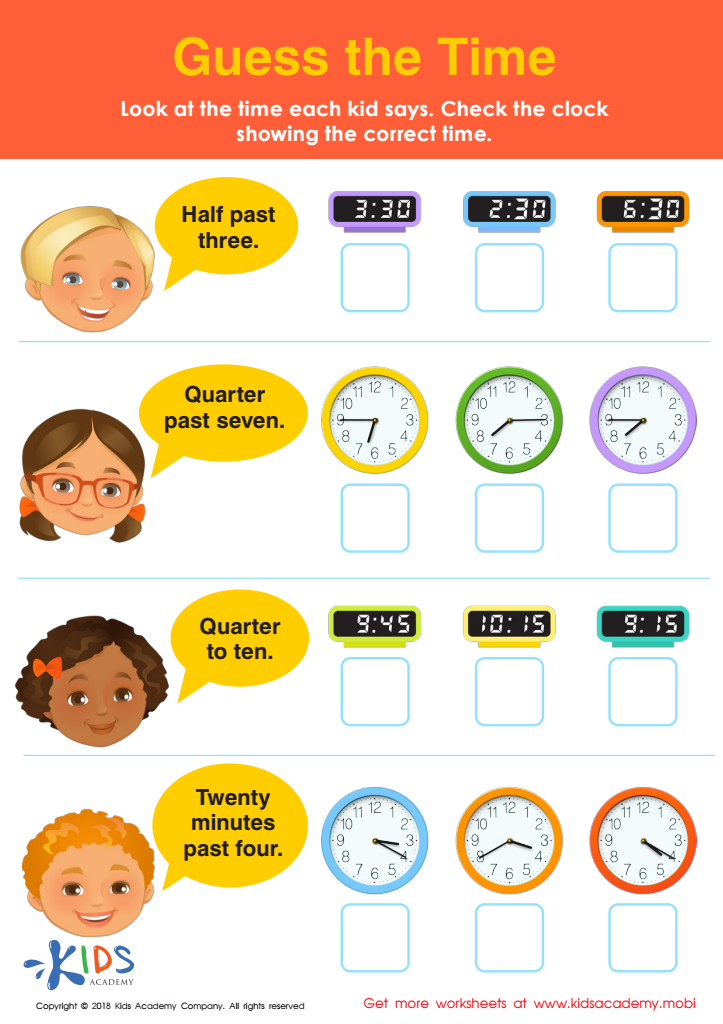
Guess the Time Worksheet
Help students tell the time accurately with this fun exercise. Read the time each person says and find the corresponding clock. Check the options on the left and have students guess the right time. This worksheet is sure to sharpen their time-telling skills.
Guess the Time Worksheet
Worksheet
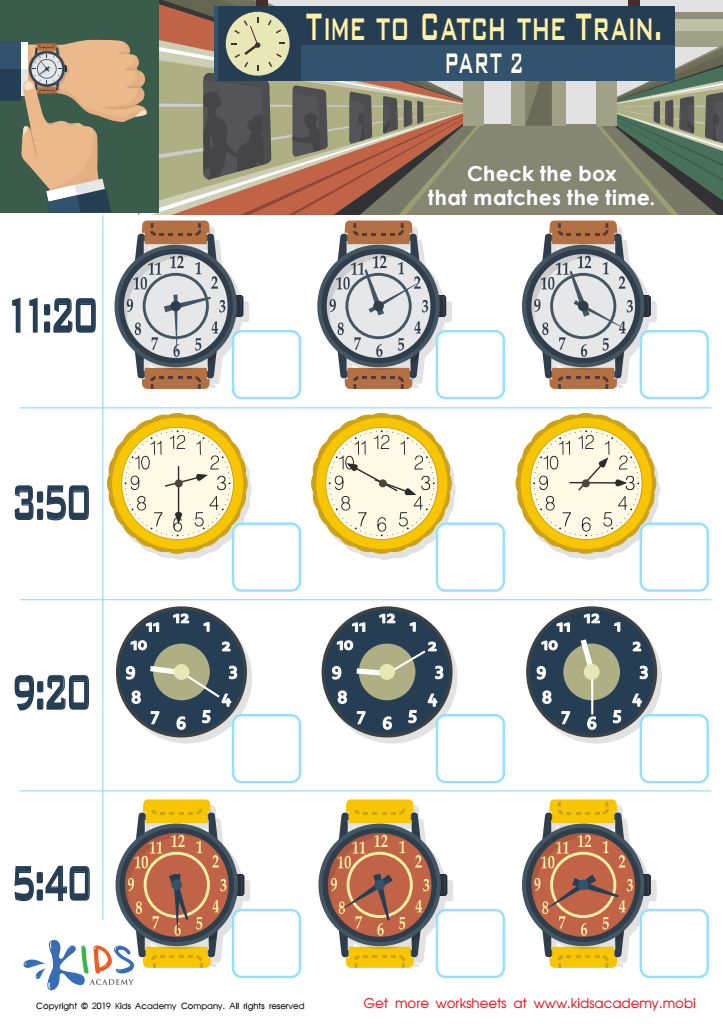
Time to Catch the Train Part 2 Worksheet
Teach your kids the importance of telling time and how to do it. Explain that there are multiple ways to show the time, such as written on the left side or watches in the picture. Guide them to check the box that matches the time. Knowing the time is essential to get things done and create order. Ensure your kids understand this and they will reap the benefits.
Time to Catch the Train Part 2 Worksheet
Worksheet
Join Kids Academy for Free
Who is primarily going to use this learning content?








Time recognition and measurement are foundational skills that significantly contribute to a child's cognitive development and daily functioning. For ages 4-8, understanding time helps children grasp the concept of sequence and duration, essential for routine and discipline. It fosters time management abilities early on, which can translate into better study habits as they grow older. Recognizing the fundamentals of time, children learn to differentiate between days, weeks, and months, aiding their scheduling and planning capabilities.
For young children, comprehending time assists in creating a consistent daily routine, giving them a sense of order and security. Knowing when to expect activities like meals, playtime, or bedtime helps them feel more stable and less anxious. Teachers benefit as structured time can create smoother classroom management and transitions between activities.
Time recognition also improves mathematical skills. Concepts such as hours, minutes, and even estimating time can reinforce number sense and basic arithmetic principles. Moreover, the ability to tell time supports life skills essential for independence. Punctuality and time-oriented tasks become comprehensively manageable, ultimately equipping children with lifelong skills valuable in academic, social, and professional settings. Parents and teachers thus play a crucial role in acknowledging and fostering these time-related competencies.








