
Fraction subtraction Worksheets for Ages 4-9
3 filtered results
Difficulty Level
Grade
Age
-
From - To
Subject
Activity
Standards
Discover our Fraction Subtraction Worksheets designed for kids aged 4-9! These engaging and educational worksheets help young learners master the essential math skill of fraction subtraction with ease. Each activity is tailored to different skill levels, allowing children to progress at their own pace while having fun. Colorful visuals and interactive exercises boost confidence and understanding through practice. Ideal for classroom use or homeschooling, these worksheets are perfect for paving the way for future math success. Give your child the tools they need to excel in fraction subtraction today with our expertly crafted worksheets from Kids Academy!
Favorites
With answer key
Interactive
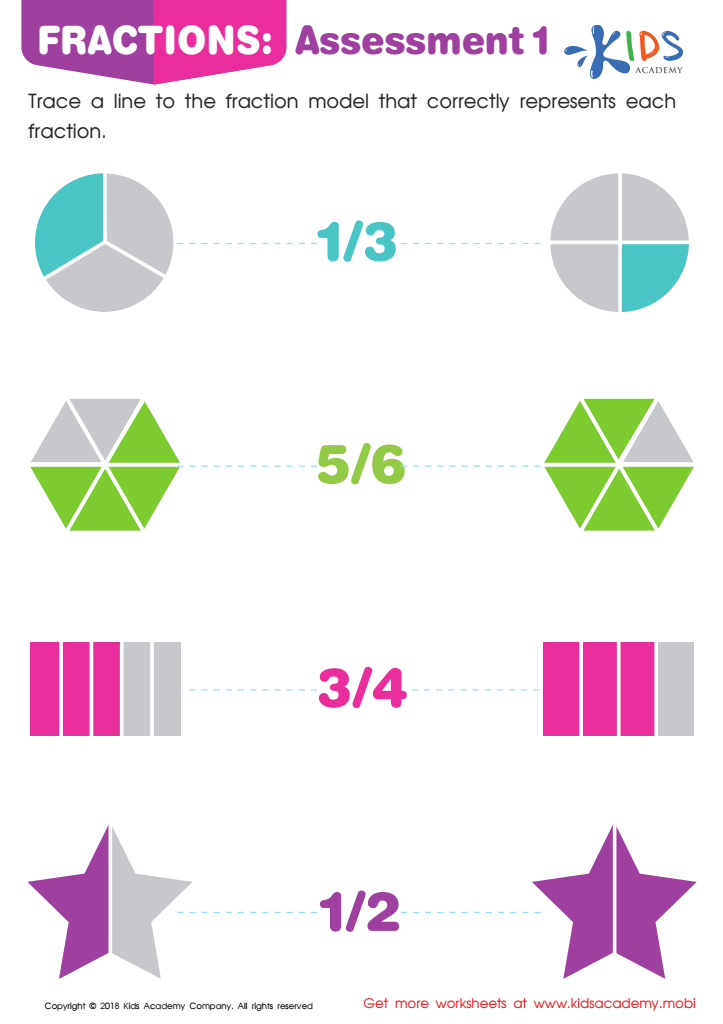
Fractions: Assessment 1 Worksheet
Master fractions easily with this worksheet! It has four sets of fraction models and fraction equations with two models each. Guide your kids to trace a line to the correct fraction model for each equation.
 Assign to My Students
Fractions: Assessment 1 Worksheet
Worksheet
Join Kids Academy for Free
Who is primarily going to use this learning content?



.jpg)




Understanding fraction subtraction for children aged 4-9 is crucial for several reasons. Early exposure to fractions and their operations lays a strong mathematical foundation. Fractions represent parts of a whole, a concept that translates to many real-world situations. Grasping the idea of subtracting fractions prepares children for more complex math topics they will encounter later in their education.
Developing fraction subtraction skills at a young age fosters critical thinking and problem-solving abilities. It enables children to approach problems methodically, improving their logical reasoning and analytical skills. Additionally, it enhances their numerical fluency and confidence with numbers and operations, essential for comprehensive mathematical understanding.
Moreover, learning fraction subtraction at an early age can make future learning experiences less intimidating. Consistently reinforcing these concepts can bridge the gap between concrete and abstract thinking, making it easier for children to grasp more advanced topics like algebra, geometry, and even everyday applications like cooking or managing money.
Finally, early education in such topics can identify and address potential learning gaps or difficulties, allowing for timely interventions. It ensures every child has the opportunity to excel academically and develop a positive attitude towards mathematics, fostering long-term academic success and a love for learning.








