
Practice problem-solving Worksheets for Ages 4-9
5 filtered results
Difficulty Level
Grade
Age
-
From - To
Subject
Activity
Standards
Discover our engaging practice problem-solving worksheets designed specifically for children ages 4 to 9. These worksheets foster critical thinking and creativity while helping young learners develop essential problem-solving skills. With colorful illustrations and age-appropriate activities, kids will enjoy tackling a variety of fun challenges that encourage logical reasoning and analytical thinking. Each worksheet supports early learning and cognitive development, providing a valuable resource for parents, teachers, and caregivers. Perfect for home practice or classroom use, our worksheets will empower your child to think independently and improve their confidence in tackling everyday problems. Unlock their potential with our fun, interactive resources!
Favorites
With answer key
Interactive
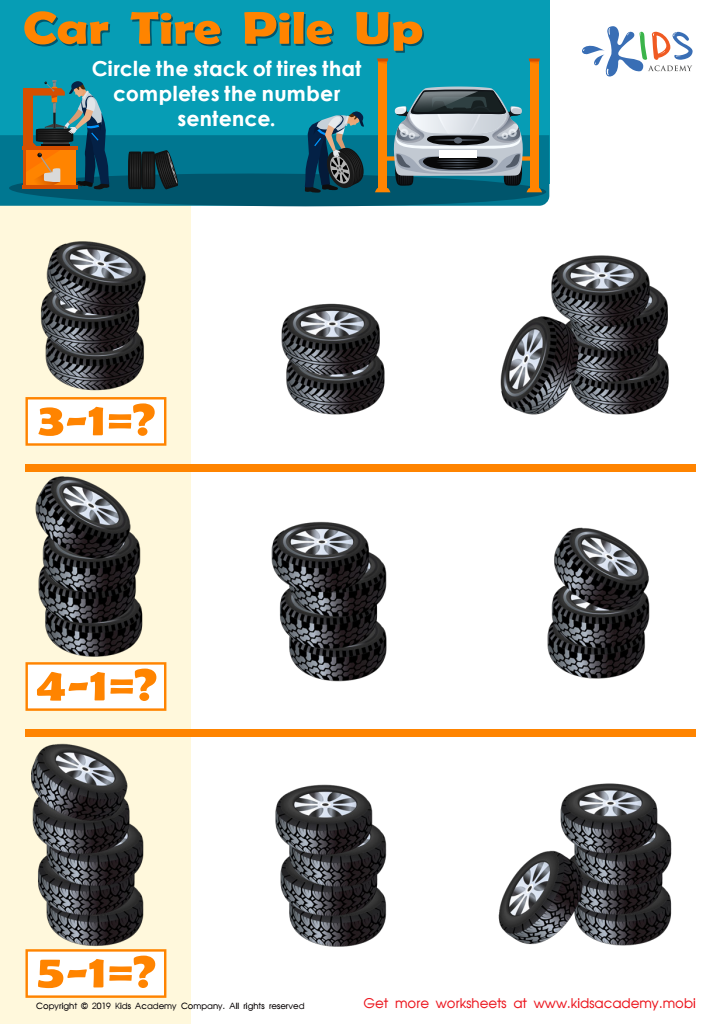
Car Tire Pile Up Worksheet
Examine the pic with your kids. Can they recognize the items piled up? The tires are organized in different quantities. Equations are on the left. Have your children work out the equations, counting the tire stacks to identify the correct answer.
 Assign to My Students
Car Tire Pile Up Worksheet
Worksheet
Join Kids Academy for Free
Who is primarily going to use this learning content?







Parents and teachers should prioritize problem-solving practice for children ages 4-9 because these foundational skills play a crucial role in overall development. At this young age, children's brains are developing rapidly, and fostering problem-solving abilities enhances critical thinking, creativity, and resilience. Engaging in problem-solving tasks encourages children to think independently and explore different solutions, which helps them build confidence in their reasoning.
Moreover, problem-solving skills are essential for academic success. Whether dealing with math challenges, language puzzles, or social interactions, children who practice these skills are typically better equipped to navigate various difficulties they encounter. This capability supports their emotional intelligence as they learn to assess situations, anticipate consequences, and make informed decisions.
In addition, integrating problem-solving activities into everyday learning, like games or hands-on projects, makes learning engaging and interactive. It nurtures collaboration and communication with peers, laying the groundwork for teamwork skills they will use throughout their lives. By prioritizing problem-solving, educators and caregivers foster lifelong learners, preparing children to face complex real-world challenges and instilling a sense of curiosity that motivates further exploration. Thus, investing in problem-solving practice is vital for holistic development and future success.








