
Solving word problems Worksheets for Ages 4-9
6 filtered results
Difficulty Level
Grade
Age
-
From - To
Subject
Activity
Standards
Unlock your child's potential with our Solving Word Problems Worksheets for Ages 4-9. Designed to enhance critical thinking and math skills, these worksheets offer engaging and age-appropriate word problems tailored to young learners. Our carefully crafted exercises help kids understand real-world math applications while fostering problem-solving techniques. With colorful visuals and relatable scenarios, children remain motivated and confident as they improve their reading comprehension and mathematical abilities. Ideal for both classroom and home learning, these worksheets are perfect tools to support your child's educational journey. Start their adventure in solving word problems today and see the incredible progress!
Favorites
With answer key
Interactive
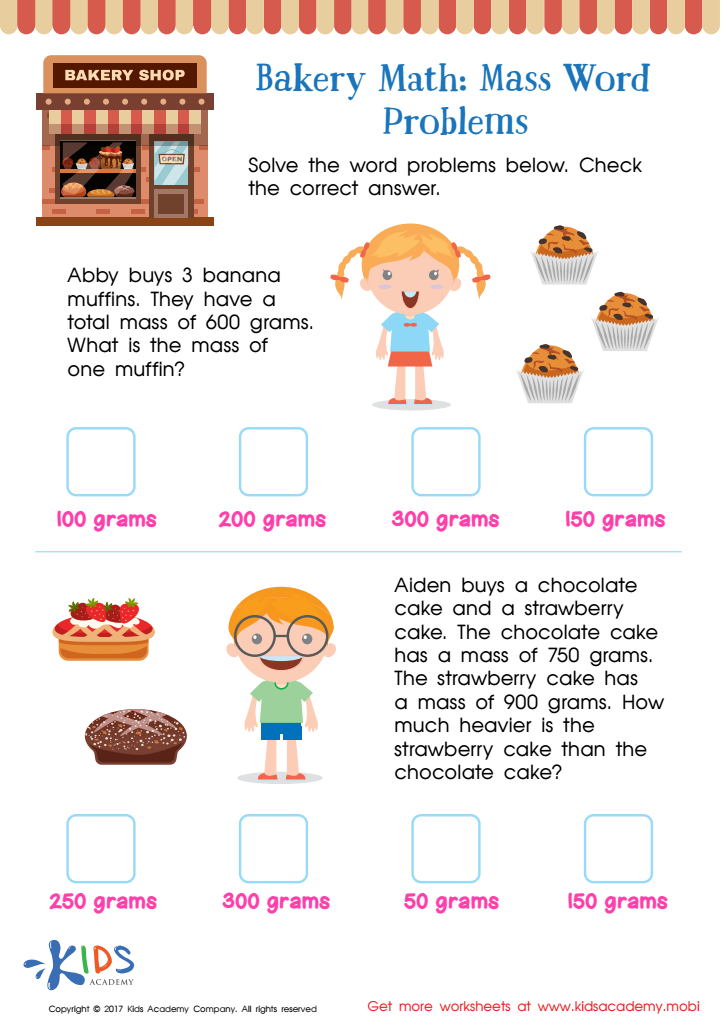
Mass Word Problems Worksheet
This worksheet challenges kids with tricky mass word problems. It offers valuable practice with grams. Through division and subtraction, children gain experience handling mass.
 Assign to My Students
Mass Word Problems Worksheet
Worksheet
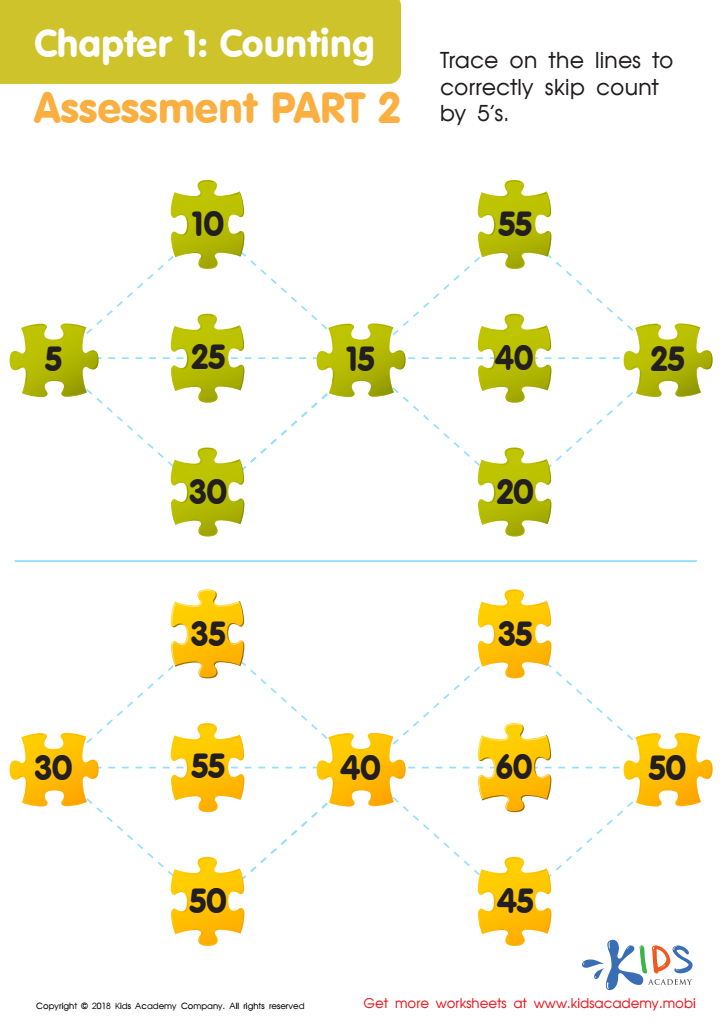
Counting: Assessment 2 Worksheet
By now, your child should be able to count up to the hundreds. If they're still learning the tens, that's okay - as long as they're going at their own pace. This worksheet will be easy if they can count to ten. Ask them to trace the lines and skip count by 5's.
Counting: Assessment 2 Worksheet
Worksheet
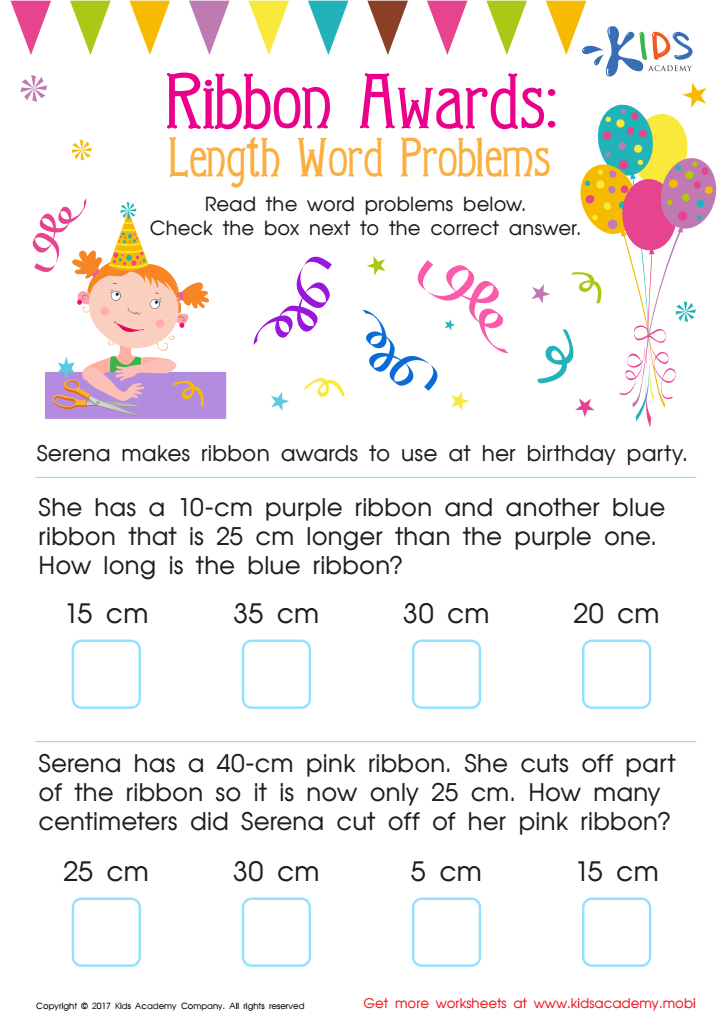
Length Word Problems Worksheet
Word problems help grade 2 students practice measurement using everyday scenarios. This worksheet provides practice in working with centimeters and inches, like measuring ribbon. It's a great way to learn and apply math skills.
Length Word Problems Worksheet
Worksheet
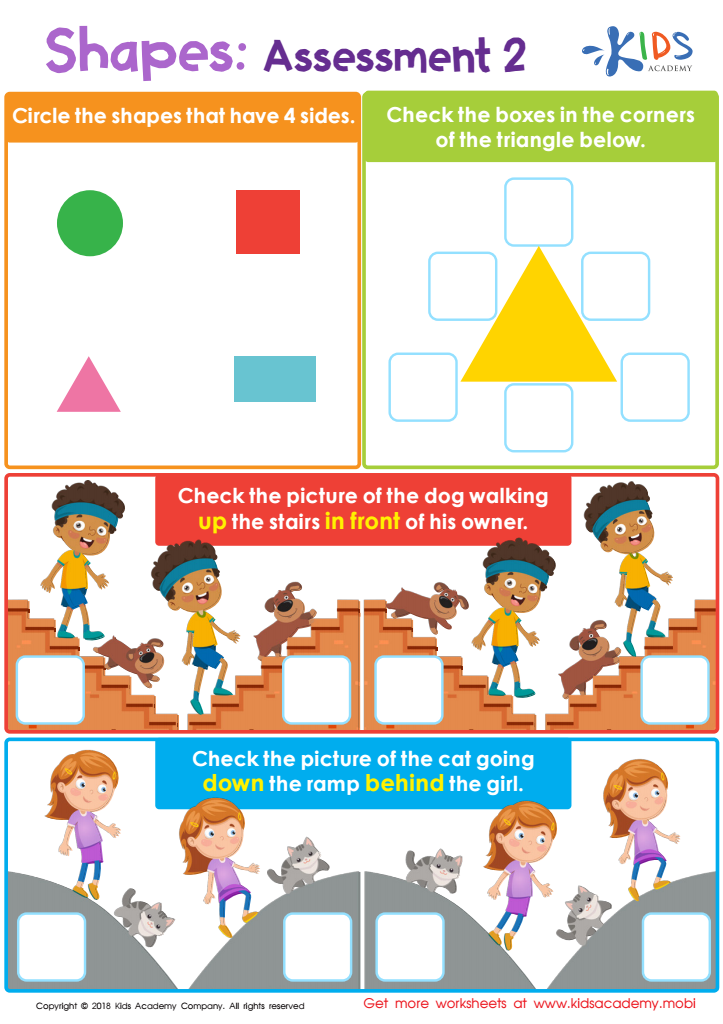
Shapes: Assessment 2 Worksheet
This geometry worksheet assesses a student's knowledge of shapes and positional words. They must identify shapes with 4 sides and corners on a triangle. The worksheet also tests understanding of words like "up", "front", "down" and "behind". Easily determine what your student knows about these concepts with this downloadable worksheet!
Shapes: Assessment 2 Worksheet
Worksheet
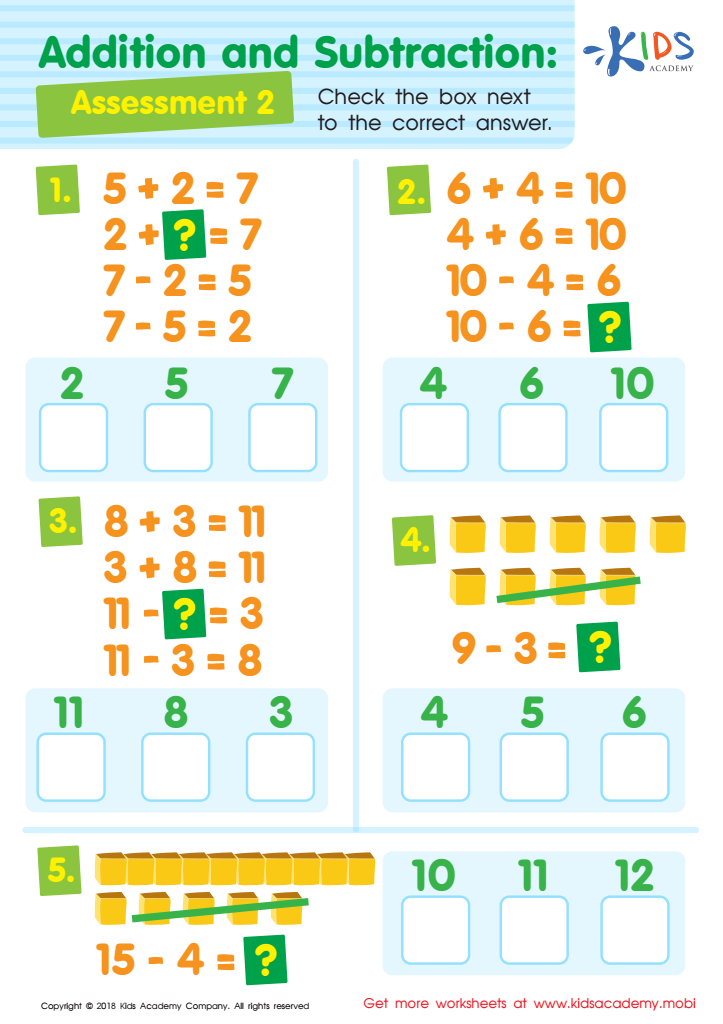
Addition and Subtraction Assessment 2 Worksheet
As your child grows, math problems become harder. To keep their brains active and provide extra help if needed, use this math worksheet. It'll help them become more familiar with equations. Go through each one carefully with your child and have them check the box next to the right answer.
Addition and Subtraction Assessment 2 Worksheet
Worksheet
Join Kids Academy for Free
Who is primarily going to use this learning content?








Parents and teachers should care about teaching children aged 4-9 how to solve word problems because it lays a critical foundation for future academic success and life skills. During early childhood, cognitive development is exceptionally rapid, making it a crucial time for developing problem-solving skills. Word problems teach children how to translate real-world situations into mathematical contexts, enhancing both their computational skills and their understanding of practical applications.
Solving word problems helps young learners develop critical thinking and reasoning abilities. It encourages them to think logically, analyze different elements of a problem, and devise effective strategies to find solutions. This promotes a deeper understanding of mathematical concepts beyond rote memorization, swimming them in problem-solving mindsets they'll use throughout life.
Additionally, word problems integrate literacy and numeracy, improving reading comprehension alongside mathematical skills. Children learn to identify key information, understand vocabulary in context, and follow multi-step processes, all of which are essential skills in other academic areas and everyday life.
For parents and teachers, fostering these abilities early better equips children to approach challenges with confidence and resilience. This proactive engagement not only enhances their educational journey but also supports emotional and social development, creating inquisitive, capable problem-solvers ready to tackle wider societal issues as they grow.








