Spatial awareness 2D Shapes Worksheets for Ages 4-9
3 filtered results
-
From - To
Discover our engaging Spatial Awareness 2D Shapes Worksheets for ages 4-9, designed to enhance young learners' understanding of shapes and their spatial relationships. These worksheets provide interactive activities that help children recognize, categorize, and manipulate 2D shapes while developing essential spatial awareness skills. Featuring colorful illustrations and age-appropriate challenges, our resources encourage hands-on learning and critical thinking. Ideal for classrooms or at-home practice, these worksheets not only support early math concepts but also foster creativity and problem-solving abilities. Join us in nurturing your child's mathematical foundation through fun and interactive shape exploration—perfect for budding mathematicians!
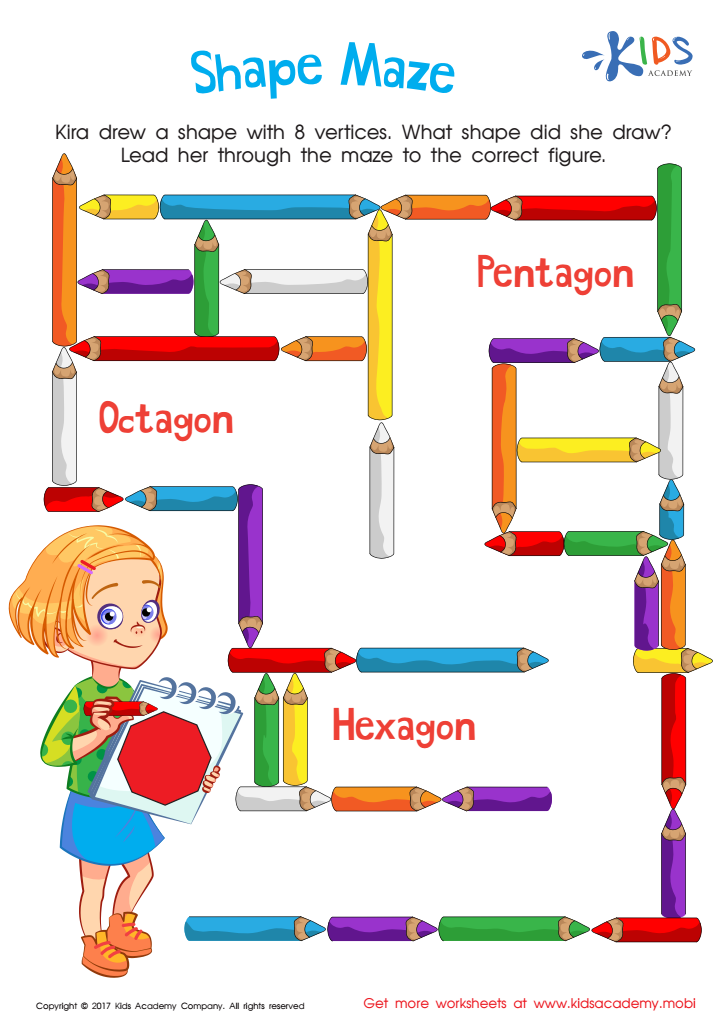
Shape Maze Worksheet
 Assign to My Students











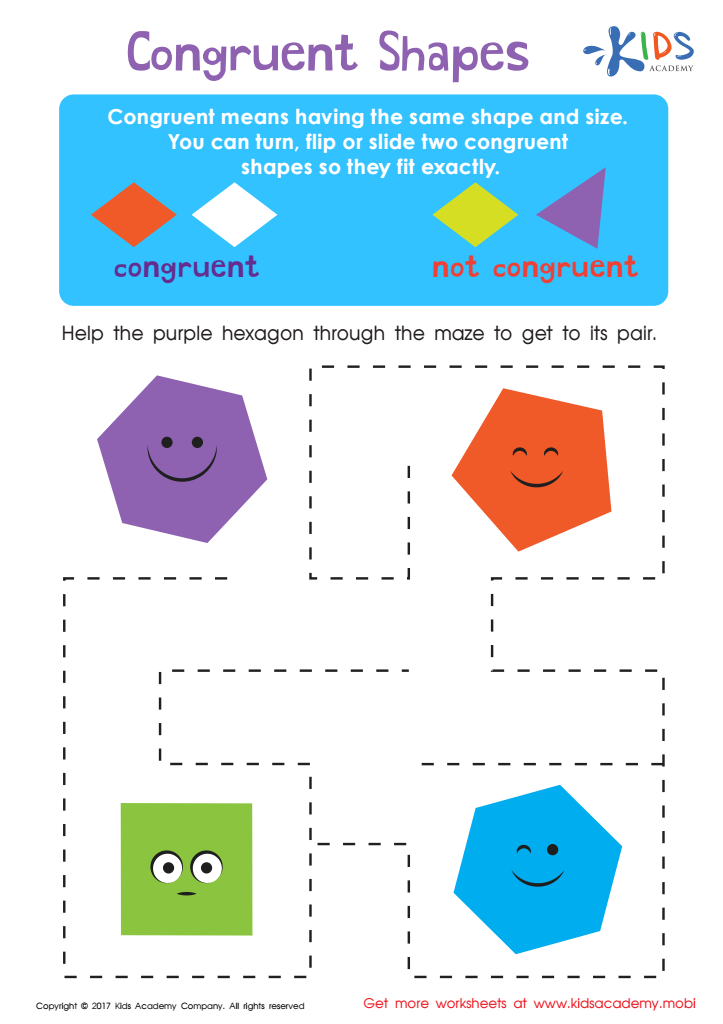
Congruent Shapes Worksheet
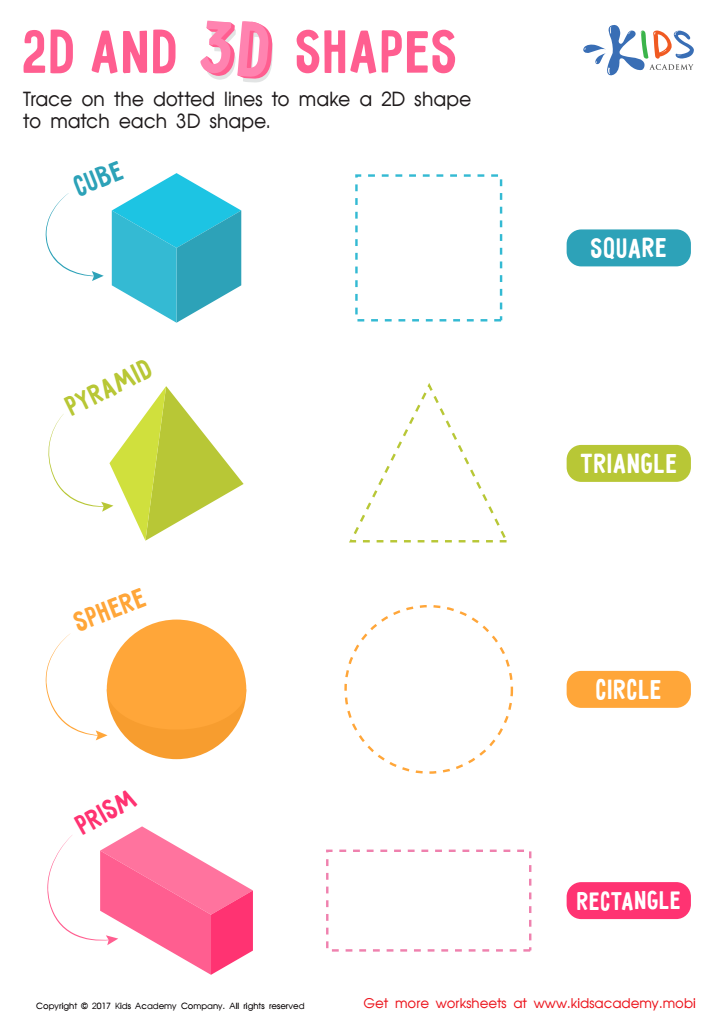
2D and 3D Shapes Worksheet








Spatial awareness and understanding of 2D shapes are crucial foundational skills for children ages 4-9. These skills play a vital role in their cognitive development and everyday life. Spatial awareness involves recognizing and interacting with objects in three-dimensional space, which is essential for tasks such as reading, writing, mathematics, and even physical activities.
Teaching spatial awareness helps children grasp concepts such as distance, direction, and the relationships between objects, enhancing their problem-solving abilities. For instance, when children recognize and categorize 2D shapes like circles, rectangles, and triangles, they build the basis for more advanced mathematical understanding, including geometry and algebra.
Additionally, spatial awareness contributes to fine motor skill development, enabling children to navigate their environment safely and confidently. It encourages creativity, as children learn to manipulate shapes in art projects or when building with blocks.
Parents and teachers should prioritize these skills not only to enhance academic performance but also to support emotional and social growth, as cooperative play often involves spatial awareness tasks. By fostering these essential skills, adults prepare children for future learning experiences, helping them become more successful learners and effective problem solvers.