Categorization skills Addition & Subtraction Worksheets for Ages 4-9
3 filtered results
-
From - To
Enhance your child's mathematical journey with our Categorization Skills Addition & Subtraction Worksheets, perfect for ages 4-9. These engaging worksheets are meticulously designed to improve essential math skills by blending creativity with learning. Young learners will enjoy categorizing various objects while mastering addition and subtraction concepts. This dual-focus approach not only reinforces mathematical abilities but also sharpens critical thinking and attention to detail. Ideal for both classroom settings and at-home practice, these worksheets offer a fun and educational experience. Help your child build a solid foundation in math with activities that inspire and challenge them!
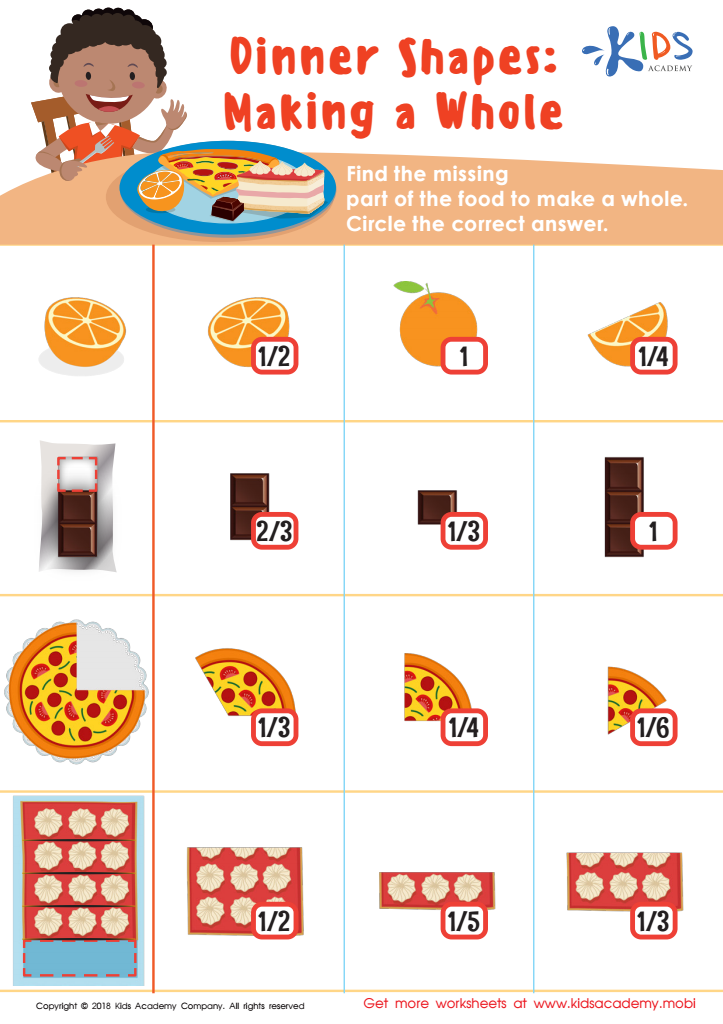
Dinner Shapes: Making a Whole Worksheet
 Assign to My Students
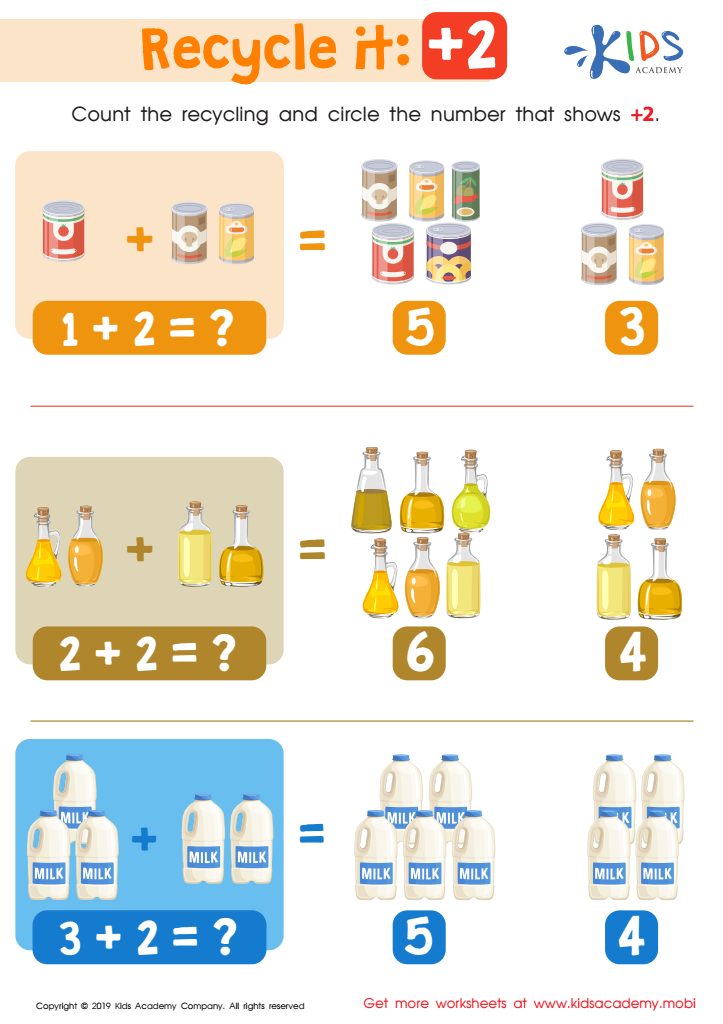
Recycle It: +2 Worksheet








Parents and teachers should care deeply about categorization skills and basic arithmetic, such as addition and subtraction, for children aged 4-9 because these are foundational components of cognitive and mathematical development.
Categorization skills allow children to organize information systematically, which enhances memory retention, problem-solving agility, and the ability to understand complex concepts later on. This is crucial in early education, as it sets the stage for academic success across various subjects. For instance, by learning to group objects by size, shape, or color, children improve their sorting, deduction, and critical thinking capabilities.
Parallelly, addition and subtraction are among the earliest forms of arithmetic that children encounter, forming the backbone for all future math learning, including concepts of multiplication, division, and beyond. Proficiency in these basic operations fosters number sense, helps children understand the relationships between quantities, and instills confidence in their ability to tackle more advanced mathematical problems. This early mastery also promotes logical reasoning and analytical skills.
Therefore, integrating engaging, hands-on activities that foster these abilities is essential. A blend of categorization tasks and simple arithmetic exercises tailored to this young age group lays down a robust foundation for lifelong learning and intellectual development. Investing time and effort in these areas cultivates a well-rounded, competent learner who is prepared for the academic challenges ahead.








