
Mathematical skills Addition & Subtraction Worksheets for Ages 4-9
3 filtered results
Difficulty Level
Grade
Age
-
From - To
Subject
Activity
Standards
Unlock the potential of young minds with our Addition & Subtraction Worksheets designed for children aged 4-9. Tailored to enhance mathematical skills, these engaging worksheets from Kids Academy offer a fun and interactive way to learn. From simple sums to challenging problems, each sheet builds confidence and competency in basic math operations. Perfect for home or classroom use, our worksheets make learning enjoyable with colorful illustrations and age-appropriate exercises. Empower your child’s education journey and watch their skills grow with our expertly crafted materials. Download and print today for a seamless blend of fun and learning!
Favorites
With answer key
Interactive
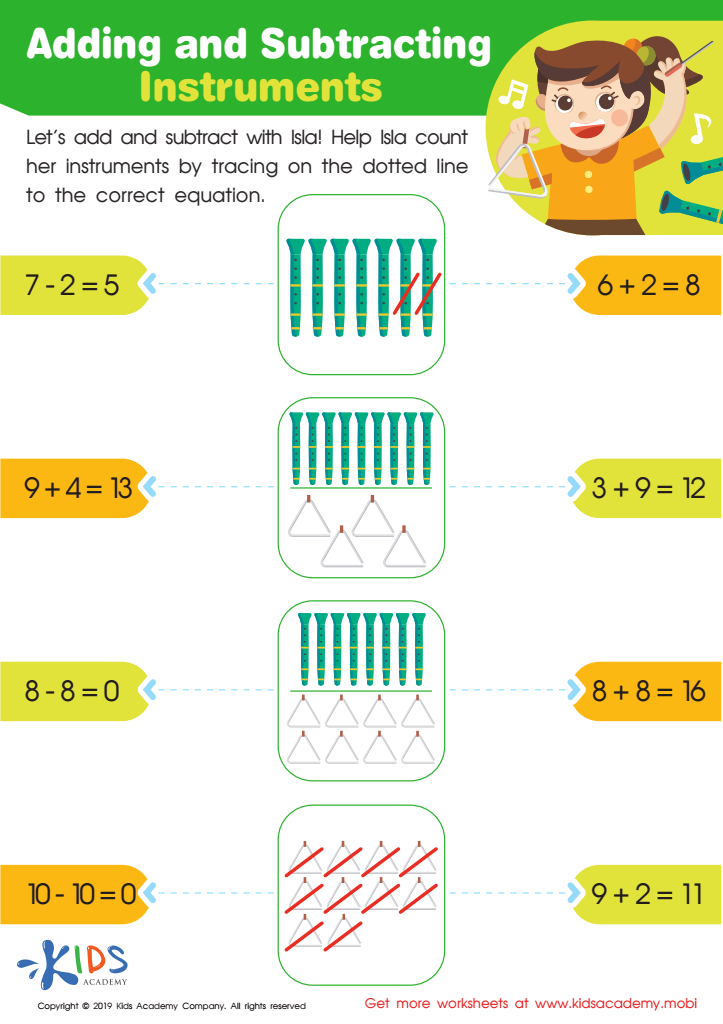
Adding and Subtracting: Instruments Worksheet
Children can help Isla count her musical instruments with this fun worksheet. The downloadable PDF gives them a chance to practice addition and subtraction by connecting pictures to equations. It's also a great way to learn the order of operations.
 Assign to My Students
Adding and Subtracting: Instruments Worksheet
Worksheet
Join Kids Academy for Free
Who is primarily going to use this learning content?








Mathematical skills, particularly addition and subtraction, are crucial for children ages 4-9 because they lay a foundational framework for more complex mathematical concepts and everyday problem-solving. At this young age, children are highly absorbent and most receptive to learning new skills. Introducing and reinforcing addition and subtraction helps develop their cognitive abilities, critical thinking, and numerical literacy.
Firstly, addition and subtraction are not just operations; they are essential for understanding the concepts of quantity, relationship, and change. These skills support children's ability to measure, categorize, and prioritize information, which is useful not only in advanced mathematics but also in everyday life activities, like understanding money, time, and even basic decision-making.
In addition to cognitive development, mastering these skills significantly bolsters children's confidence. Early success in math can foster a positive attitude towards the subject, leading to sustained interest and better academic performance over time. Moreover, children with a solid grasp of basic math are better prepared to tackle other subjects, such as science and technology, which are increasingly important in the modern world.
Finally, strong mathematical skills in early childhood are linked to better academic trajectories, opening doors to greater educational and career opportunities in the future. Parents and teachers play a pivotal role in nurturing these essential skills by creating a supportive and stimulating learning environment, using real-life examples, and encouraging a curious and problem-solving attitude.








