
Word Recognition Addition & Subtraction Worksheets for Ages 4-9
5 filtered results
Difficulty Level
Grade
Age
-
From - To
Subject
Activity
Standards
Discover engaging Word Recognition Addition & Subtraction Worksheets tailored for children aged 4-9! These printable resources are designed to enhance young learners' math skills while fostering vocabulary development. By integrating word recognition with fundamental addition and subtraction concepts, kids will practice solving math problems through fun, relatable scenarios. The easy-to-follow worksheets cater to various learning styles, allowing educators and parents to support academic growth effectively. Perfect for classroom use or at-home learning, these worksheets provide a fun way for children to build confidence and improve their problem-solving abilities. Boost your child's learning journey today with these interactive and educational resources!
Favorites
With answer key
Interactive
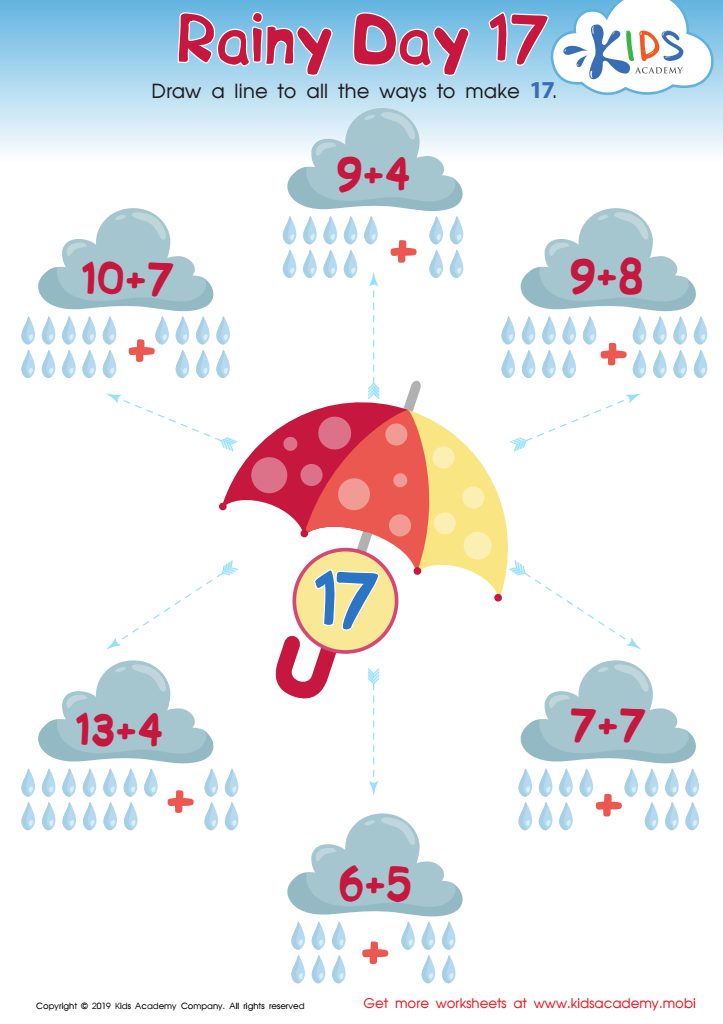
Rainy Day 17 Worksheet
Assist your kids with the 6 equations given. Each cloud displays the sum of two numbers, some of which make 17. Guide them to figure out the total of both numbers when added and draw a line to the umbrella in the center to illustrate the different ways to make 17. This activity will sharpen their addition skills.
 Assign to My Students
Rainy Day 17 Worksheet
Worksheet
Join Kids Academy for Free
Who is primarily going to use this learning content?








Word recognition in the context of addition and subtraction is crucial for children aged 4-9, as it significantly impacts their mathematical development and literacy skills. At this formative age, children are discovering language patterns and their meanings, which parallels their understanding of mathematical concepts. Mastery of word problems forms an essential foundation for problem-solving, fostering cognitive skills that extend beyond math.
When children can recognize and comprehend the wording in mathematical problems, they learn to translate verbal information into numerical expressions. This ability boosts their confidence and independence in solving math problems, making them more successful in evaluations and real-world applications. Additionally, exposure to word recognition in mathematics encourages critical thinking and comprehension skills, which are vital as children progress in their education.
For parents and teachers, encouraging word recognition alongside addition and subtraction cultivates a holistic educational approach. It equips children with the tools they need to tackle more complex concepts in the future. Ensuring children have the foundational skills in both math and language will ultimately contribute to their overall academic success, increasing their enjoyment in learning and their readiness for advanced education challenges. Prioritizing these skills sets the stage for strong, lifelong analytical abilities.








