Enhance problem-solving ability Math Worksheets for Ages 4-9
3 filtered results
-
From - To
Boost your child's problem-solving skills with our engaging Math Worksheets designed for ages 4-9! These interactive worksheets offer a variety of fun and challenging activities that encourage critical thinking and logical reasoning. Tailored to different learning levels, they cover essential math concepts such as addition, subtraction, patterns, and shapes. With vivid illustrations and imaginative scenarios, children will enjoy exploring math in a playful manner. Perfect for at-home learning or supplementary practice, our worksheets aim to enhance math proficiency while fostering a love for learning. Download and watch your child thrive in their problem-solving abilities today!
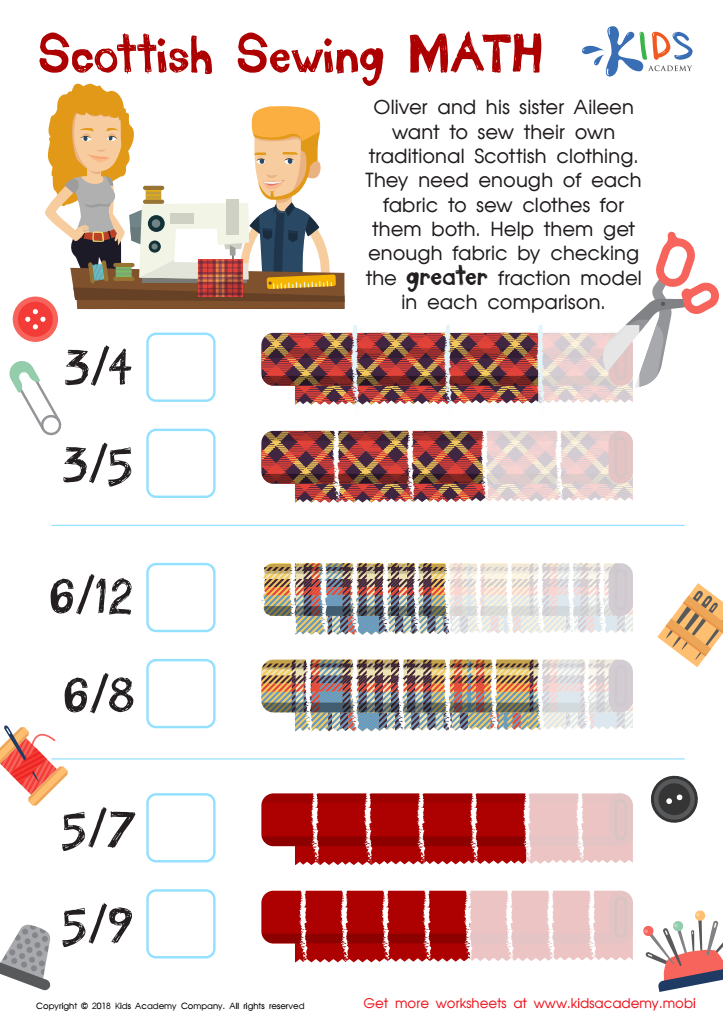
Scottish Sewing Math Worksheet
 Assign to My Students
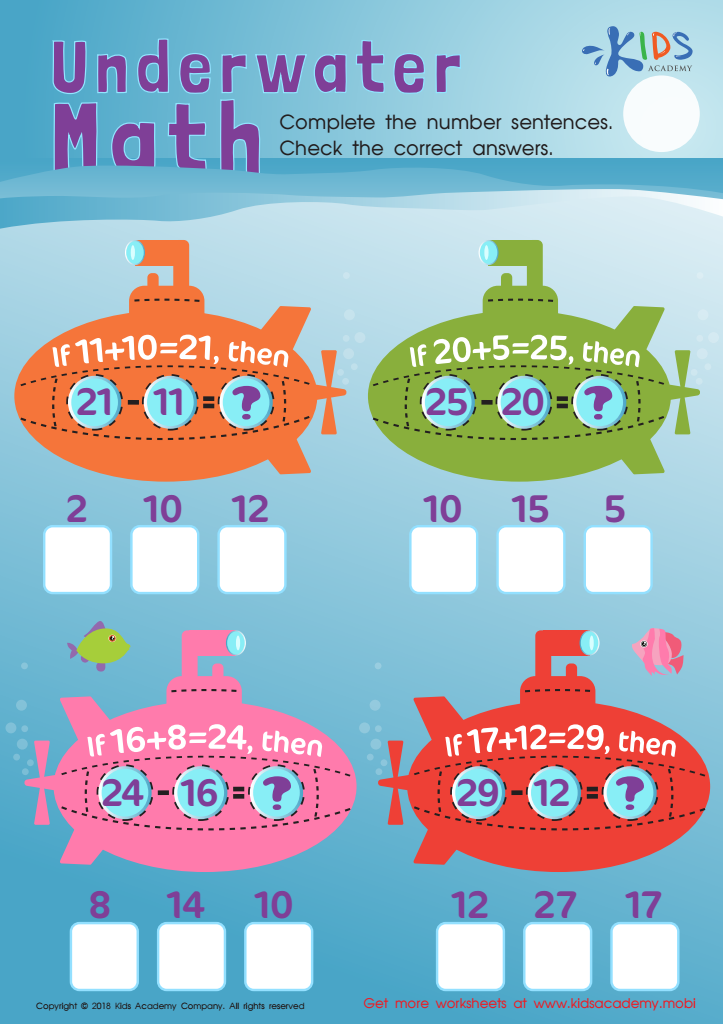
Addition and Subtraction: Underwater Math Worksheet







.jpg)
Enhancing problem-solving ability in mathematics for children aged 4-9 is essential for their cognitive development and future academic success. At this critical stage, children are developing foundational skills that shape their understanding of numbers and mathematical concepts. Engaging with mathematical problem-solving activities fosters logical thinking, creativity, and perseverance, which are crucial not only in math but across all subjects and real-life scenarios.
Moreover, when children learn to approach problems methodically, they develop a sense of confidence in their abilities. This boosts their self-esteem and encourages a growth mindset—a belief that they can improve through effort and practice. By involving parents and teachers in this process, children receive consistent support and encouragement, which reinforces their learning experiences.
Additionally, developing problem-solving skills early helps children learn how to navigate everyday challenges, whether calculating the total cost of items while shopping or estimating time for daily activities. Ultimately, enhancing problem-solving abilities in math equips children with essential life skills, laying the foundation for future learning and problem-solving success that goes beyond the classroom. Parents and teachers thus play a pivotal role in nurturing these skills during these formative years.








