Visual-motor skills Math Worksheets for Ages 4-9
5 filtered results
-
From - To
Enhance your child's learning experience with our Visual-Motor Skills Math Worksheets designed for ages 4-9. These engaging worksheets promote the development of essential visual-motor coordination while reinforcing foundational math concepts. Through fun activities such as tracing, coloring, and interactive exercises, kids will sharpen their fine motor skills and improve hand-eye coordination, all while mastering early math skills. Ideal for home or classroom use, our worksheets ensure that children enjoy learning while building confidence in their abilities. Explore our collection to provide your child with the tools they need for academic success and a love for learning! Download and get started today!
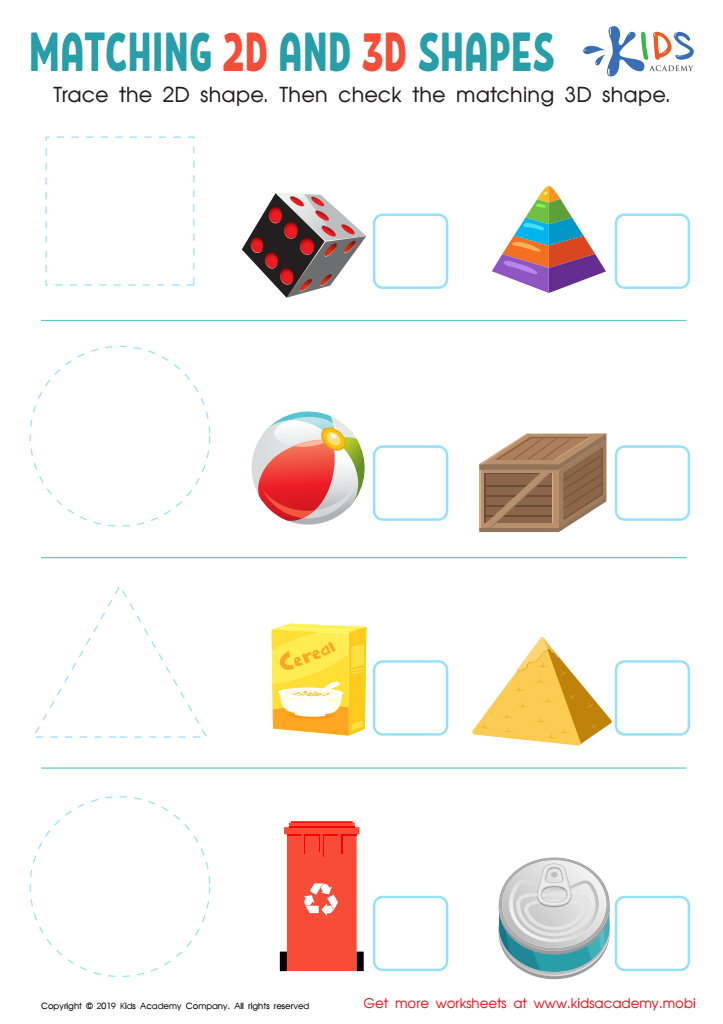
Matching 2D and 3D Shapes Worksheet
 Assign to My Students








Visual-motor skills are essential for children ages 4-9, particularly in their mathematical development. These skills integrate visual input with motor coordination, enabling kids to perform tasks such as writing numbers, using rulers, and engaging with manipulatives. Understanding math concepts often requires children to visualize problems and translate those estimates onto paper or digital interfaces.
For parents and teachers, emphasizing visual-motor skills in math education is crucial for several reasons. First, children with strong visual-motor coordination can better handle tasks involving spatial awareness and measurement, which are foundational in mathematics. Without these skills, students may struggle with basic operations, leading to frustration and diminished self-esteem.
Moreover, fostering visual-motor skills can enhance students' overall learning experiences, allowing them to engage more confidently in collaborative activities like group projects, where they might draw diagrams or make presentations. It prepares them for advanced subjects where visualization plays a key role, including geometry and algebra.
By supporting the development of visual-motor skills, parents and teachers help cultivate a solid mathematical foundation, promoting a persistent interest in learning and equipping children with critical skills that benefit them well beyond the classroom. Investing time and resources in this area leads to long-term academic success and personal growth.








