
Fine Motor Skills Multiplication Worksheets for Ages 4-9
3 filtered results
Difficulty Level
Grade
Age
-
From - To
Subject
Activity
Standards
Enhance your child's fine motor skills while introducing them to multiplication with our engaging worksheets designed for ages 4-9. These thoughtfully crafted activities promote hand-eye coordination and dexterity through fun, hands-on multiplication exercises, making math learning interactive and enjoyable. With challenges such as tracing numbers, coloring patterns, and cutting shapes, your little ones will strengthen their pencil grip and coordination abilities. Tailored to spark curiosity and encourage exploration, our fine motor skills multiplication worksheets seamlessly blend essential math concepts with creative, skill-building tasks. Explore our collection today to support your child's development in a playful and effective way!
Favorites
With answer key
Interactive
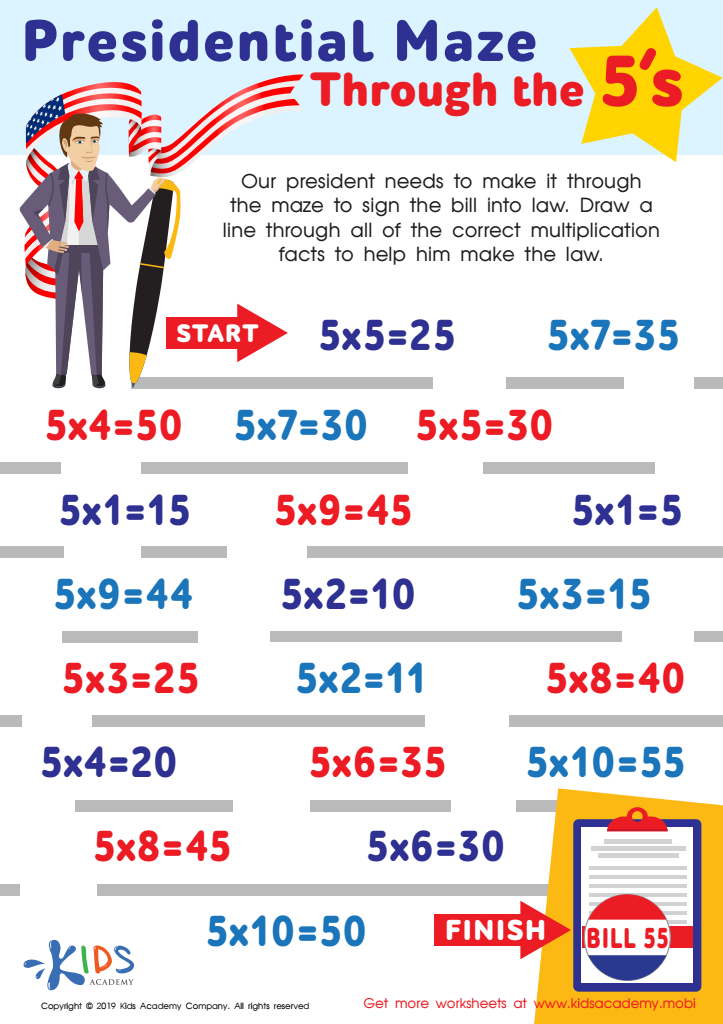
Presidential Maze Through the 5’s Worksheet
Help your kids draw a line through the right multiplication facts to guide the state's President to sign the bill into law. This is a big responsibility - the President has been elected to make decisions on behalf of the people and has the power to make laws and sign them.
 Assign to My Students
Presidential Maze Through the 5’s Worksheet
Worksheet
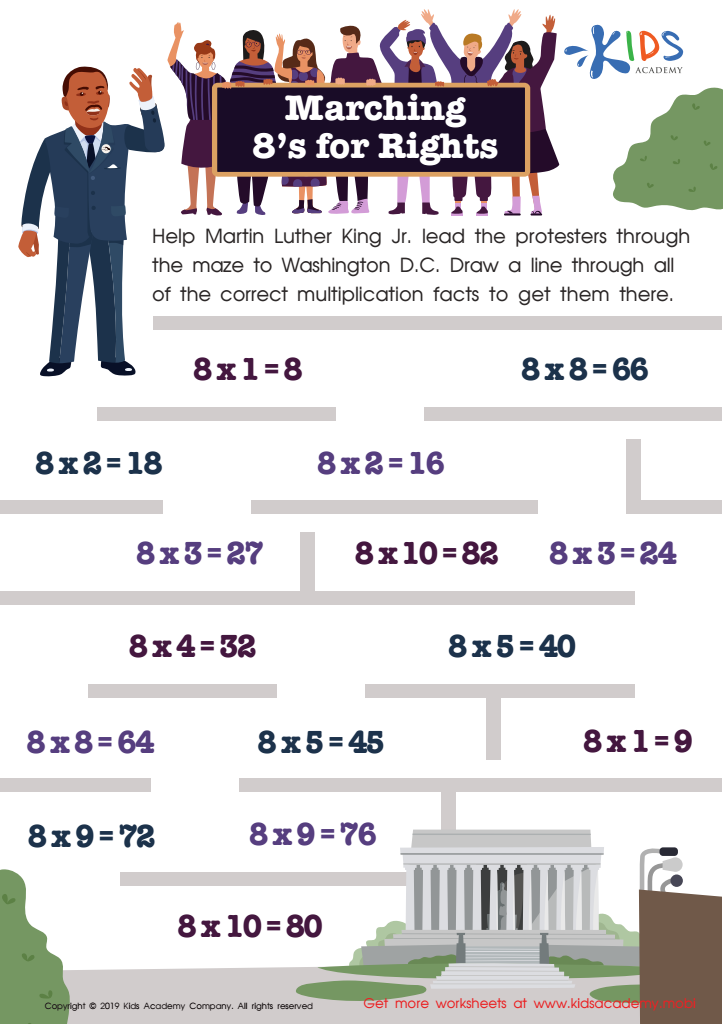
Marching 8’s for Rights Worksheet
Encourage your students to explore MLK's history! This worksheet provides the perfect opportunity. Help them understand his contributions by having them "march" MLK from the starting point to Washington D.C. Have them draw a line through the correct multiplication facts to get there. It's an enjoyable way for kindergartners to learn about a key part of history.
Marching 8’s for Rights Worksheet
Worksheet
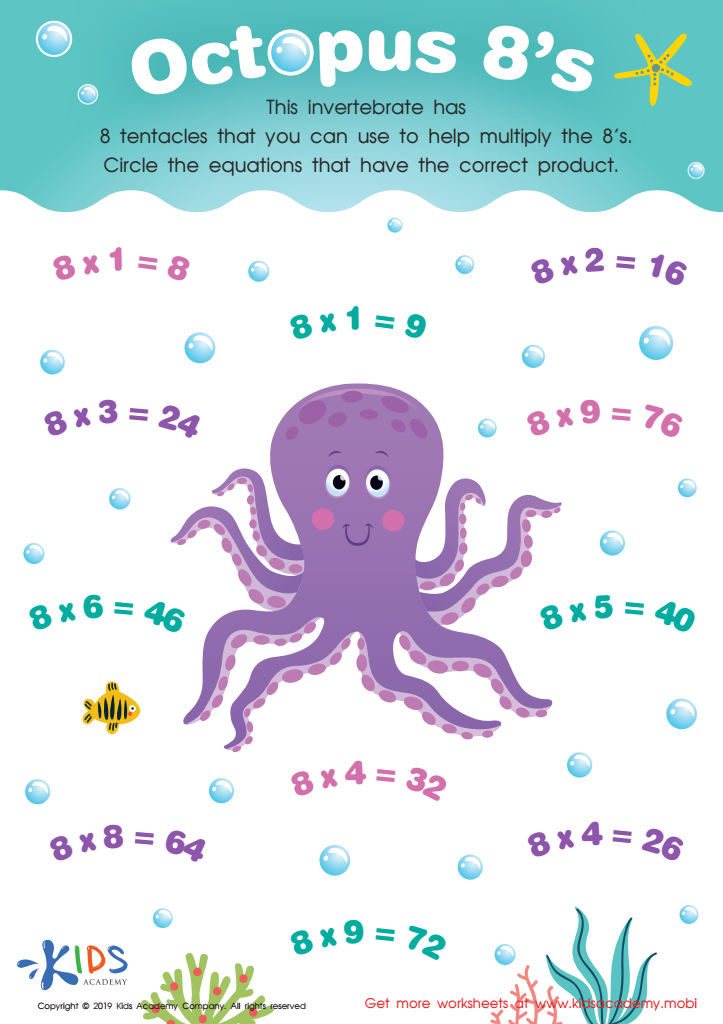
Octopus 8’s Worksheet
Can your child identify the octopus in the worksheet? It's an invertebrate with 8 tentacles. Have your child circle the equations with the correct products, and see if they can tell you some other features of the octopus too.
Octopus 8’s Worksheet
Worksheet
Join Kids Academy for Free
Who is primarily going to use this learning content?








Fine motor skills are essential for young children as they lay the groundwork for many everyday activities, from writing to self-care. Multiplication,, while often considered a cognitive task, can actually be supported through engaging fine motor activities as well. At ages 4-9, children are developing their hand-eye coordination, dexterity, and control, which are integral to their overall learning process.
By fostering fine motor skills through multiplications, teachers and parents can create engaging learning experiences. For instance, using manipulatives like beads or blocks can make multiplication tangible and interactive, blending physical engagement with mathematical concepts. As children handle objects, they enhance their dexterity—permitting them to excel in writing and drawing later.
Moreover, strong fine motor abilities can boost a child’s confidence and motivation. Children who feel competent in physical tasks often carry that confidence into academic areas, including math. Thus, supporting fine motor skills in the context of multiplication not only strengthens mathematical understanding but culminates in well-rounded developmental progress. Promoting these skills should actively be a holistic part of early education, empowering children to tackle more complex tasks as they grow. In essence, supporting fine motor skills is an investment in a child's future academic success.








