
Observational skills Addition & Subtraction Worksheets for 4-Year-Olds
3 filtered results
Difficulty Level
Grade
Age
-
From - To
Subject
Activity
Standards
Enhance your 4-year-old's observational skills with our engaging Addition & Subtraction Worksheets! Designed specifically for young learners, these activities provide a fun and interactive way for children to develop essential early math skills. Through colorful visuals and relatable examples, kids will practice recognizing quantities, comparing numbers, and performing simple addition and subtraction tasks. Our worksheets encourage critical thinking as they learn to observe and make connections between numbers and objects. Perfect for homeschooling, preschool, or supplementary learning, these resources promote early mathematical understanding while fostering a love for learning. Discover the joy of math with our thoughtfully designed worksheets today!
Favorites
With answer key
Interactive
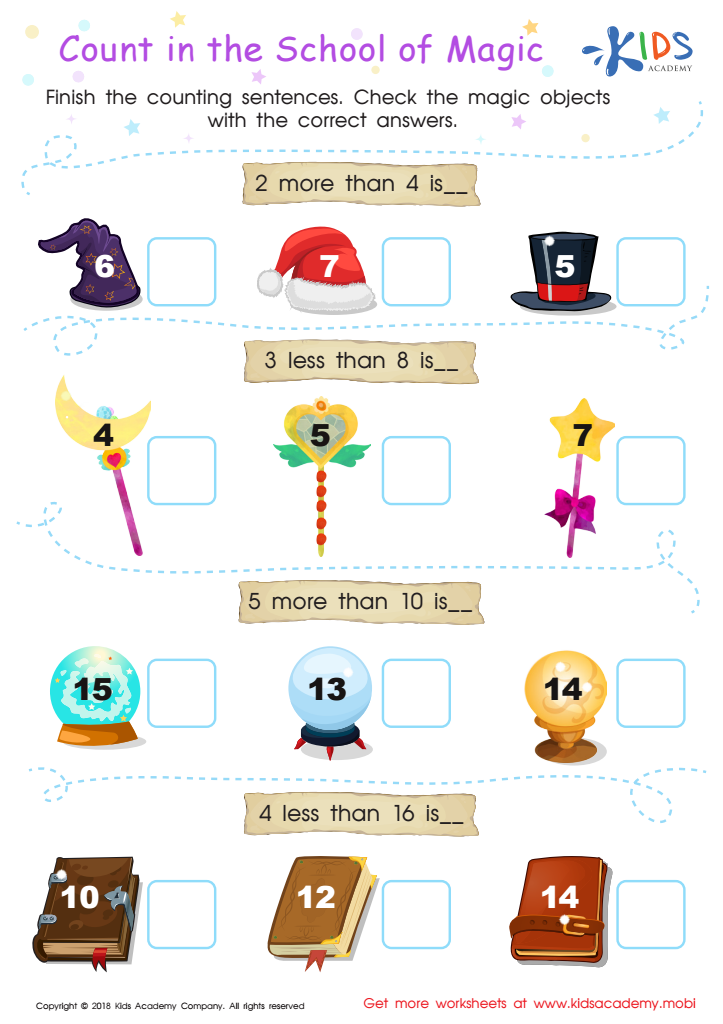
Count in the School of Magic Worksheet
Your math learners can explore the School of Magic with this worksheet. They'll read equations with addition and subtraction numbers under 20, count back and forth to find the answer, then complete the counting sentences. Fun pictures and easy accuracy make it an enjoyable and successful learning experience.
 Assign to My Students
Count in the School of Magic Worksheet
Worksheet
Join Kids Academy for Free
Who is primarily going to use this learning content?








Observational skills in young children, particularly related to addition and subtraction, hold significant importance for parents and teachers alike. At the age of four, children's cognitive development is rapidly advancing; thus, fostering their observational skills can enhance their overall learning capabilities. By recognizing patterns, quantities, and numerical relationships in their environment, children develop a foundational understanding of math concepts.
Firstly, observational skills enable young learners to engage with their surroundings more meaningfully, allowing them to see math in everyday situations—whether counting toys, distributing snacks, or arranging objects. This experiential learning makes abstract concepts like addition and subtraction more relatable and easier to grasp.
Moreover, employing observational skills in basic math promotes critical thinking, as children begin to reason about space, quantity, and problem-solving. This cognitive engagement lays the groundwork for future mathematical skills.
Finally, incorporating these skills strengthens parent-teacher collaboration, as adults can model and encourage observation in various daily activities. By valuing observational skills in addition and subtraction, caregivers contribute to a more enriching educational experience, ultimately fostering a child's confidence and enthusiasm for learning. Hence, paying attention to this aspect of early education is vital for nurturing capable and well-rounded learners.








