Understanding number bonds Worksheets for Ages 5-7
3 filtered results
-
From - To
Explore our engaging "Understanding Number Bonds Worksheets for Ages 5-7," specially designed to develop young learners' mathematical foundations. These interactive worksheets offer a fun and effective way for children to grasp the concept of number bonds, essential for building addition and subtraction skills. With vibrant illustrations and age-appropriate exercises, kids will enjoy hands-on practice while enhancing their problem-solving abilities. Our resources cater to various learning styles, ensuring every child can engage with the content meaningfully. Help your child become confident in mathematics as they discover the connections between numbers. Start their journey to numerical literacy today!
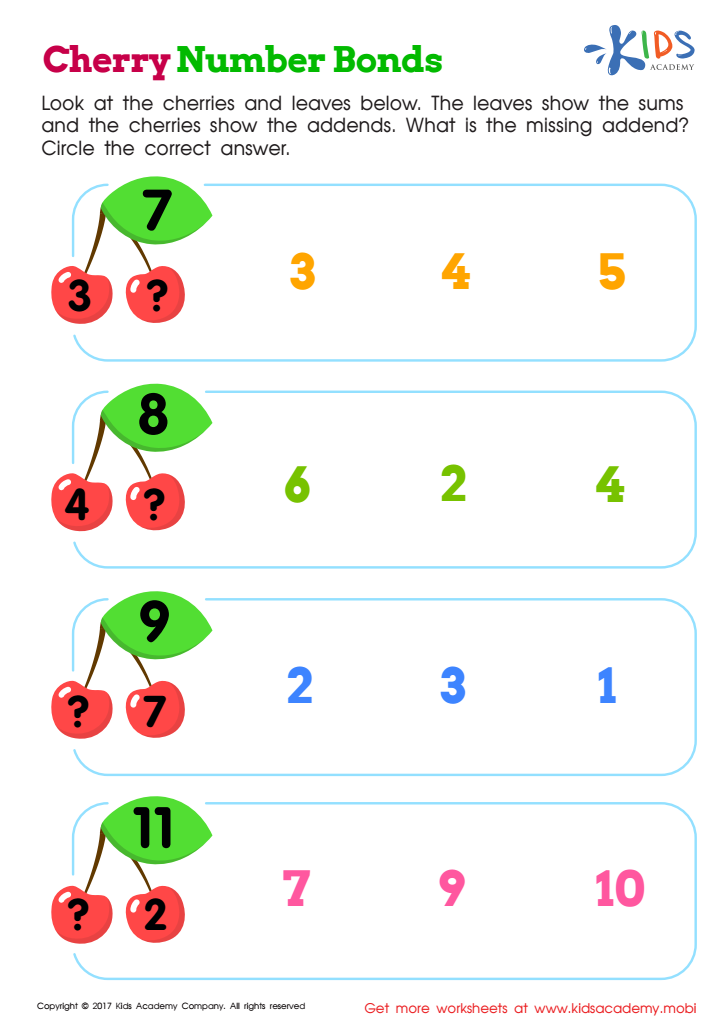
Cherry Number Bonds Worksheet
 Assign to My Students
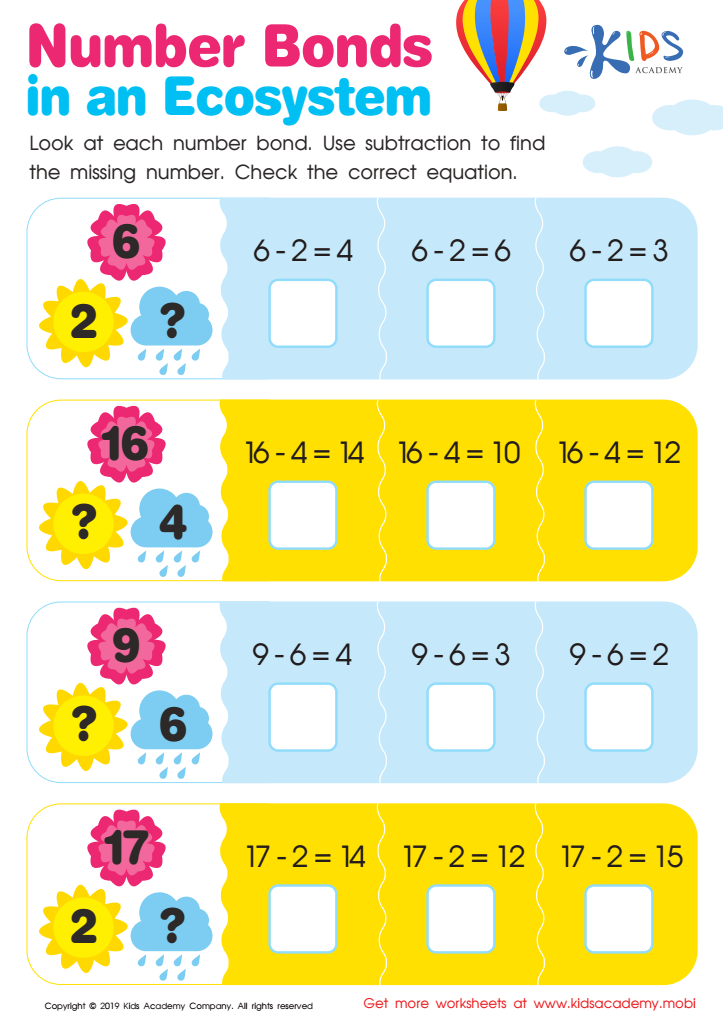
Number Bonds in an Ecosystem Worksheet
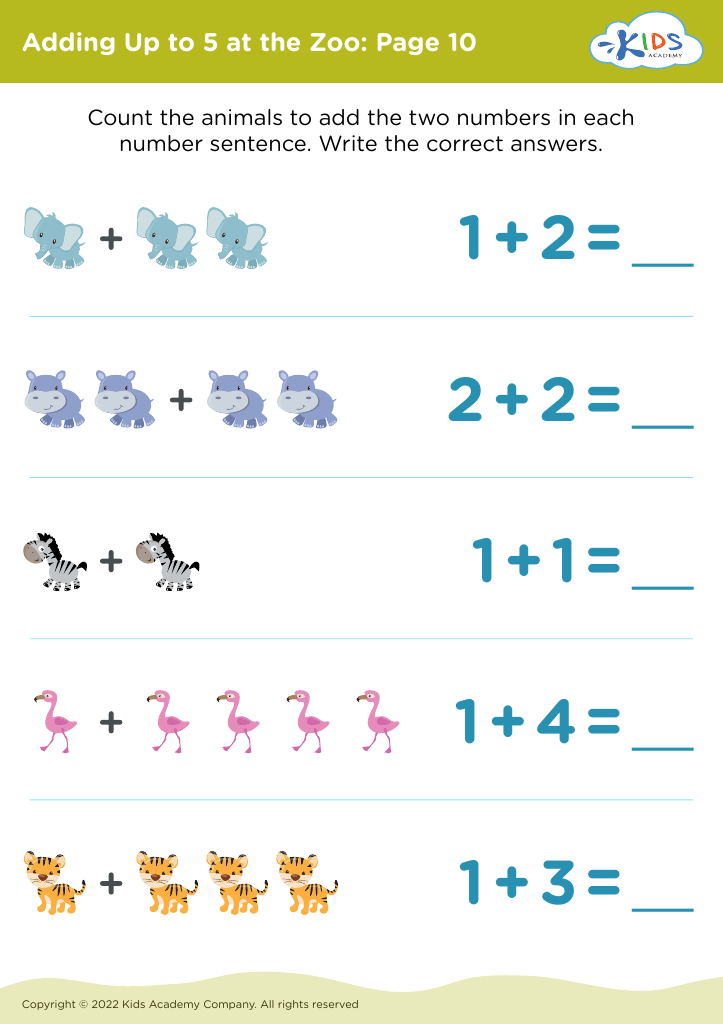








Understanding number bonds is essential for children aged 5-7 as it forms the basis for their mathematical development. Number bonds represent the relationship between numbers, showing how they combine and break apart. For example, knowing that 3 + 2 = 5 allows children to understand not only addition but also subtraction, creating a strong foundation for arithmetic.
Parents and teachers should care about number bonds because they foster an early understanding of mathematical concepts. Children who grasp these relationships can solve problems more efficiently and approach new topics with confidence. This foundational knowledge also promotes mental math skills, enabling kids to perform calculations without relying on paper or digital tools, which is crucial for more complex math later on.
Moreover, when children learn number bonds, they build critical thinking skills and the ability to make connections, which are important not just in math but across all subjects. Engaging with number bonds in fun and interactive ways can motivate children and enhance their love for learning.
Ultimately, investing time in teaching number bonds equips young learners for future success in math and helps them develop a positive attitude toward the subject, promoting lifelong learning.








