Understanding number values Adding Up to 5 Worksheets for Ages 5-7
3 filtered results
-
From - To
Introduce young learners to basic math with our "Understanding Number Values Adding Up to 5 Worksheets" for ages 5-7. These fun, engaging worksheets help children grasp fundamental math concepts, including addition, number recognition, and counting. Designed to support early math skills, each worksheet features colorful visuals and interactive exercises to make learning exciting and effective. Perfect for both classroom and home use, these resources foster confidence and a strong foundation in mathematics. Download now and watch as your little ones master the basics while enjoying every moment of their educational journey.
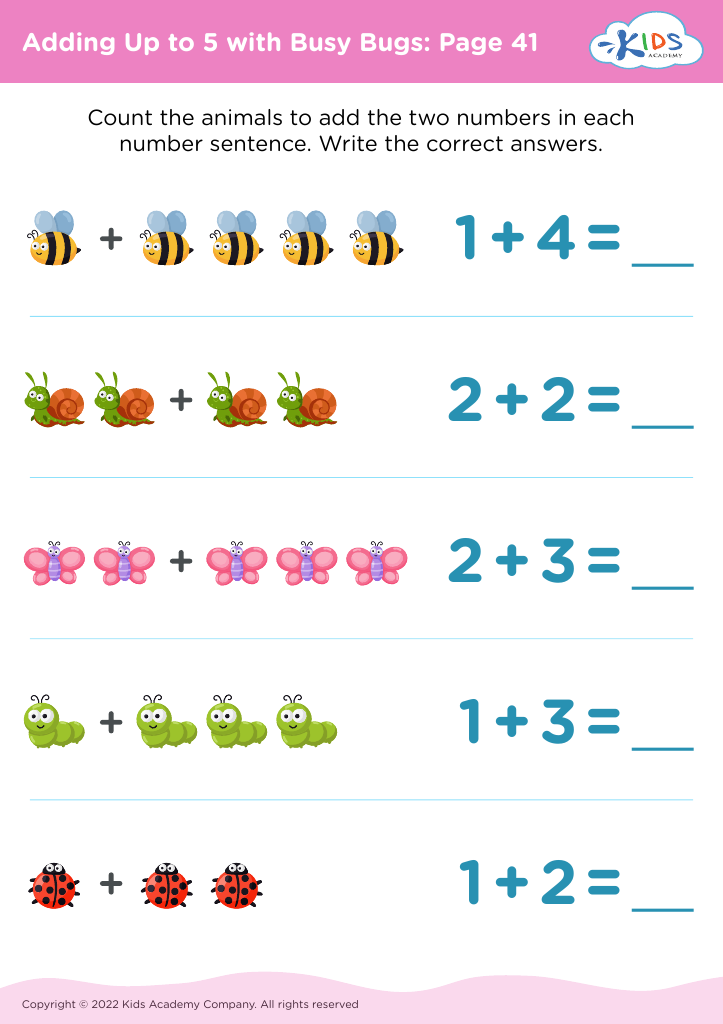
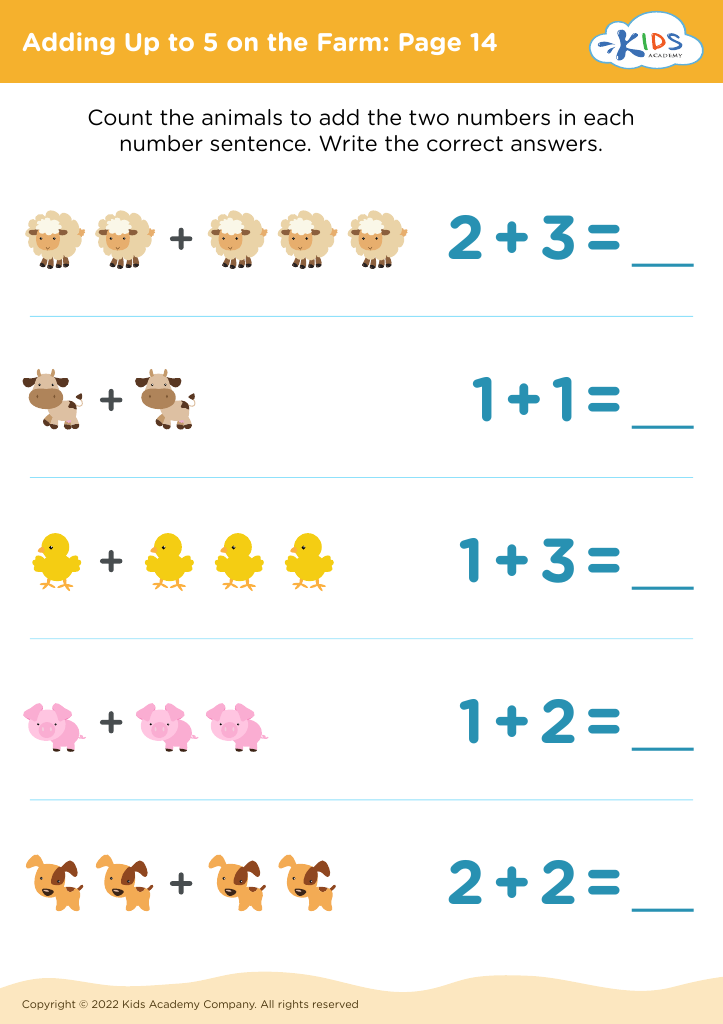
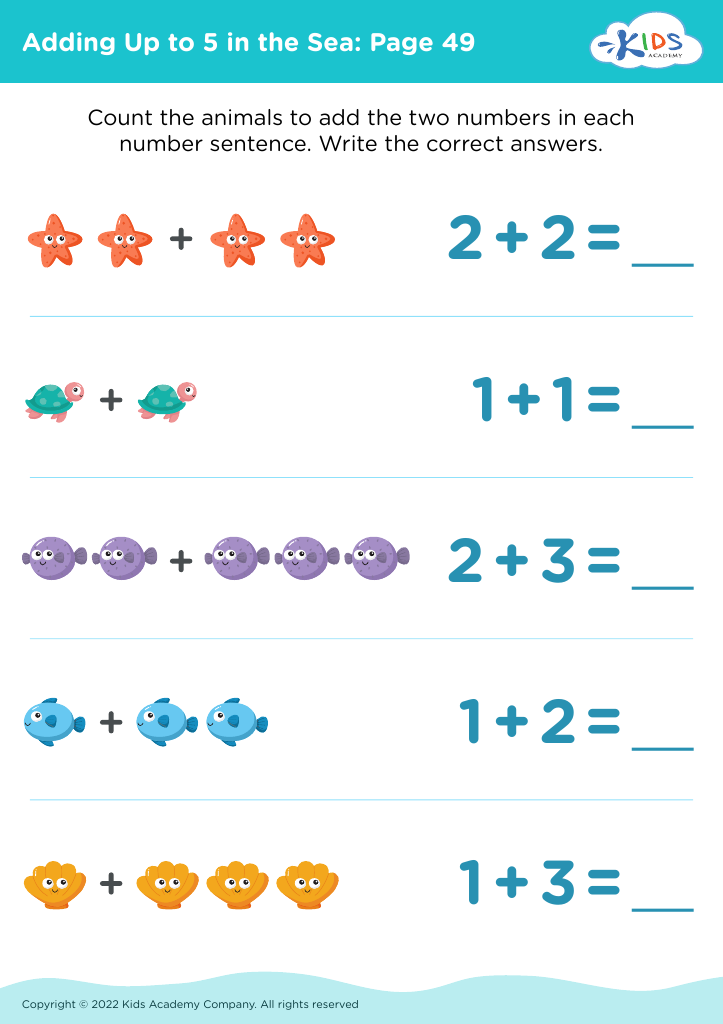








Understanding number values and adding up to 5 for children aged 5-7 is foundational for their future mathematical success. At this tender age, children are transitioning from concrete to more abstract thinking. Mastering these basic math skills helps them make sense of the world and develop essential problem-solving abilities.
First, getting comfortable with number values up to 5 builds a child's number sense—the ability to recognize, relate to, and manipulate numbers. This understanding forms the bedrock for more complex math skills, such as addition, subtraction, and later, multiplication and division. Recognizing small quantities instantly is known as subitizing, and this capability significantly enhances a child’s ability to handle numbers mentally and with ease.
Additionally, learning to add numbers up to 5 aids in understanding mathematical operations, laying the groundwork for arithmetic fluency. Simple addition helps children comprehend the concept of adding groups together, practicing skills that are engaged in everyday activities like sharing toys or counting snacks.
Moreover, early math proficiency fosters confidence and a positive attitude towards learning. Children who struggle early may develop math anxiety, which can impair their willingness to engage with math in the future.
Thus, parents and teachers should prioritize these foundational math skills to ensure children build a robust base for lifelong learning and appreciation for mathematics.








