
Comparison Skills Addition & Subtraction Worksheets for Ages 5-7
4 filtered results
Difficulty Level
Grade
Age
-
From - To
Subject
Activity
Standards
Enhance your child's math abilities with our "Comparison Skills Addition & Subtraction Worksheets" designed specifically for ages 5 to 7. These engaging worksheets focus on developing critical comparison skills through fun and interactive activities. Kids will practice comparing numbers, understanding greater or lesser values, and mastering addition and subtraction concepts grasped through visual aids and relatable scenarios. Our resources are perfect for home learning or classroom use, ensuring seamless skill development and boosting confidence in young learners. Equip your little ones with the fundamentals of math in an enjoyable way that encourages cognitive growth and problem-solving skills!
Favorites
With answer key
Interactive
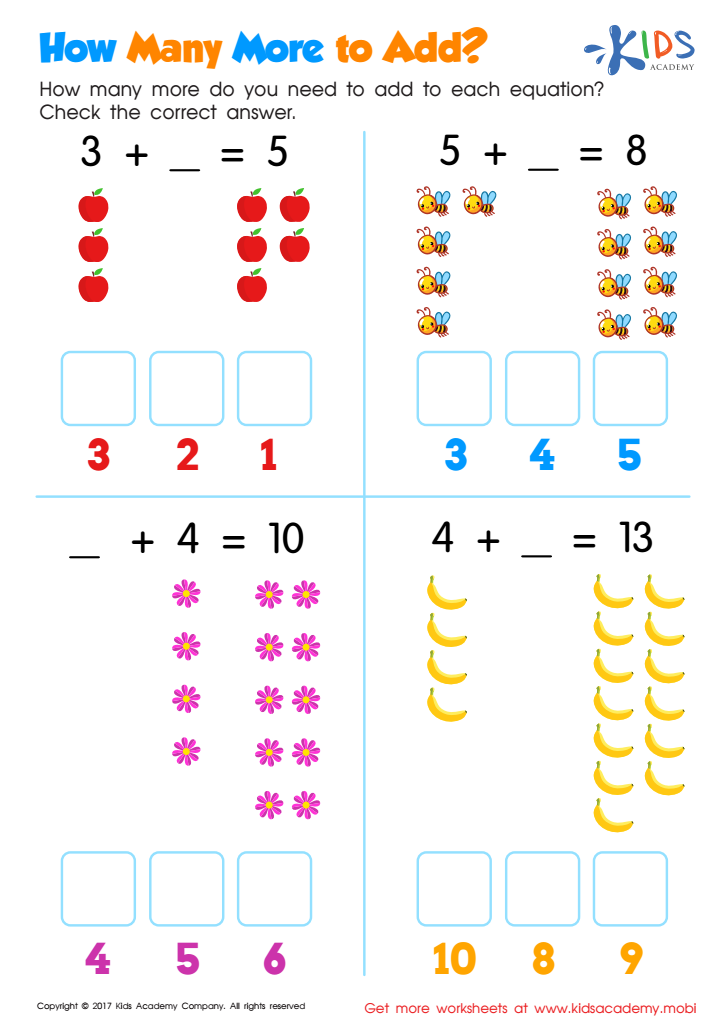
How Many More to Add Worksheet
Sharpen your child's math skills with this pdf worksheet. Help them figure out how many apples, bees, flowers and bananas are needed to reach the answer given. The possible answers are provided at the bottom of the boxes. Have some fun doing some addition and subtraction magic together and get those math skills sharpened!
 Assign to My Students
How Many More to Add Worksheet
Worksheet
Join Kids Academy for Free
Who is primarily going to use this learning content?








Comparison skills in addition and subtraction are crucial for children aged 5-7 as they form the foundation for advanced mathematical concepts. At this early stage, children are not just learning to calculate but also to understand relationships between numbers. By fostering comparison skills, parents and teachers can help children grasp concepts such as greater than, less than, and equal to, which will aid them in problem-solving and critical thinking.
Developing these skills enhances number sense, enabling kids to analyze and compare different quantities, which is vital for real-world applications like shopping or estimating when preparing food. Moreover, these skills promote confidence in mathematics, reducing anxiety and building a positive attitude toward this subject area.
Children who are adept in comparison skills are better equipped to tackle word problems, recognize patterns, and develop logical reasoning. As they progress, these skills will also support their understanding of more complex operations and mathematical relationships, paving the way for success in future education. By actively engaging in activities that promote comparison skills, such as games and hands-on exercises, parents and teachers can create a rich learning environment that empowers children as lifelong learners in mathematics.








