Recognizing equivalent fractions Addition & Subtraction Worksheets for Ages 5-7
5 filtered results
-
From - To
Welcome to our "Recognizing Equivalent Fractions Addition & Subtraction Worksheets" designed specifically for children aged 5-7! These engaging and interactive worksheets help young learners grasp the concept of equivalent fractions through fun exercises. Children will practice identifying and manipulating fractions, laying a strong foundation for future math skills. Our colorful illustrations and clear instructions ensure that kids can navigate the activities with ease, making learning enjoyable and effective. Perfect for home or classroom use, these worksheets encourage mastery of basic math concepts while building confidence in young learners. Start your child’s journey towards math success today!
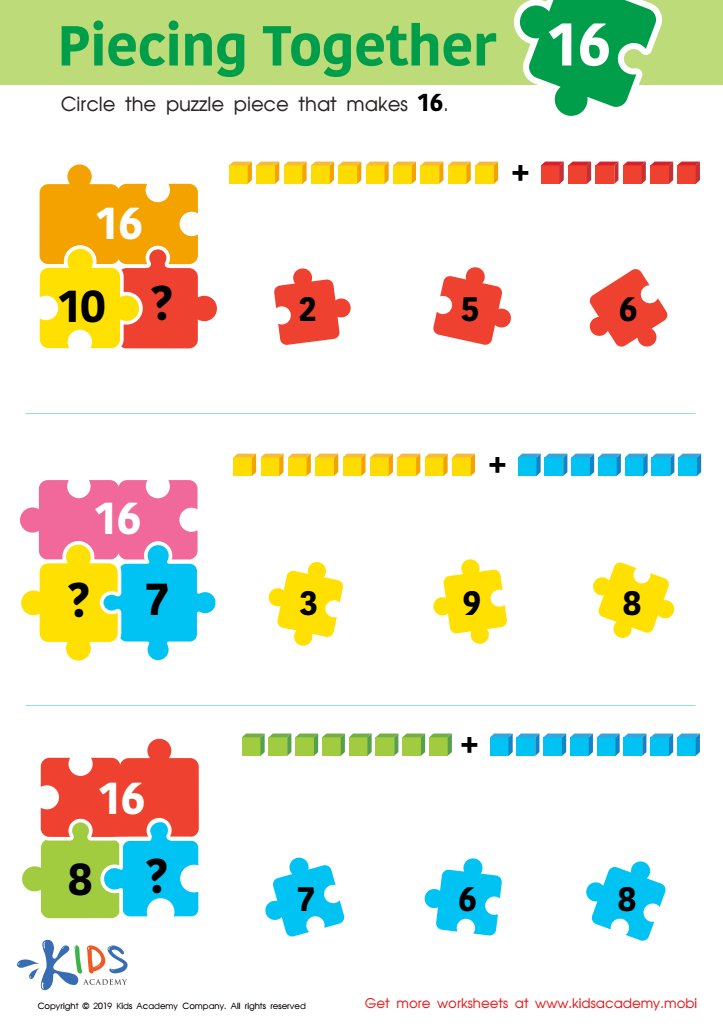
Piecing Together 16 Worksheet
 Assign to My Students








Recognizing equivalent fractions is a foundational math skill that is crucial for young learners, particularly between ages 5-7. During these formative years, children develop their understanding of numbers and their relationships, making it vital for educators and parents to emphasize this concept.
Understanding fractions helps children grasp the idea of part-to-whole relationships, which fosters critical thinking and problem-solving abilities. When kids learn to recognize equivalent fractions—like 1/2 being the same as 2/4—they develop a deeper comprehension of the concepts of addition and subtraction. This groundwork is essential as they advance in mathematics.
Additionally, mastering equivalent fractions promotes confidence in tackling more complex math topics in future grades. It lays the groundwork for understanding ratios, proportions, and eventually, algebraic concepts. Engaging children in activities that highlight equivalent fractions can make learning interactive and enjoyable, reinforcing the idea that math is not just about numbers but also about relationships between those numbers.
Ultimately, teachers and parents should care about this skill because it supports overall math literacy, equips children for future challenges, and helps cultivate a positive attitude toward learning mathematics. Encouraging young learners to explore these concepts paves the way for lifelong success in mathematics.








