
Spatial awareness Addition & Subtraction Worksheets for Ages 5-7
6 filtered results
Difficulty Level
Grade
Age
-
From - To
Subject
Activity
Standards
Discover our engaging Spatial Awareness Addition & Subtraction Worksheets designed for children aged 5-7! These worksheets are crafted to enhance math skills through spatial reasoning, teaching young learners how to visualize and understand numbers in relation to one another. Each activity combines fun visuals and interactive exercises that make learning addition and subtraction an enjoyable experience. By improving their spatial awareness, kids build a strong foundation for mathematical concepts while developing critical thinking skills. Perfect for home or classroom use, these worksheets are a valuable resource for early education, ensuring that your child grasps essential math skills in a playful and effective way!
Favorites
With answer key
Interactive
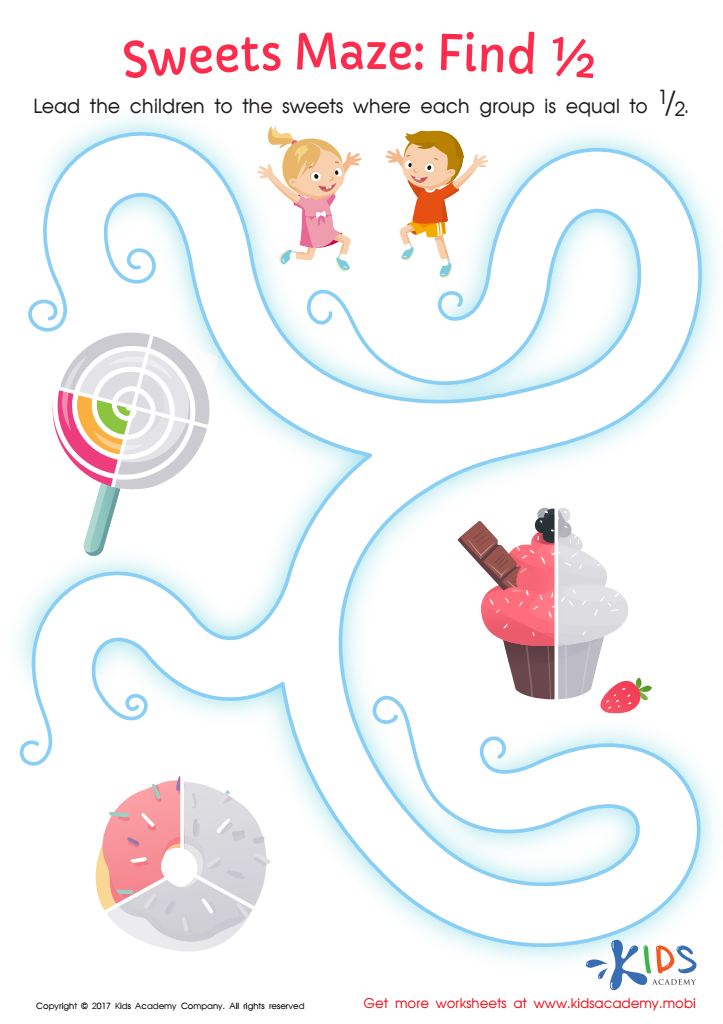
Fractions: Sweets Maze Worksheet
Kids will enjoy mastering parts of a whole with this tantalizing maze featuring tasty treats. Visuals help them understand fractions and the fun theme will motivate them to learn! Get started now to help your child find and identify ½!
 Assign to My Students
Fractions: Sweets Maze Worksheet
Worksheet
Join Kids Academy for Free
Who is primarily going to use this learning content?








Spatial awareness plays a crucial role in the development of young children’s mathematical skills, particularly in addition and subtraction. For children aged 5 to 7, understanding spatial concepts helps them visualize numbers and their relationships. When kids can identify shapes, sizes, and positions, they gain a foundational understanding necessary for manipulating numbers effectively.
Teachers and parents should care about fostering spatial awareness because it enhances problem-solving abilities. Children with strong spatial skills can visualize math problems, making it easier to comprehend and perform addition and subtraction. For example, using manipulatives like blocks or visual aids such as number lines helps children physically see quantities and their interactions.
Additionally, spatial skills contribute to overall cognitive growth. Children adept in spatial reasoning are often better at geometry and measurement in later grades, which signifies a stronger overall math foundation.
Moreover, engaging spatial activities, like puzzles or games that involve movements, strengthen motor skills and coordination, making them more adept learners. By prioritizing spatial awareness, parents and teachers ensure children not only excel in math but also develop critical thinking skills that are essential for lifelong learning. Nurturing these abilities from an early age sets the stage for a successful academic journey.








