Fraction visualization Fractions of Shapes Worksheets for Ages 5-7
5 filtered results
Difficulty Level
Grade
Age
-
From - To
Subject
Activity
Standards
Explore our engaging fraction visualization worksheets designed specifically for children ages 5 to 7! These interactive activities help young learners grasp the concept of fractions through fun and colorful representations of shapes. By working with various figures, children will develop their ability to identify, compare, and understand fractions in practical settings. Each worksheet is crafted to reinforce essential math skills while promoting critical thinking and problem-solving. Perfect for both classroom and home learning, our fractions of shapes resources make math enjoyable and accessible. Download now to provide your little ones with the tools they need to succeed in their mathematical journey!
Favorites
With answer key
Interactive
Equal Parts: Chocolate Party Worksheet
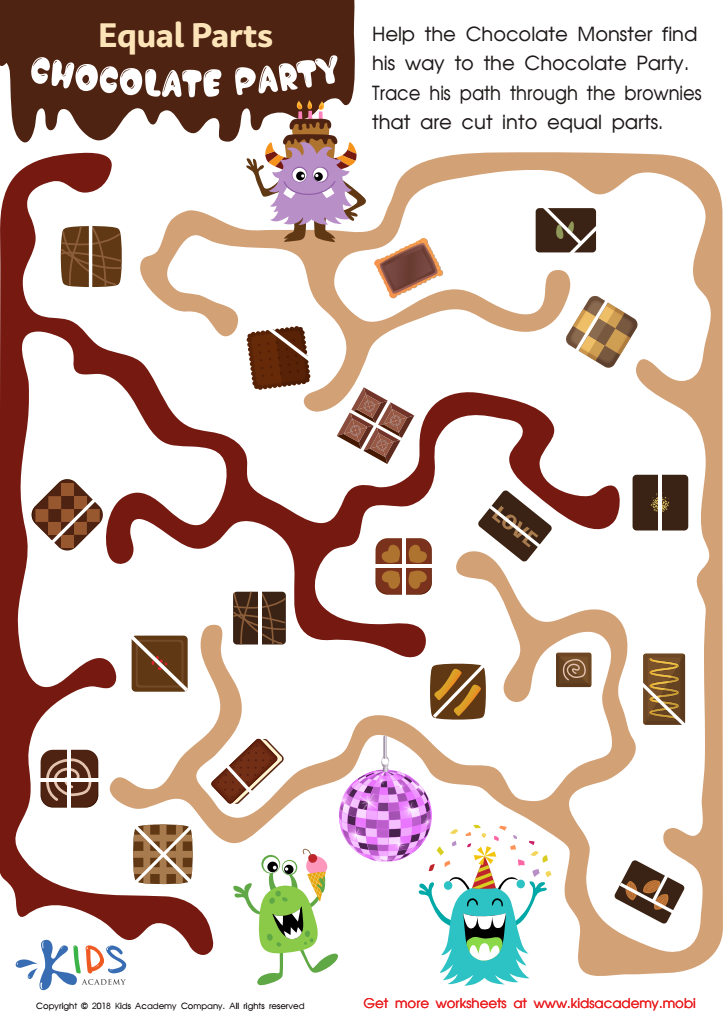
Mention "chocolate" and watch your kids' excitement soar! Learning can go hand-in-hand with that sugary treat. This worksheet helps kids guide the Chocolate Monster to the Chocolate Party, following a trail of brownie halves. It's an easy, tasty way to have fun!
 Assign to My Students
Equal Parts: Chocolate Party Worksheet
Worksheet
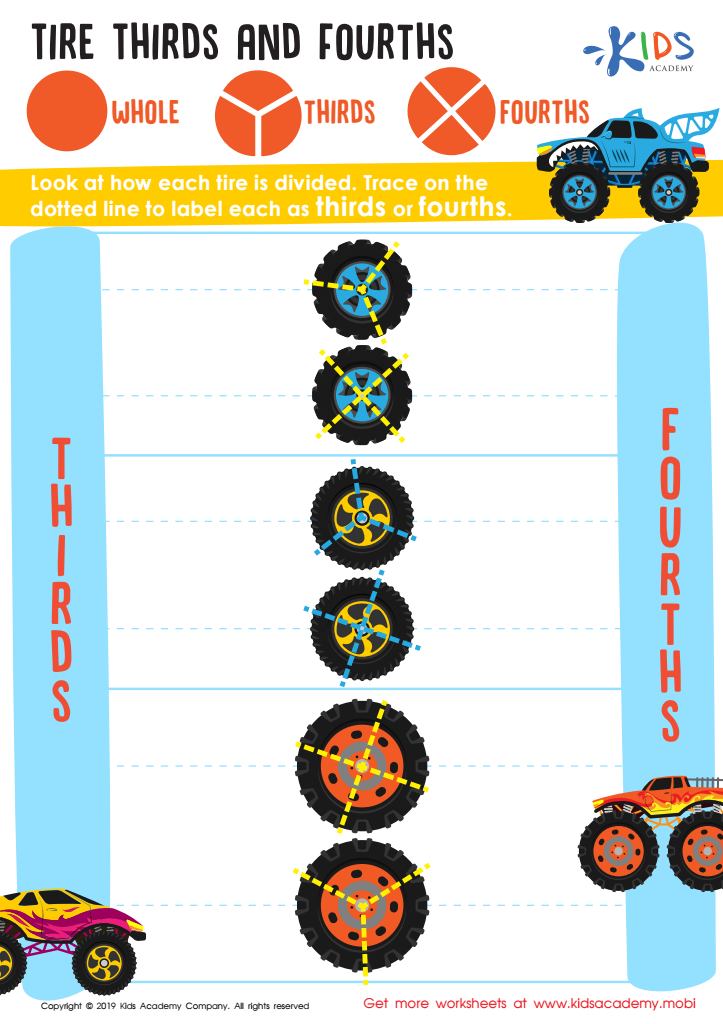
Tire Thirds and Fourths Worksheet
Learning geometry is key in your child's education. Have them identify and name shapes cut into 2, 3 and 4 parts. Test their knowledge with this worksheet - trace the dotted line to label each as third or fourth. Encourage them to keep learning!
Tire Thirds and Fourths Worksheet
Worksheet
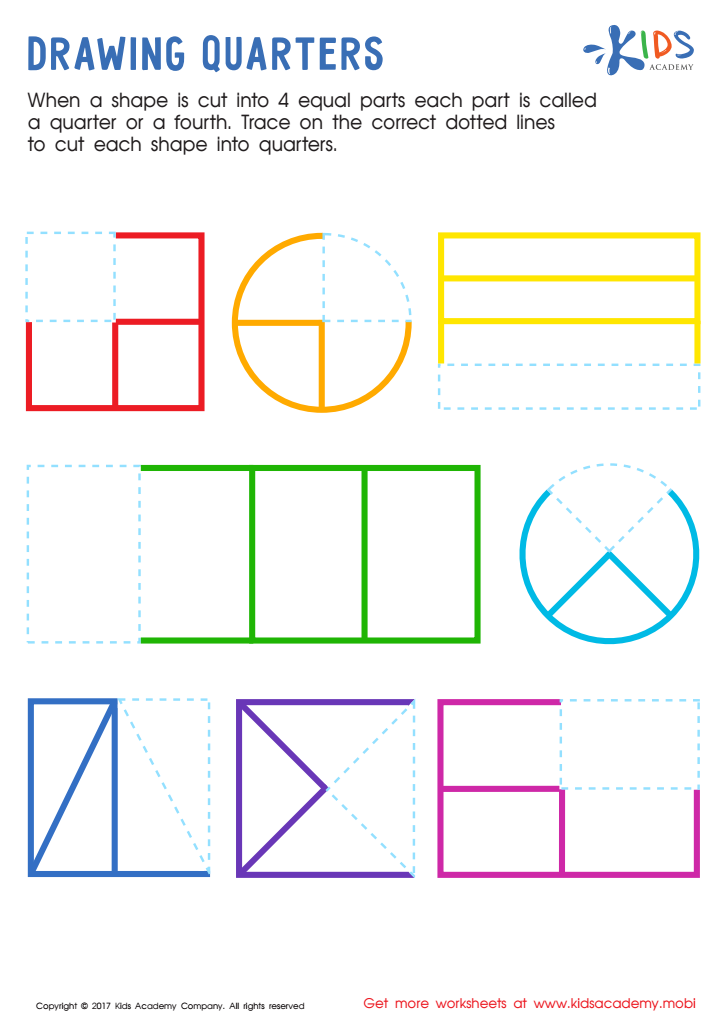
Drawing Quarters Worksheet
Help your kids divide shapes into quarters! Have them trace dotted lines to cut each shape into 4 equal parts. Each of the 4 parts is called a quarter or a fourth. This worksheet will help kids learn more about dividing shapes into four equal parts.
Drawing Quarters Worksheet
Worksheet
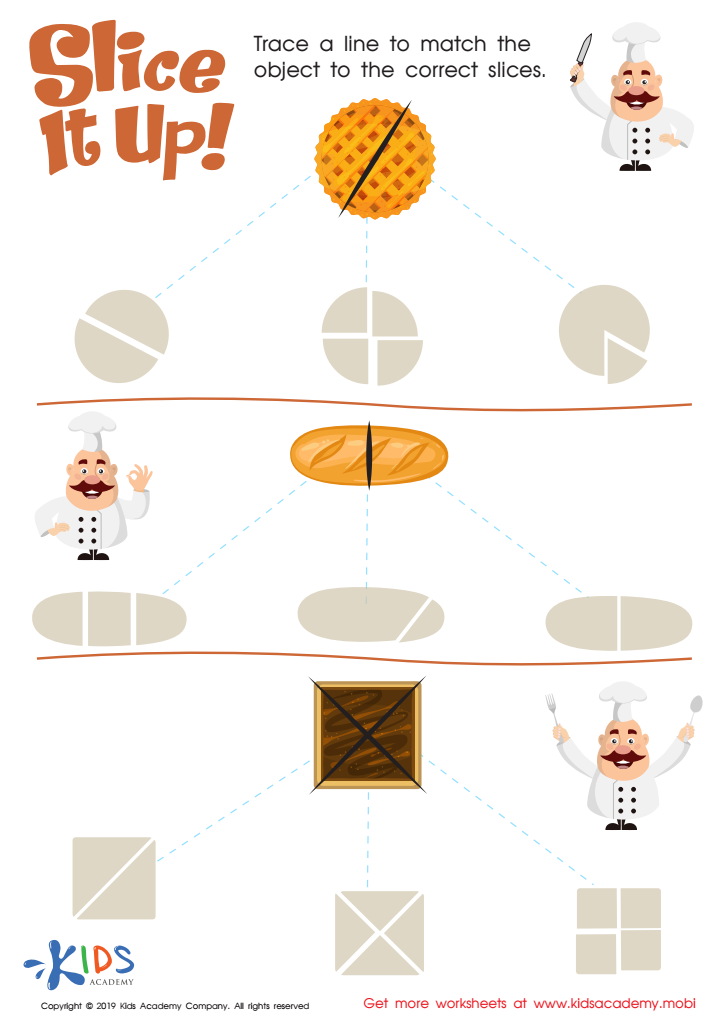
Slice It Up Worksheet
Try this fun math, reading and writing worksheet with your kids! They will love the colorful activities that perfect coordination and tracing. Engaging learning exercises help keep young minds sharp and boost skills. With these worksheets, your kids will be academically ahead of the curve!
Slice It Up Worksheet
Worksheet
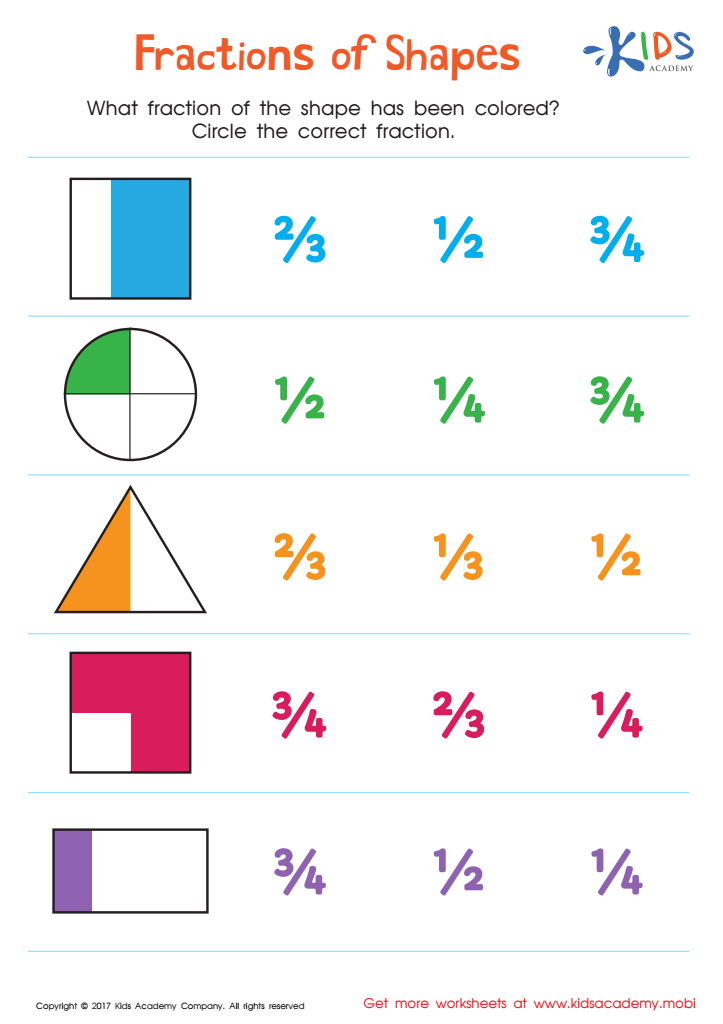
Fractions of Shapes: Math Concept Worksheet
Fractions can be tricky, but with pictures to illustrate them, they become much easier to understand. Our fractions of shapes worksheet is a great way to help children visualize fractions and gain a better understanding of them.
Fractions of Shapes: Math Concept Worksheet
Worksheet
Join Kids Academy for Free
Who is primarily going to use this learning content?








Understanding fraction visualization, particularly through shapes, is crucial for children ages 5-7 as it lays a strong foundation for their mathematical development. At this early age, children are naturally curious and ready to explore basic math concepts. Using shapes to represent fractions makes abstract ideas concrete, enabling them to visualize and comprehend how fractions part off from a whole.
When children see fractions displayed as parts of pizza slices, segmented circles, or divided rectangles, they can grasp the concept of a fraction as a part of a whole more effectively. This visualization aids in the development of critical thinking and problem-solving skills as they learn to compare sizes, understand equivalencies, and perform operations with fractions in future math topics.
Moreover, fostering an early understanding of fractions can decrease math anxiety later on, making students more comfortable with numerical concepts as they advance in their education. By engaging in activities involving fraction visualization, parents and teachers can encourage collaboration and discussion, enhancing social interaction skills. Ultimately, a solid grasp of fractions enables kids to tackle more complex mathematical topics with confidence, setting the stage for academic success. Thus, both educators and parents should prioritize fraction visualization in early learning.