Spatial reasoning Numbers Worksheets for Ages 5-7
3 filtered results
-
From - To
Boost your child's mathematical abilities with our engaging Spatial Reasoning Numbers Worksheets designed for ages 5-7. These expertly crafted exercises help young learners develop essential spatial reasoning skills through interactive number activities. By working with patterns, shapes, and number positioning, kids enhance their problem-solving abilities and mathematical thinking. Our worksheets make learning fun and effective, encouraging children to visualize and manipulate numbers in various spatial contexts. Perfect for home or classroom use, these worksheets support early math foundations, fostering confidence and a love for numbers. Empower your child’s learning journey with these dynamic resources.
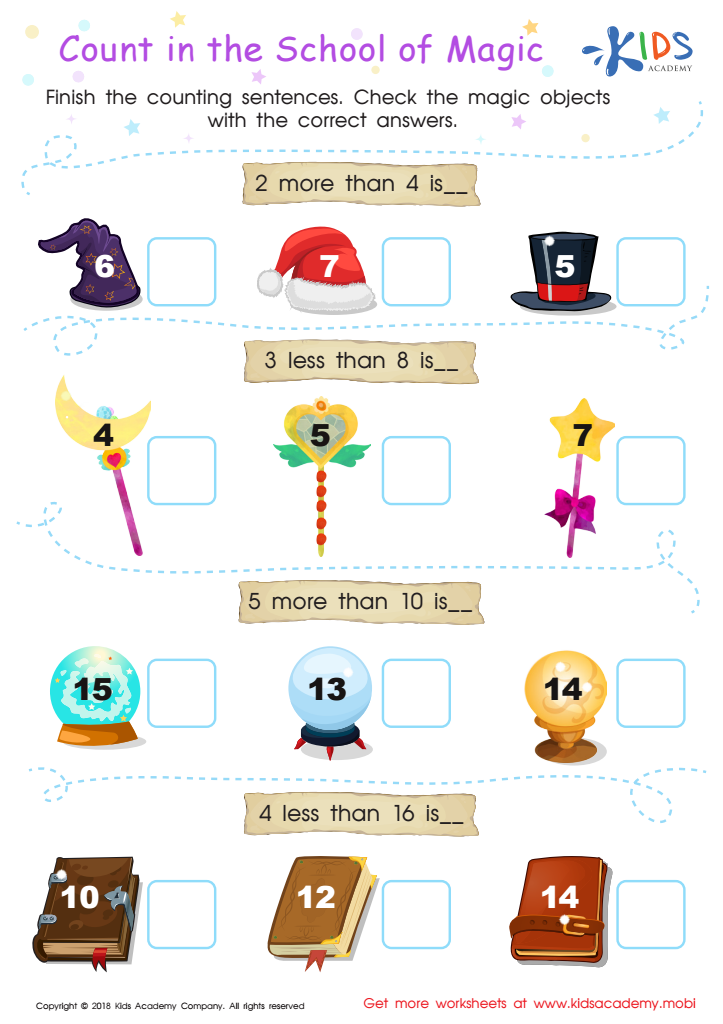
Count in the School of Magic Worksheet
 Assign to My Students
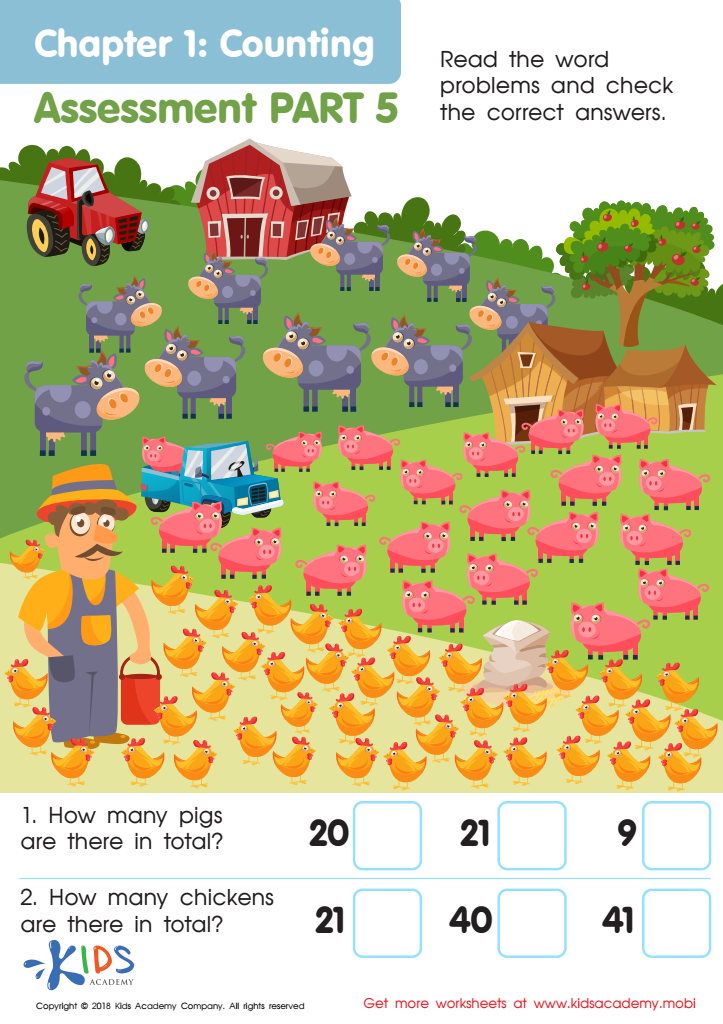
Counting: Assessment 5 Worksheet
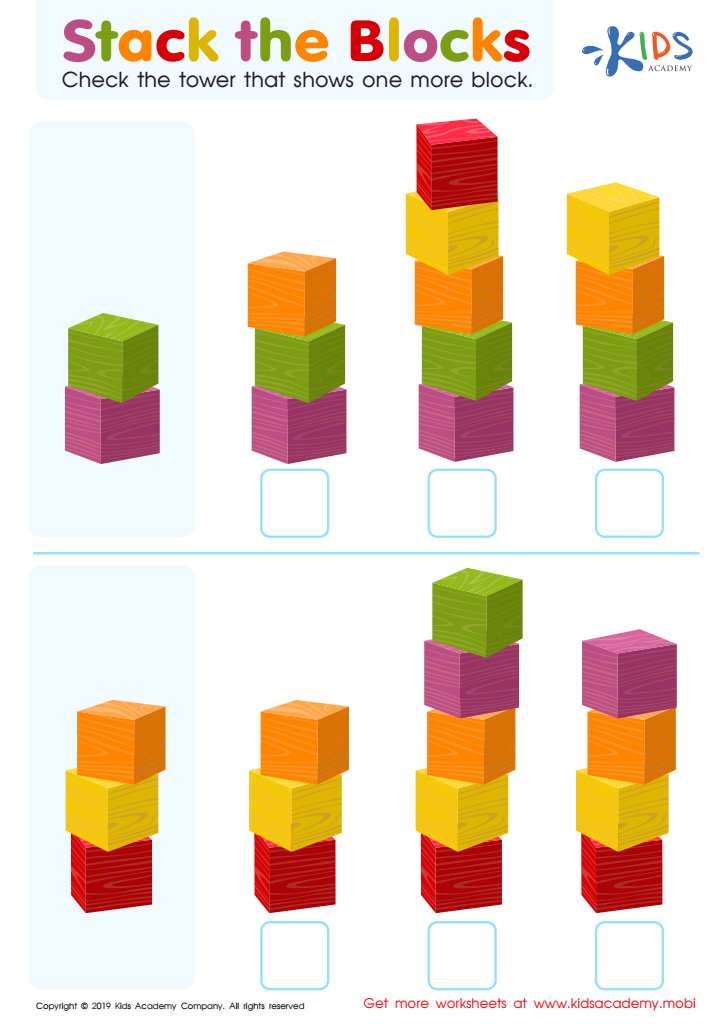
Stack the Blocks Worksheet








Spatial reasoning and an understanding of numbers are foundational skills for young children ages 5-7, and both play a crucial role in their cognitive development.
Firstly, spatial reasoning, the ability to visualize and manipulate objects in space, is integral for success in mathematics and science. It enables children to grasp geometric concepts, understand maps, and visualize mathematical problems, fostering strong problem-solving skills. These skills are not only pivotal in academics but also in everyday tasks, ranging from organizing space to understanding directions.
Furthermore, numerical skills are essential for understanding quantity, measurement, and eventually tackling more advanced mathematics. At this age, children transition from counting to more complex number concepts such as addition, subtraction, and recognizing patterns. Proficiency in these areas builds a strong mathematical foundation crucial for later academic success.
By fostering spatial reasoning and numerical skills, parents and teachers support holistic cognitive growth. Structured play, puzzles, and engaging learning activities can significantly enhance these abilities. Such interventions at a young age promise not only immediate educational benefits but also long-term advantages in life and academic pursuits, positioning children well for diverse future opportunities.
Parents and teachers should prioritize these areas to ensure that children develop the necessary skills to navigate and succeed in an increasingly complex world.








