
Analog clock reading Math Worksheets for Ages 5-7
4 filtered results
Difficulty Level
Grade
Age
-
From - To
Subject
Activity
Standards
Help your child master time-telling with our engaging Analog Clock Reading Math Worksheets for ages 5-7. These printable, fun, and educational activities are perfect for young learners beginning to understand how to read analog clocks. The worksheets incorporate colorful clock faces to teach children the basics of hours and minutes. Through hands-on practice, kids will develop their time-telling skills, enhance their mathematical understanding, and boost their confidence in reading analog clocks. Ideal for both classroom use and at-home learning, these worksheets are designed to make learning to tell time an enjoyable adventure for your child.
Favorites
With answer key
Interactive
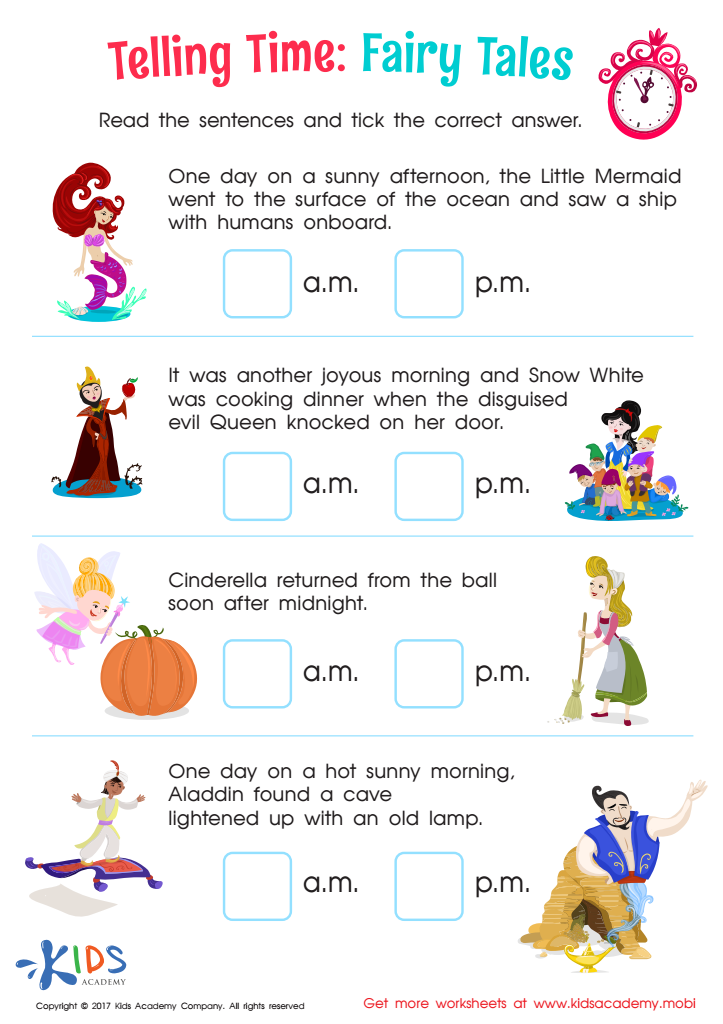
Telling Time: Fairy Tales Worksheet
Bring your child's imagination to life with classic fairy tales! This colorful telling time worksheet has it all: The Little Mermaid, Cinderella, and more! Plus, your child will have fun learning to distinguish a.m. from p.m. with this charming worksheet.
 Assign to My Students
Telling Time: Fairy Tales Worksheet
Worksheet
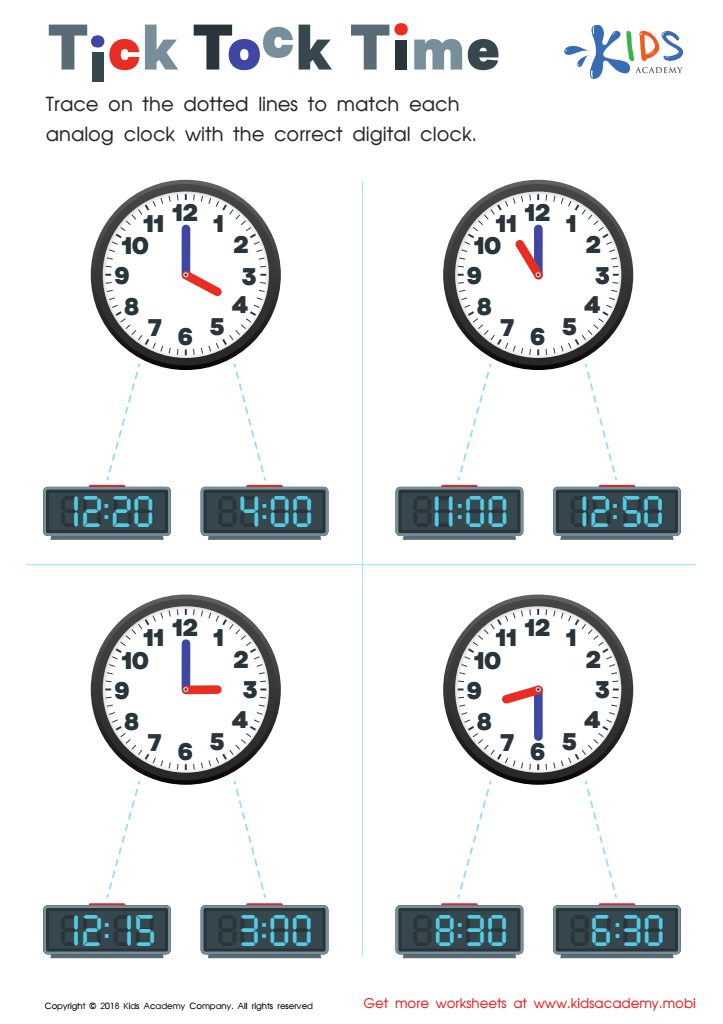
Tick Tock Time Worksheet
Trace the dotted lines on this worksheet to match analog and digital clocks! It's a great way to help your kids learn time-telling. They'll get better at converting analog to digital, and vice versa. Get your children to try it - it's a fun way to practice!
Tick Tock Time Worksheet
Worksheet
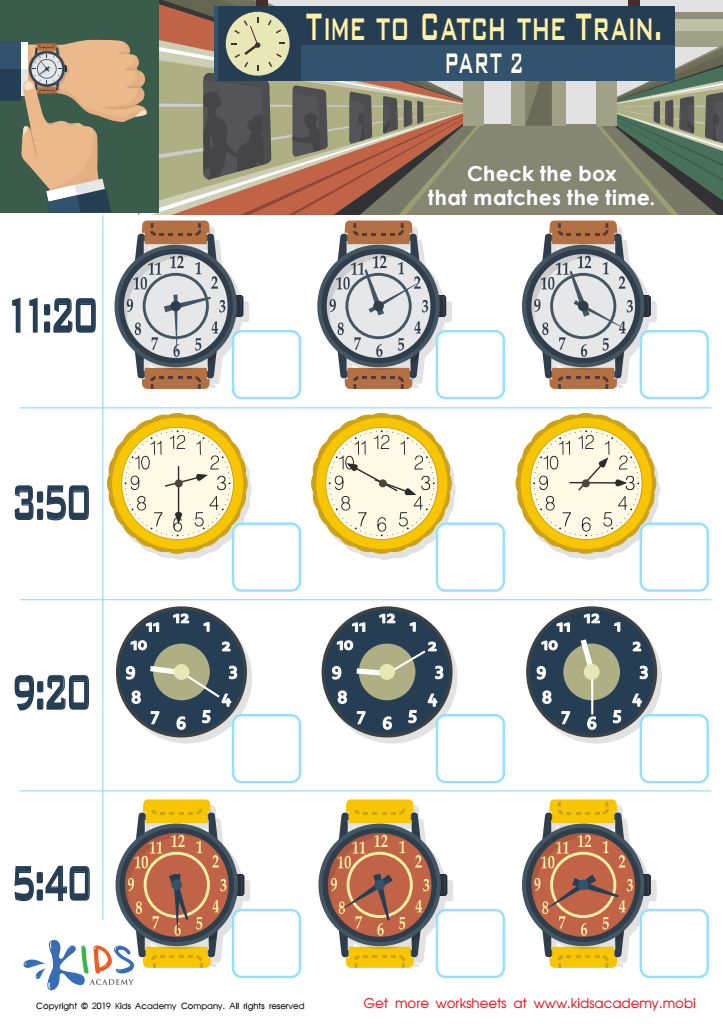
Time to Catch the Train Part 2 Worksheet
Teach your kids the importance of telling time and how to do it. Explain that there are multiple ways to show the time, such as written on the left side or watches in the picture. Guide them to check the box that matches the time. Knowing the time is essential to get things done and create order. Ensure your kids understand this and they will reap the benefits.
Time to Catch the Train Part 2 Worksheet
Worksheet
Join Kids Academy for Free
Who is primarily going to use this learning content?







Teaching young children, aged 5-7, to read an analog clock plays a crucial role in their overall cognitive development, builds essential life skills, and strengthens mathematical understanding.
First, analog clock reading involves counting by fives and recognizing number patterns as they interpret the positions of the hour and minute hands. This bolsters their number sense and reinforces basic arithmetic principles, laying a solid foundation for future math learning. Additionally, learning to manage time teaches children vital life skills such as punctuality and planning, which foster independence.
Analog clocks also enhance spatial reasoning by helping children understand the circular layout of time, which contrasts with the linear sequences they encounter in digital formats. This broadens their cognitive abilities, helping them to visualize and interpret diverse concepts better.
Furthermore, reading an analog clock nurtures patience and attention to detail. Kids learn to observe a continuously moving process rather than instant results displayed digitally. It encourages mindful reflection on the passing minutes and hours, thereby enhancing their focus.
Given these benefits, it’s clear that both parents and teachers should encourage analog clock reading. By integrating this skill early on, they can cultivate well-rounded, punctual, and mathematically adept individuals, prepared to tackle both academic challenges and everyday life with confidence.








