Basic addition practice Math Worksheets for Ages 5-7 - Page 2
25 filtered results
-
From - To
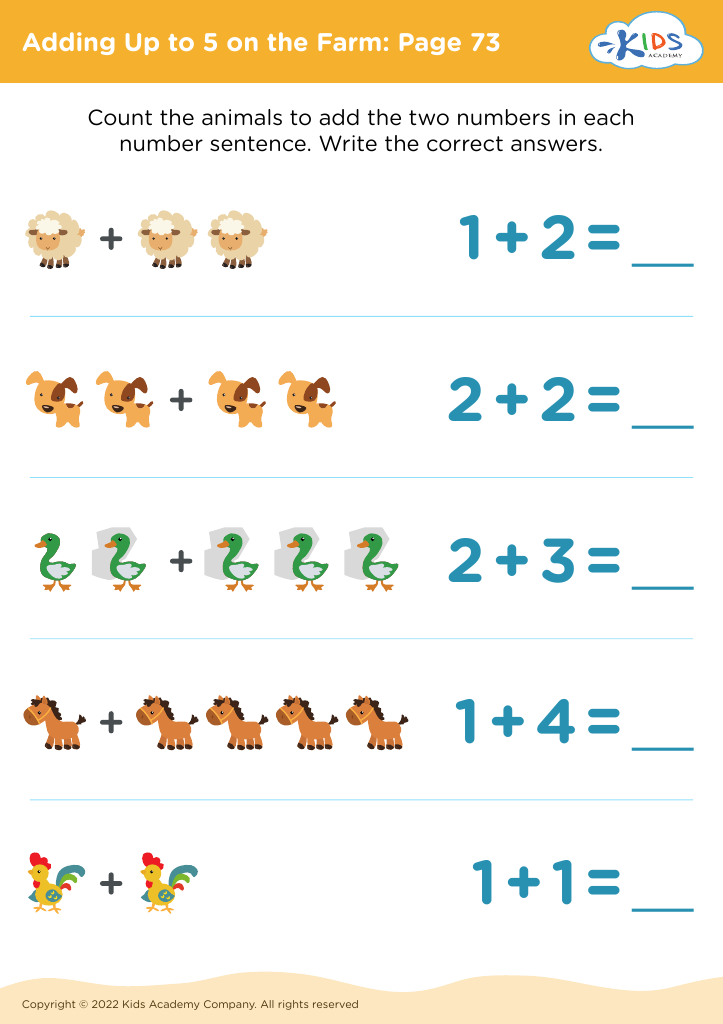







Basic addition practice for ages 5-7 forms the cornerstone of mathematical understanding and cognitive development. At this early stage, students' minds are highly receptive, making it an ideal time to introduce foundational math concepts. When children practice basic addition, they develop their number sense, which is crucial for grasping more advanced math skills later on. Proficiency in addition enhances students' ability to solve simple arithmetic problems, fostering confidence and a positive attitude toward math.
For parents and teachers, ensuring that young students master addition is instrumental in academic success. This foundational skill spills over into other areas, from science to logic, and even problem-solving in everyday life. Additionally, early math proficiency is predictive of future academic achievement, both in and out of math-related fields. Students who don't grasp these concepts early may struggle later, leading to frustration and a lack of interest in math.
Moreover, practicing basic addition helps children develop attention to detail, memory, and logical thinking. It is an engaging way for children to begin learning discipline, focus, and persistence. Therefore, parents and teachers should prioritize and enthusiastically support basic addition practice, laying a solid educational foundation that benefits children throughout their academic journeys and beyond.








