
Identify numbers Math Worksheets for Ages 5-7
3 filtered results
Difficulty Level
Grade
Age
-
From - To
Subject
Activity
Standards
Explore our engaging "Identify Numbers Math Worksheets" designed specifically for children ages 5-7. These worksheets focus on helping young learners recognize and differentiate numbers through fun and interactive activities. Perfect for both home and classroom use, our resources encourage early number identification skills essential for mathematical foundations. With a variety of exercises, including tracing, matching, and games, children will enhance their number recognition in a playful way. Ideal for reinforcing lessons and boosting confidence, these worksheets align with educational standards to ensure an effective learning experience. Start your child's math journey today with our delightful and educational resources!
Favorites
With answer key
Interactive
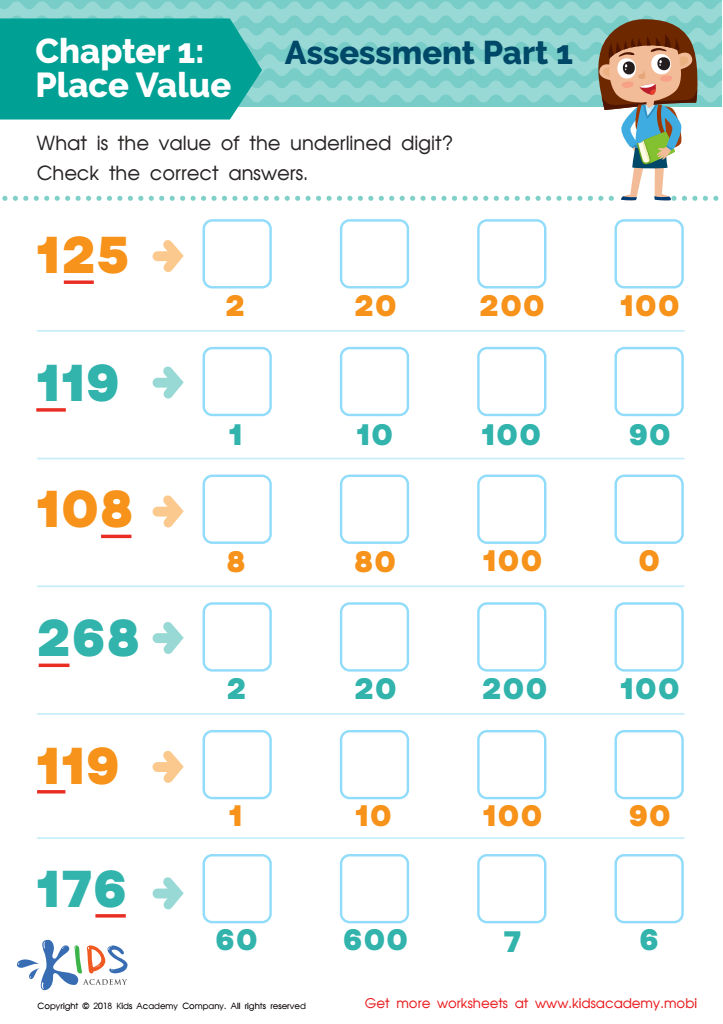
Place Value: Chapter 1 Worksheet
Check your kid's place value understanding with this assessment worksheet. It features 6 questions with one digit underlined for your child to determine the correct value of. Get the download and see if they can correctly choose the answer from the options given. It's a great way to test progress and keep their minds sharp!
 Assign to My Students
Place Value: Chapter 1 Worksheet
Worksheet
Join Kids Academy for Free
Who is primarily going to use this learning content?




%20(1).jpg)
.jpg)


Identifying numbers is a fundamental skill for children aged 5-7, and both parents and teachers play a crucial role in fostering this ability. At this developmental stage, children are naturally curious and eager to explore their surroundings, making it an ideal time to introduce math concepts. By learning to identify numbers, children develop a foundational understanding of quantity, order, and value, which are critical components in more complex math skills later on.
Mastering number identification aids in cognitive development; it helps improve memory, attention, and problem-solving skills. Moreover, recognizing numbers supports everyday activities, such as counting objects, telling time, and understanding financial basics, which are essential life skills. Engaging in math-related activities also boosts a child's confidence, encouraging a positive attitude toward learning.
Additionally, collaboration between parents and teachers amplifies the learning experience. Parents can reinforce lessons at home or in practical contexts, while teachers provide structured and engaging activities in the classroom. Together, they create a nurturing environment that fosters a child's enthusiasm for math, setting the stage for a lifelong appreciation of learning and critical thinking skills that extend far beyond the classroom.








