
Practice problem-solving Math Worksheets for Ages 5-7
5 filtered results
Difficulty Level
Grade
Age
-
From - To
Subject
Activity
Standards
Empower young minds with our Practice Problem-Solving Math Worksheets for Ages 5-7! Specifically crafted to enhance critical thinking and build foundational math skills, these engaging worksheets cover key concepts such as addition, subtraction, pattern recognition, and number sequences. Our fun and interactive activities will captivate your child’s imagination while systematically developing their problem-solving abilities. Perfect for classroom use or home practice, these worksheets are an essential tool for fostering a love of math in early learners. Help your child build confidence and enjoy the journey to mathematical proficiency with Kids Academy’s expertly designed resources.
Favorites
With answer key
Interactive
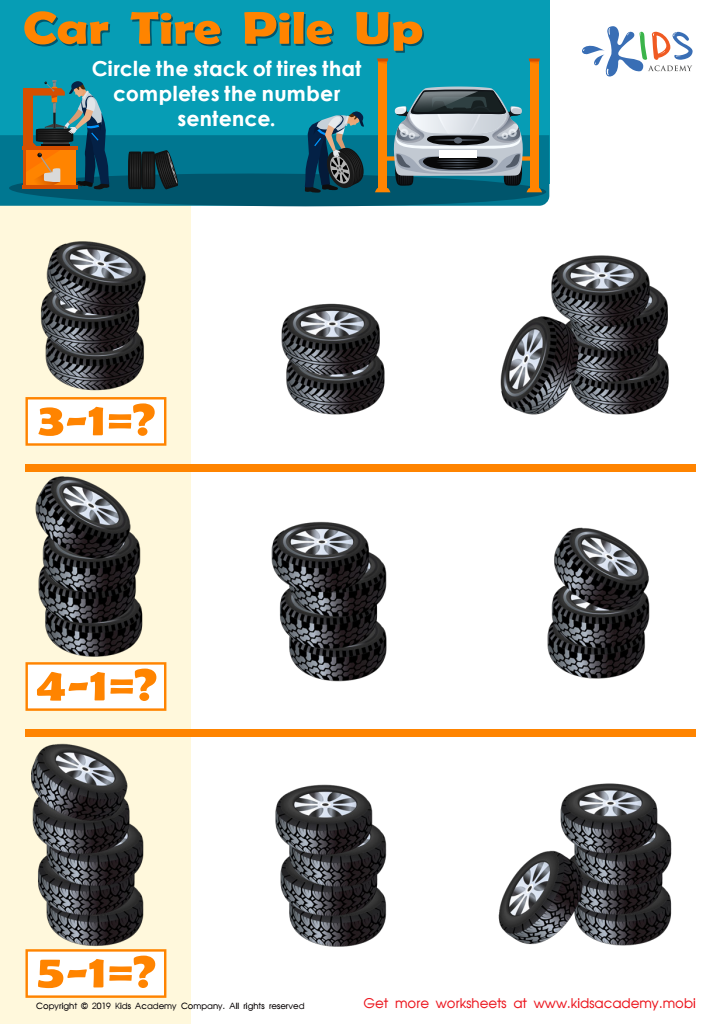
Car Tire Pile Up Worksheet
Examine the pic with your kids. Can they recognize the items piled up? The tires are organized in different quantities. Equations are on the left. Have your children work out the equations, counting the tire stacks to identify the correct answer.
 Assign to My Students
Car Tire Pile Up Worksheet
Worksheet
Join Kids Academy for Free
Who is primarily going to use this learning content?



.jpg)




Math problem-solving for ages 5-7 is essential because it lays the foundation for critical cognitive and life skills. At this age, children's brains are highly receptive and begin to grasp basic concepts of counting, addition, and subtraction. Engaging in practice early, encourages logical thinking and helps them understand patterns and relationships. This skill is crucial not only for academic success but also for everyday situations that require planning, decision-making, and resource management.
For parents and teachers, investing time in practice problem-solving can foster a child's confidence and enjoyment in math, setting a positive tone for future learning experiences. Developing these abilities early can prevent math anxiety and make complex topics more approachable as they grow older. Moreover, these activities boost attention span, enhance memory, and hone fine motor skills when problems are solved through drawings or manipulatives.
Additionally, early problem-solving practice promotes collaborative learning. When children work together on math problems, they learn to share ideas, communicate effectively, and appreciate different perspectives. This social interaction further supports emotional development and teamwork skills.
By prioritizing problem-solving in math at an early age, parents and teachers help children establish a strong educational foundation, setting them on a path toward success in school and life.








