Recognizing equal parts Math Worksheets for Ages 5-7
3 filtered results
-
From - To
Boost your child's understanding of fundamental math concepts with our "Recognizing Equal Parts Math Worksheets" designed for ages 5-7. These engaging and educational worksheets help young learners identify and divide shapes into equal parts, fostering essential skills in geometry and fractions. Colorful illustrations and interactive exercises make learning intuitive and fun, promoting hands-on practice and independent thinking. Perfect for both classroom reinforcement and home study, these worksheets provide a strong foundation in mathematics, preparing kids for more advanced concepts. Empower your child's early math journey with resources that make learning equal parts exciting and accessible.
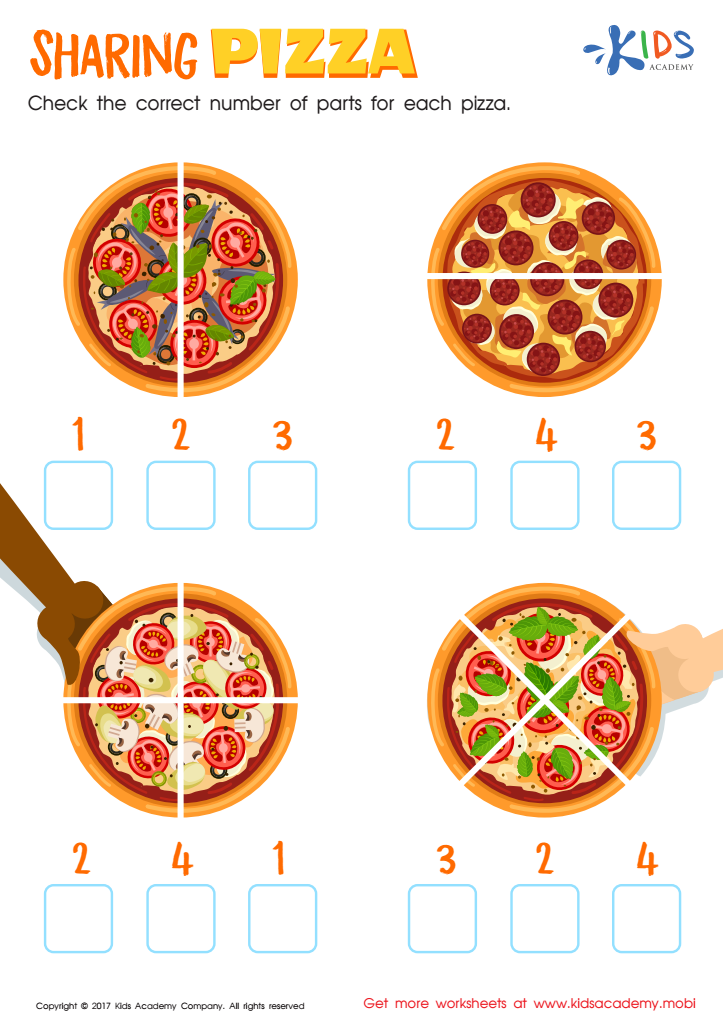
Sharing Pizza Worksheet
 Assign to My Students
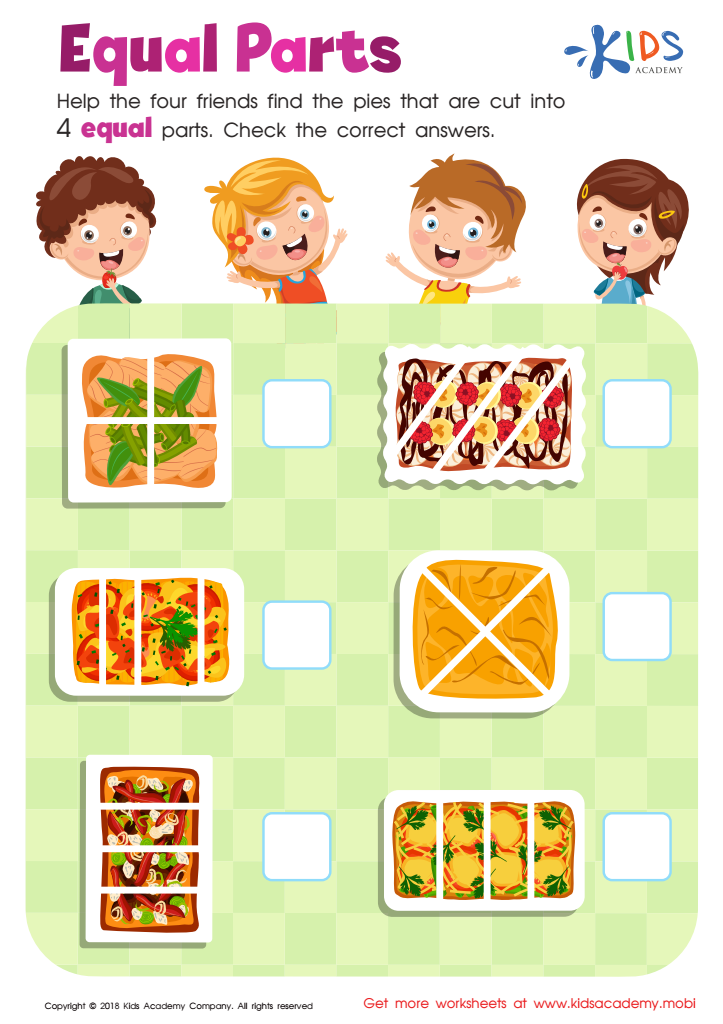
Equal Parts: Food Worksheet








Recognizing equal parts is a foundational math skill for children ages 5-7 and plays a crucial role in their overall cognitive development. At this early stage, grasping the concept of equality and equity in partitioning shapes and numbers helps children build a strong mathematical foundation. This foundational skill is a prerequisite for more complex math topics such as fractions, geometry, and even algebra later on.
When children learn to identify and create equal parts, they develop essential problem-solving skills and logical thinking. It enhances their ability to understand and apply the concept of fairness and sharing, which translates to practical, real-life situations.
Moreover, mastering equal parts recognition boosts a child's confidence in their math abilities, creating a positive attitude toward learning. It also promotes visual-spatial skills as children learn to visualize and mentally manipulate different shapes and sizes.
For parents and teachers, encouraging this skill through interactive activities and hands-on materials, such as dividing objects (like fruits or toys) or using visual aids (like diagrams or drawing), can make math enjoyable and engaging. Doing so not only supports academic success but also fosters a lifelong love for learning and critical thinking in young children.








