
Understanding fact families Subtraction Worksheets for Ages 5-7
3 filtered results
Difficulty Level
Grade
Age
-
From - To
Subject
Activity
Standards
Unlock your child’s math potential with our "Understanding Fact Families Subtraction Worksheets" designed for ages 5-7. These engaging worksheets introduce the concept of fact families, helping young learners to grasp the relationships between subtraction and addition. By exploring fact families, children will improve their mathematical reasoning skills, enhance their problem-solving abilities, and develop a strong foundation for future arithmetic. Our worksheets feature colorful illustrations and interactive exercises that keep kids motivated and eager to learn. Perfect for at-home practice or classroom activities, these resources make mastering subtraction both fun and educational. Start your child's math journey today!
Favorites
With answer key
Interactive
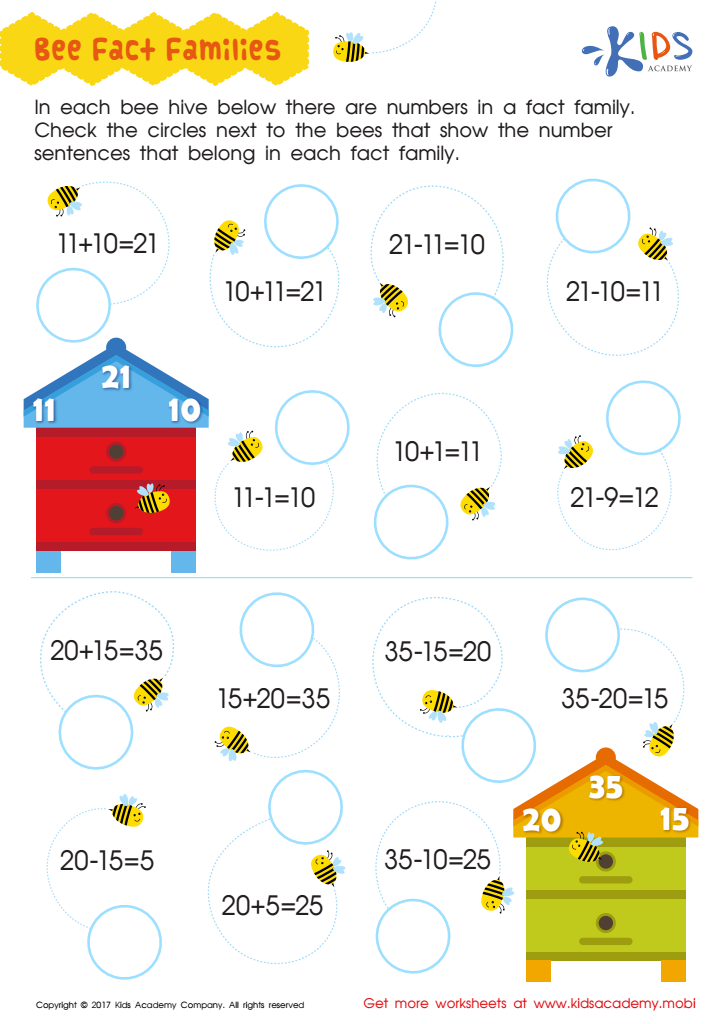
Fact Families Worksheet
Your 2nd grader will love this engaging activity.
Kids will buzz about fact families with this fun worksheet! Images of bees and their hives make learning numeracy enjoyable. Engaging and entertaining, your 2nd grader will love this activity.
 Assign to My Students
Fact Families Worksheet
Worksheet
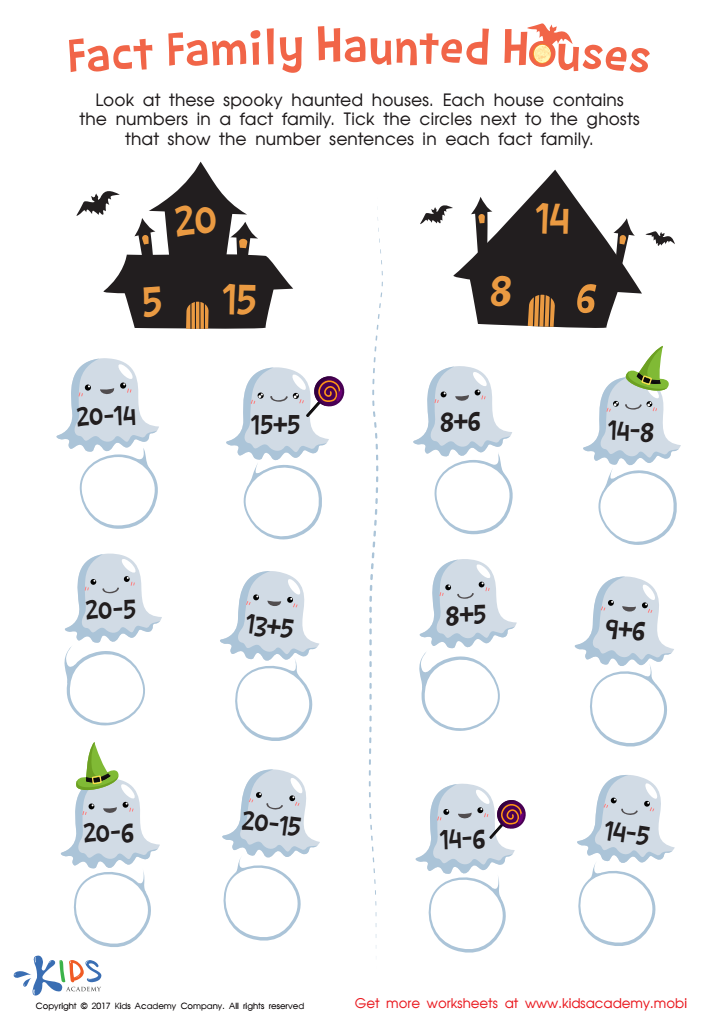
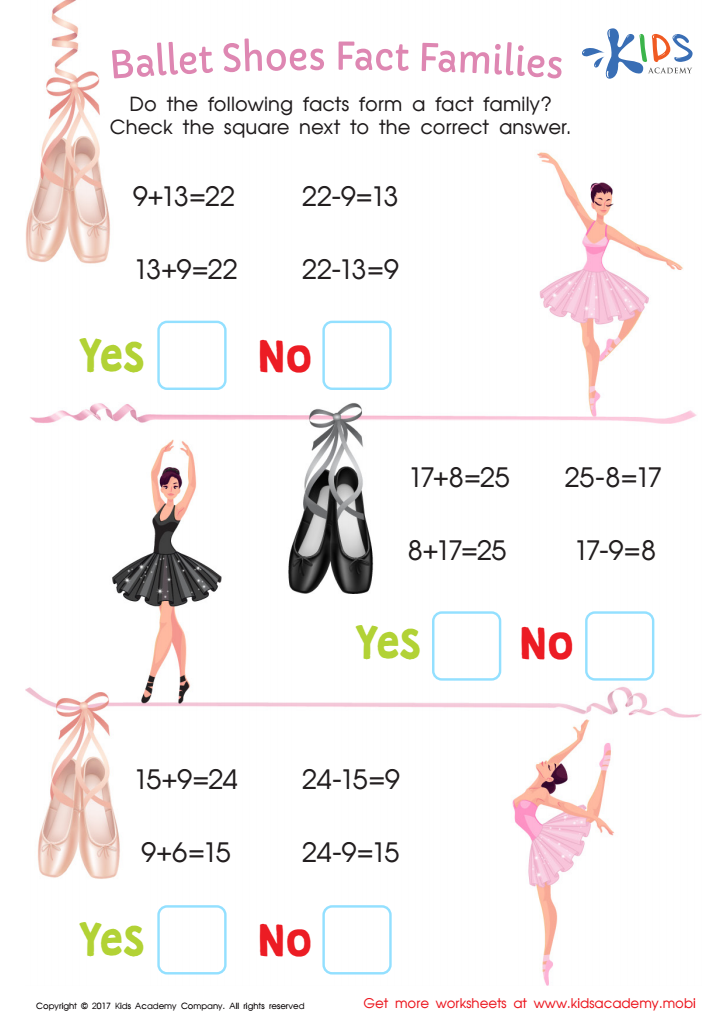
Ballet Shoes Fact Family Printable
Have them observe the equations and determine which groupings are fact families for a delightful learning experience. It encourages critical thinking, showing how addition and subtraction are related.
Ballet Shoes Fact Family Printable
Worksheet
Learning Skills
Understanding fact families
Enhancing mental arithmetic skills
Demonstrating mathematical relationships
Comprehending addition/subtraction
Practicing problem-solving skills
Improve number relationships knowledge
Addition and subtraction practice
Enhance mental math skills
Foster problem-solving abilities
Improving mental math
Join Kids Academy for Free
Who is primarily going to use this learning content?








Understanding fact families in subtraction is crucial for children aged 5-7 as it fosters essential math skills and promotes mathematical fluency. Fact families are groups of related addition and subtraction facts that link numbers in a specific way, helping children recognize the relationship between these operations. For example, if children know that 8 and 3 make 11, they can also understand that 11 minus 8 equals 3 and 11 minus 3 equals 8.
By grasping fact families, students develop a deeper comprehension of number relationships, aiding in their ability to solve problems efficiently. This understanding nurtures critical thinking and equips children with the skills to approach more complex mathematics later on. Importantly, it helps build their confidence in math, reducing anxiety and resistance towards the subject.
Moreover, mastering fact families serves as a foundational skill for future math concepts. As parents and teachers observe their children engage with these relationships, they foster a supportive learning environment, reinforcing the importance of effort and practice. Ultimately, understanding fact families in subtraction is not just about numbers; it cultivates perseverance, problem-solving abilities, and a positive attitude towards mathematics that benefits students throughout their educational journey.








