Letter recognition Tracing Letters Worksheets for Ages 5-8 - Page 2
26 filtered results
-
From - To
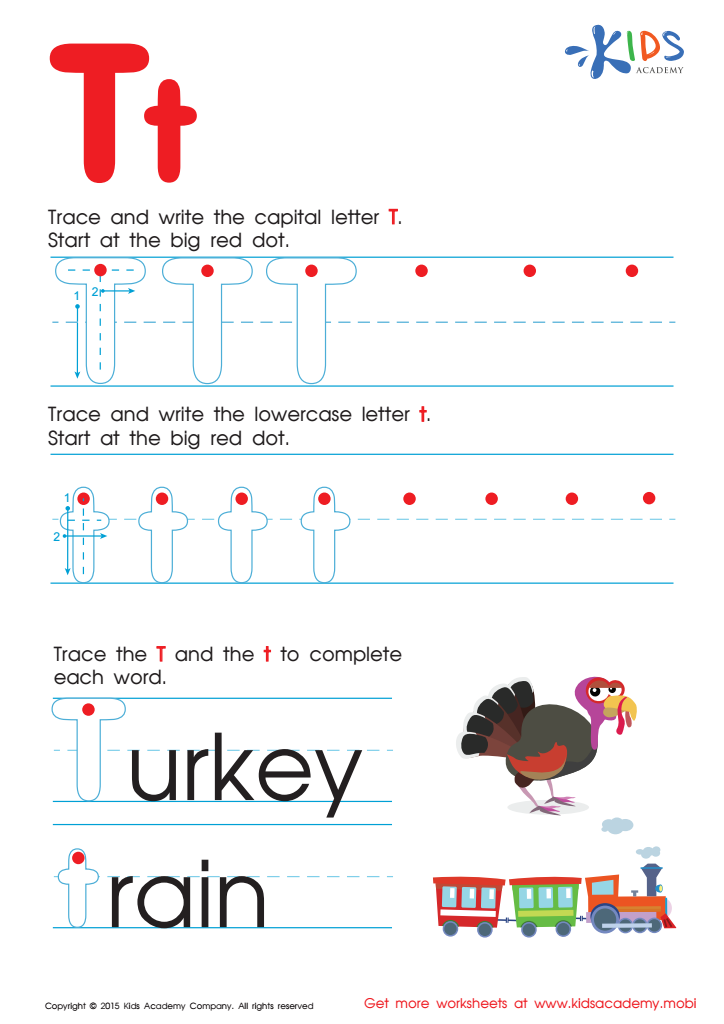
Letter T Tracing Page
 Assign to My Students

Letter D Tracing Page








Letter recognition and tracing letters are foundational skills crucial for children aged 5-8 for several important reasons:
-
Early Literacy: Letter recognition is the first step toward learning to read and write. Recognizing letters enables children to understand that written text corresponds to spoken language. This sets the stage for phonemic awareness and decoding skills.
-
Fine Motor Skills: Tracing letters enhances fine motor skills. The repetitive motion of tracing aids in the development of hand-eye coordination and muscle memory, which are essential for efficient handwriting.
-
Cognitive Development: Understanding letters involves processing visual cues and associating them with sounds, which stimulates cognitive development. As children piece together letters to form words, they also hone their problem-solving and memory skills.
-
Confidence Building: Successfully identifying and tracing letters provides a sense of accomplishment for young children. This builds confidence and a positive attitude towards learning, promoting a lifelong love of education.
-
Educational Milestones: Mastery of letter recognition is often a key milestone in kindergarten and early grades. Achieving this foundational skill aligns with educational benchmarks and expectations, preparing children for more advanced literacy tasks.
Overall, by focusing on letter recognition and letter tracing, parents and teachers can help children build a robust base for reading and writing, setting them on a path to academic success and lifelong learning.








