
Encourage attention to detail Worksheets for Ages 5-8
3 filtered results
Difficulty Level
Grade
Age
-
From - To
Subject
Activity
Standards
Unlock your child's potential with our "Encourage Attention to Detail Worksheets" designed for ages 5-8. These engaging, printable activities help young learners hone their observation skills and boost their critical thinking. Packed with fun and interactive exercises, these worksheets challenge children to identify differences, complete patterns, and focus on finer points in art and texts. By fostering the ability to notice details, children build a strong foundation for future learning. Explore our diverse selection of worksheets that make skill-building enjoyable and effective, ensuring children are engaged while developing essential attention to detail skills crucial for academic success. Download today!
Favorites
With answer key
Interactive
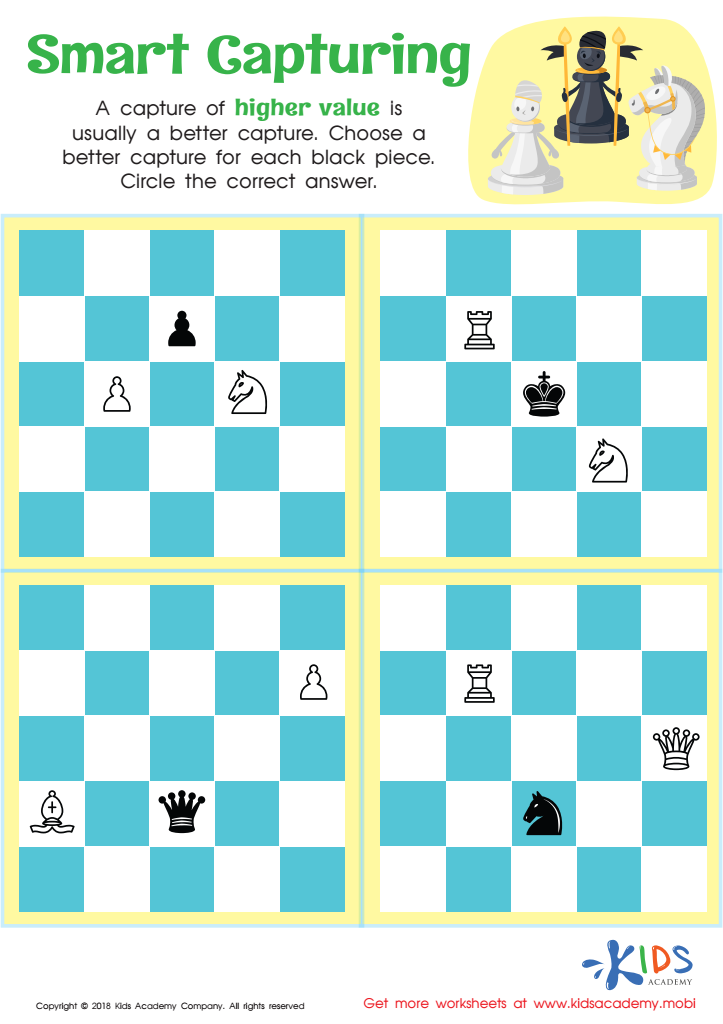
Smart Capturing Worksheet
Chess is a game of strategy and calculation. When presented with two captures, a player should always go for the one that yields the highest value. For example, taking a knight over a pawn. In this worksheet, your children will choose the best capture for each black piece. Ask them to circle the correct answers. (80 words)
 Assign to My Students
Smart Capturing Worksheet
Worksheet
Join Kids Academy for Free
Who is primarily going to use this learning content?







Encouraging attention to detail in children aged 5-8 is vital for their cognitive and social development. During these formative years, children are like sponges, absorbing and processing information from their surroundings. By promoting attention to detail, parents and teachers help children develop critical thinking skills that enhance their learning experience. When children learn to observe intricate details, they become better problem solvers, improving their ability to analyze situations and draw logical conclusions.
Additionally, attention to detail enhances literacy and numeracy skills. Recognizing patterns in letters and numbers, for instance, prepares children for reading and math concepts, providing a strong foundation for future academic success. Furthermore, being detail-oriented fosters creativity. By noticing subtle elements in art or stories, children can add depth to their own expressions.
Socially, children with strong attention to detail can pick up on social cues, improving their interpersonal skills. This ability reduces misunderstandings and promotes better relationships with peers and adults.
Ultimately, fostering attention to detail not only helps children succeed academically but also contributes to their emotional intelligence and confidence. By investing in this skill, parents and teachers position children to thrive in various aspects of their lives.








