
Enhancing visual perception Worksheets for Ages 5-8
3 filtered results
Difficulty Level
Grade
Age
-
From - To
Subject
Activity
Standards
Enhance your child's visual perception skills with our engaging worksheets designed specifically for ages 5 to 8. Created to bolster critical learning abilities, these worksheets offer a variety of fun and interactive activities that focus on shape recognition, pattern identification, and visual discrimination. As children complete each task, they not only sharpen their cognitive skills but also boost their confidence in learning. Our vibrant, easy-to-follow worksheets inspire young minds while making learning enjoyable. Perfect for teachers, parents, or caregivers, these resources provide a solid foundation for academic success by fostering essential visual perception skills that will benefit your child for years to come.
Favorites
With answer key
Interactive

Community: Homes Worksheet
Help your child discover the different types of homes with this free worksheet! Full of colors and pictures, they'll assess which are suitable for people to live in. As they check each picture, they'll use their fine motor skills to draw a conclusion. They'll recognize familiar homes and learn about new ones. There's no place like home!
 Assign to My Students
Community: Homes Worksheet
Worksheet
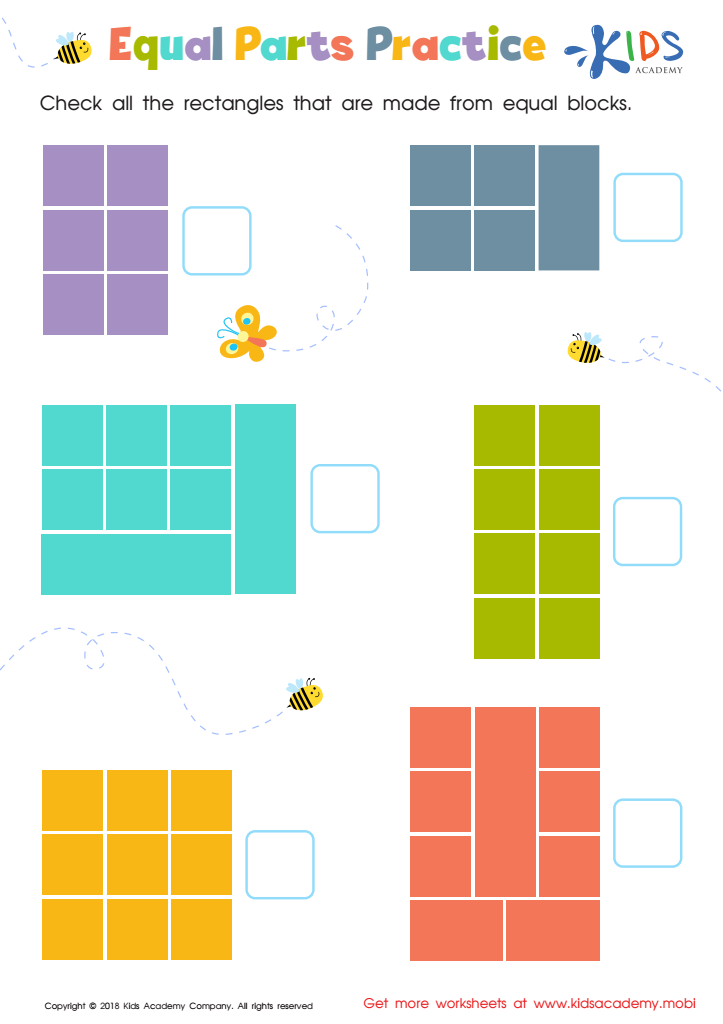
Equal Parts Practice Worksheet
This worksheet checks your child's knowledge of halves and equal pieces. Have them go through the rectangles and check those made up of equal blocks. Your kids should be able to tell which parts are equal and which are not after the exercise.
Equal Parts Practice Worksheet
Worksheet
Join Kids Academy for Free
Who is primarily going to use this learning content?








Enhancing visual perception in children aged 5-8 is crucial for their overall development and academic success. During this formative stage, children are building foundational skills that will serve them throughout their lives. Strong visual perception skills enable children to interpret and organize visual information, helping them successfully navigate their learning environments. This is particularly relevant when it comes to early literacy, as children must recognize letters, words, and pictures to develop reading and writing skills.
Furthermore, improved visual perception supports mathematical understanding, aiding in shape recognition, spatial awareness, and an understanding of patterns. Beyond academics, these skills translate into everyday tasks such as puzzles, arts and crafts, and sports—activities that foster problem-solving, creativity, and coordination.
Parents and teachers play a vital role in nurturing these abilities through targeted activities like games, reading exercises, and hands-on learning experiences. Recognizing the importance of visual perception training can lead to smoother transitions into more complex concepts later on, ultimately setting a solid foundation for lifelong learning. Investing time and resources into enhancing visual perception not only boosts academic performance but also cultivates confidence and independence in young learners as they engage with the world around them.








